
Online Database of Chemicals from Around the World
| Hangzhou Verychem Science And Technology Co., Ltd. | China | |||
|---|---|---|---|---|
 | www.verychem.com | |||
 | +86 (571) 8816-2785 +86 13606544505 | |||
 | +86 (571) 8816-2787 | |||
 | lucy@verychem.com | |||
| Chemical manufacturer since 2004 | ||||
| chemBlink Standard supplier since 2006 | ||||
| Hubei Research Institute of Chemistry | China | |||
|---|---|---|---|---|
| www.haisopharm.com | |||
| +86 (27) 8742-2225 | |||
| +86 (27) 8749-6702 | |||
| info@haisopharm.com | |||
| Chemical manufacturer since 1973 | ||||
| chemBlink Standard supplier since 2007 | ||||
| Taizhou Crene Biotechnology Co., Ltd. | China | |||
|---|---|---|---|---|
| www.pharm-intermediates.com | |||
| +86 (576) 8881-3233 8820-5808 +86 13396860566 | |||
| +86 (576) 8822-9589 | |||
| sales@pharm-intermediates.com | |||
 | QQ Chat | |||
| Chemical manufacturer since 2011 | ||||
| chemBlink Standard supplier since 2009 | ||||
| Hangzhou Utanpharma Biology Co., Ltd. | China | |||
|---|---|---|---|---|
| www.utanpharma.com | |||
| +86 (571) 8682-1378 8682-0258 5683-6287 5683-6288 | |||
| +86 (571) 8682-1328 | |||
| sales@utanpharma.com utansale@hotmail.com | |||
| Chemical manufacturer | ||||
| chemBlink Standard supplier since 2010 | ||||
| BOC Sciences | USA | |||
|---|---|---|---|---|
| www.bocsci.com | |||
| +1 (631) 485-4226 | |||
| +1 (631) 614-7828 | |||
| info@bocsci.com | |||
| Chemical manufacturer | ||||
| chemBlink Standard supplier since 2010 | ||||
| Hangzhou Leap Chem Co., Ltd. | China | |||
|---|---|---|---|---|
| www.leapchem.com | |||
| +86 (571) 8771-1850 | |||
| market19@leapchem.com | |||
| QQ Chat | |||
| Chemical manufacturer since 2006 | ||||
| chemBlink Standard supplier since 2015 | ||||
| Shanghai Yingrui Biopharm Co., Ltd. | China | |||
|---|---|---|---|---|
| www.shyrchem.com | |||
| +86 (21) 3358-5366 3466-6753 +86 13311639313 | |||
| +86 (21) 3497-9012 | |||
| sales02@shyrchem.com | |||
| QQ Chat | |||
 | Skype Chat | |||
| Chemical manufacturer since 2009 | ||||
| chemBlink Standard supplier since 2017 | ||||
| Shandongjunrui Pharmaceutials Co., Ltd. | China | |||
|---|---|---|---|---|
| www.yanchem.com | |||
| +86 (539) 563-6807 | |||
| 2676735117@qq.com | |||
| Chemical manufacturer since 2016 | ||||
| chemBlink Standard supplier since 2018 | ||||
| Shanghai Finetech pharm Co., Ltd. | China | |||
|---|---|---|---|---|
| www.finetechpharm.cn | |||
| +86 18221039705 | |||
| ad@finetechpharm.cn | |||
| Chemical manufacturer since 2016 | ||||
| chemBlink Standard supplier since 2026 | ||||
| Classification | API >> Hormone and endocrine-regulating drugs >> Prostaglandins |
|---|---|
| Name | Limaprost |
| Synonyms | ONO 1206; (2E)-7-[(1R,2R,3R)-3-Hydroxy-2-[(1E,3S,5S)-3-hydroxy-5-methyl-1-nonen-1-yl]-5-oxocyclopentyl]-2-heptenoic acid |
| Molecular Structure | 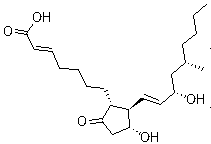 |
| Molecular Formula | C22H36O5 |
| Molecular Weight | 380.52 |
| CAS Registry Number | 74397-12-9 |
| EC Number | 636-141-5 |
| SMILES | CCCC[C@H](C)C[C@@H](/C=C/[C@H]1[C@@H](CC(=O)[C@@H]1CCCC/C=C/C(=O)O)O)O |
| Density | 1.118 |
|---|---|
| Hazard Symbols |  GHS06 Danger Details GHS06 Danger Details | ||||||||||||
|---|---|---|---|---|---|---|---|---|---|---|---|---|---|
| Risk Statements | H300 Details | ||||||||||||
| Safety Statements | P264-P270-P301+P316-P321-P330-P405-P501 Details | ||||||||||||
| Hazard Classification | |||||||||||||
| |||||||||||||
| SDS | Available | ||||||||||||
 chemBlink Chemical Story
|
Limaprost is a synthetic prostaglandin E1 (PGE1) analogue developed for therapeutic use, primarily in the treatment of peripheral vascular disorders such as chronic arterial occlusive disease. It is designed to mimic and enhance the physiological actions of endogenous prostaglandin E1 while improving oral bioavailability and metabolic stability. Prostaglandins are lipid-derived autacoids synthesized from arachidonic acid via the cyclooxygenase pathway. They act locally as signaling molecules involved in vascular tone regulation, inflammation, and smooth muscle activity. Prostaglandin E1 in particular is known for its vasodilatory, antiplatelet, and cytoprotective effects. Limaprost functions as a prostaglandin receptor agonist, acting on EP receptor subtypes (prostaglandin E receptors), which are G protein–coupled receptors distributed in vascular and other tissues. Activation of these receptors leads to increased intracellular cyclic AMP (cAMP) in vascular smooth muscle cells, resulting in relaxation of blood vessels and improved blood flow. A key pharmacological effect of limaprost is peripheral vasodilation. By relaxing vascular smooth muscle, it improves microcirculation and tissue perfusion, particularly in ischemic limbs. This mechanism underlies its clinical use in conditions characterized by reduced arterial blood flow. In addition to vasodilation, limaprost exhibits antiplatelet effects by inhibiting platelet aggregation. This contributes to improved blood rheology and reduced risk of microvascular occlusion, further supporting its use in peripheral arterial disease. Limaprost is structurally derived from the prostaglandin E1 scaffold, which consists of a cyclopentane ring with two aliphatic side chains and multiple stereocenters. The stereochemistry is critical for receptor binding and biological activity, as prostaglandin receptors are highly stereospecific. Compared with endogenous prostaglandin E1, limaprost has been chemically modified to improve stability against rapid enzymatic degradation. Natural prostaglandins are quickly inactivated in vivo through oxidation and β-oxidation–like metabolic pathways, limiting their therapeutic utility. Structural modification in limaprost enhances its pharmacokinetic profile, allowing effective systemic activity after oral administration. Limaprost is typically administered as a prodrug ester, which is hydrolyzed in vivo to generate the active free acid form. This active form interacts directly with EP receptors to produce its pharmacological effects. The prodrug strategy improves gastrointestinal absorption, as the esterified form is more lipophilic and better able to cross biological membranes. From a physicochemical standpoint, limaprost is amphiphilic, containing both polar functional groups (hydroxyls and carboxylic acid) and hydrophobic hydrocarbon chains. This balance enables interaction with both lipid membranes and aqueous biological environments, which is characteristic of prostaglandin analogues. Clinically, limaprost is used to improve symptoms associated with peripheral arterial disease, including pain, numbness, and intermittent claudication. By enhancing blood flow and reducing vascular resistance, it helps improve functional capacity in affected patients. Like other prostaglandin analogues such as misoprostol and ophthalmic agents derived from prostaglandin F2α such as latanoprost acid, limaprost illustrates how endogenous lipid mediators can be chemically optimized for therapeutic use. Overall, limaprost is a synthetic prostaglandin E1 analogue that acts on EP receptors to promote vasodilation, inhibit platelet aggregation, and improve peripheral circulation. Its significance lies in its clinical application for ischemic vascular conditions and its role as a stabilized, orally active prostaglandin-based therapeutic agent. References 2026. Use of pregabalin and limaprost in the conservative treatment of lumbar spinal stenosis: a systematic review of the current evidence. European Journal of Clinical Pharmacology. DOI: 10.1007/s00228-025-03955-y 2025. Pharmacist intervention through protocol-based pharmacotherapy management is effective to ensure safety in invasive procedures for chronic liver disease. Journal of Pharmaceutical Health Care and Sciences. URL: https://www.ncbi.nlm.nih.gov/pmc/articles/PMC12355732 |
| Market Analysis Reports |