
Online Database of Chemicals from Around the World
| Sigma-Aldrich, Inc. | China | |||
|---|---|---|---|---|
 | www.sigmaaldrich.com | |||
 | +86 (21) 6141-5566 800-819-3336 | |||
 | orderCN@sial.com | |||
| Chemical manufacturer since 1992 | ||||
| chemBlink Standard supplier since 2013 | ||||
| wuhan chemi Pharmacy Chemical Technology Co., Ltd. | China | |||
|---|---|---|---|---|
| www.chemipharm.com.cn | |||
| +86 13971619949 | |||
| gmn424@chemipharm.com.cn | |||
 | QQ Chat | |||
 | WeChat: 13971619949 | |||
| Chemical manufacturer since 2014 | ||||
| chemBlink Standard supplier since 2026 | ||||
| Anvia Chemicals, LLC | USA | |||
|---|---|---|---|---|
| www.anviachem.com | |||
| +1 (414) 534-7845 | |||
 | +1 (414) 762-5539 | |||
| sales@anviachem.com | |||
| Chemical manufacturer | ||||
| Classification | Organic raw materials >> Heterocyclic compound >> Indoles |
|---|---|
| Name | 5,7-Dichloro-1H-indole-2,3-dione |
| Synonyms | 5,7-Dichloroisatin |
| Molecular Structure | 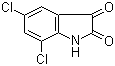 |
| Molecular Formula | C8H3Cl2NO2 |
| Molecular Weight | 216.02 |
| CAS Registry Number | 6374-92-1 |
| EC Number | 228-928-3 |
| SMILES | C1=C(C=C(C2=C1C(=O)C(=O)N2)Cl)Cl |
| Density | 1.6±0.1 g/cm3 Calc.* |
|---|---|
| Melting point | 218 - 223 °C (Expl.) |
| Index of refraction | 1.638 (Calc.)* |
| * | Calculated using Advanced Chemistry Development (ACD/Labs) Software. |
| Hazard Symbols |   GHS05;GHS07 Danger Details GHS05;GHS07 Danger Details | ||||||||||||
|---|---|---|---|---|---|---|---|---|---|---|---|---|---|
| Risk Statements | H302-H318 Details | ||||||||||||
| Safety Statements | P264-P264+P265-P270-P280-P301+P317-P305+P354+P338-P317-P330-P501 Details | ||||||||||||
| Hazard Classification | |||||||||||||
| |||||||||||||
| SDS | Available | ||||||||||||
 chemBlink Chemical Story
|
5,7-Dichloro-1H-indole-2,3-dione is a halogenated derivative of isatin, a bicyclic heteroaromatic compound containing both an indole framework and two adjacent carbonyl groups. Structurally, it belongs to the indole-2,3-dione family, in which the indole ring system is oxidized at the 2- and 3-positions to form a cyclic imide-like diketone structure. The additional chlorine substituents at positions 5 and 7 further modify its electronic and chemical properties. The core isatin scaffold is derived from indole, a fused bicyclic system composed of a benzene ring and a five-membered nitrogen-containing pyrrole ring. In isatin derivatives, oxidation at the 2 and 3 positions introduces two adjacent carbonyl groups, forming a highly electrophilic system. This indole-2,3-dione structure is reactive toward nucleophiles and participates in a variety of condensation and substitution reactions, making it a versatile intermediate in heterocyclic and medicinal chemistry. In 5,7-dichloro substitution, the presence of chlorine atoms on the benzene portion of the indole ring significantly influences the electronic distribution of the molecule. Chlorine is an electron-withdrawing substituent through inductive effects, which reduces electron density in the aromatic ring. Although chlorine can donate electron density through resonance, the net effect in this context is deactivation of the aromatic system toward electrophilic substitution. The presence of two chlorine atoms amplifies this effect and increases the overall electrophilicity of the molecule. The indole-2,3-dione core contains two carbonyl groups in conjugation with the aromatic system. These carbonyl groups are strongly electron-withdrawing and create an activated electrophilic center at the C-2 and C-3 positions. As a result, isatin derivatives readily undergo nucleophilic addition reactions, ring-opening processes, and condensation reactions with amines and hydrazines, forming a wide variety of heterocyclic products. The combined effects of the carbonyl groups and chlorine substituents make 5,7-dichloro-1H-indole-2,3-dione a highly electron-deficient aromatic system. This electron deficiency increases its susceptibility to nucleophilic attack while decreasing its reactivity toward electrophilic substitution compared with unsubstituted indole derivatives. From a structural perspective, the fused bicyclic system is largely planar due to aromatic stabilization in the benzene ring and partial conjugation with the carbonyl groups. However, the presence of sp²-hybridized carbonyl carbons and heteroatoms introduces localized distortions in electron density distribution. The molecule exhibits strong intramolecular conjugation between the aromatic ring and the dicarbonyl system. Isatin derivatives, including halogenated analogues, are widely used in organic synthesis as building blocks for more complex heterocyclic compounds. The reactive carbonyl groups allow for condensation with nucleophiles such as amines, hydrazines, and thiols, leading to the formation of spiro compounds, Schiff bases, and fused heterocycles. Halogen substitution further enables cross-coupling reactions, expanding synthetic utility. In terms of physicochemical properties, 5,7-dichloro-1H-indole-2,3-dione is expected to be a moderately polar aromatic compound. The carbonyl groups contribute significant dipole character, while the chlorine substituents increase molecular weight and lipophilicity. It is typically more soluble in polar organic solvents than in water, although hydrogen bonding interactions at the carbonyl oxygen atoms can influence solubility behavior. The compound’s reactivity is dominated by its electrophilic carbonyl centers and electron-deficient aromatic ring. These properties make it useful in constructing nitrogen-containing heterocycles, which are common structural motifs in pharmaceuticals and biologically active molecules. Overall, 5,7-dichloro-1H-indole-2,3-dione is a halogenated isatin derivative characterized by a highly electrophilic indole-dione core and electron-withdrawing chlorine substituents. Its significance lies in its role as a reactive synthetic intermediate in heterocyclic chemistry and in the development of complex nitrogen-containing molecular architectures. References 2023. Multimodal action of KRP203 on phosphoinositide kinases in vitro and in cells. Biochemical and Biophysical Research Communications. URL: https://www.ncbi.nlm.nih.gov/pmc/articles/PMC10559341 2022. A quantitative high-throughput screen identifies compounds that lower expression of the SCA2-and ALS-associated gene ATXN2. The Journal of biological chemistry. URL: https://www.ncbi.nlm.nih.gov/pmc/articles/PMC9356275 |
| Market Analysis Reports |