Pazopanib hydrochloride is the hydrochloride salt form of pazopanib, a small-molecule targeted anticancer drug that acts as a multi-tyrosine kinase inhibitor. It is used primarily in the treatment of advanced renal cell carcinoma and certain soft tissue sarcomas. The drug works by inhibiting multiple receptor tyrosine kinases involved in tumor angiogenesis and tumor cell proliferation.
Pazopanib was developed as part of efforts in oncology drug discovery to target angiogenesis, the process by which tumors stimulate the formation of new blood vessels to support their growth. A key biological target in this process is vascular endothelial growth factor receptor (VEGFR). Pazopanib inhibits VEGFR-1, VEGFR-2, and VEGFR-3, thereby blocking VEGF-mediated signaling pathways that promote endothelial cell proliferation and new blood vessel formation.
In addition to VEGF receptors, pazopanib also inhibits other receptor tyrosine kinases, including platelet-derived growth factor receptors (PDGFR-α and PDGFR-β) and c-KIT. These targets are involved in tumor cell survival, stromal support, and proliferation. The combined inhibition of these pathways contributes to its antitumor activity.
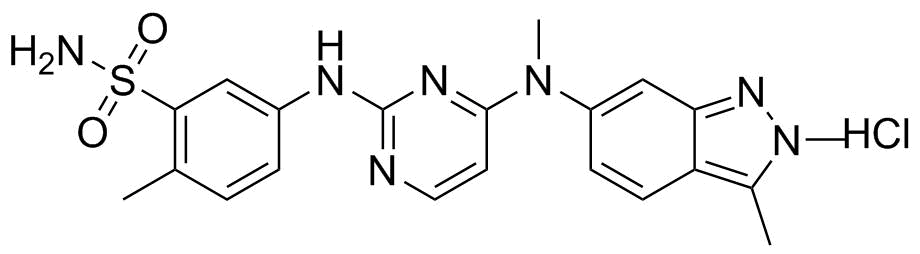
Structurally, pazopanib is a synthetic heteroaromatic compound containing multiple ring systems, including an indazole core linked to substituted aromatic and heterocyclic moieties. This structure allows it to bind competitively to the ATP-binding sites of target kinases, preventing phosphorylation events necessary for downstream signaling. The hydrochloride salt form improves its stability and solubility for pharmaceutical formulation.
The mechanism of action of pazopanib involves blockade of ATP binding in the kinase domains of its target receptors. By occupying the ATP-binding pocket, it prevents autophosphorylation and activation of signaling cascades such as the MAPK and PI3K/AKT pathways. This results in inhibition of endothelial cell proliferation and reduced tumor vascularization, ultimately limiting tumor growth and metastasis.
Pazopanib was developed through structure-guided optimization of kinase inhibitors designed to achieve broad anti-angiogenic activity. Medicinal chemistry efforts focused on improving selectivity for VEGFR and related kinases while maintaining oral bioavailability and favorable pharmacokinetics. The resulting compound exhibits multi-target kinase inhibition, which is characteristic of several modern anti-angiogenic therapies.
Clinically, pazopanib hydrochloride is administered orally and is approved for the treatment of advanced renal cell carcinoma and advanced soft tissue sarcoma in patients who have received prior chemotherapy. Its use is based on its ability to inhibit tumor angiogenesis, which is a key process in the progression of these cancers.
Pharmacokinetically, pazopanib is absorbed after oral administration and undergoes hepatic metabolism, primarily via cytochrome P450 3A4. It has a relatively long half-life, allowing once-daily dosing. Food can significantly affect its absorption, and administration guidelines typically specify dosing on an empty stomach.
Adverse effects associated with pazopanib include hypertension, hepatotoxicity, diarrhea, fatigue, and changes in hair or skin pigmentation. These effects are consistent with its inhibition of signaling pathways involved in vascular and epithelial homeostasis. Liver function monitoring is required during therapy due to potential hepatotoxicity.
The hydrochloride salt form of pazopanib is used to improve its pharmaceutical properties, including solubility and stability in oral dosage forms. Salt formation is a common strategy in drug development to optimize absorption and manufacturing characteristics.
Overall, pazopanib hydrochloride is a multi-target tyrosine kinase inhibitor that suppresses tumor angiogenesis and growth by blocking VEGFR, PDGFR, and related signaling pathways. Its development reflects advances in targeted cancer therapy focused on inhibiting vascular support systems essential for tumor progression.
References
2026. Extranodal Follicular Dendritic Cell Sarcomas and their Oligorecurrences: Lessons Learnt at a Single Tertiary Cancer Referral Centre, India. Indian Journal of Surgical Oncology.
DOI: 10.1007/s13193-026-02537-3
2026. Identification of anticancer compounds from Tapinanthus globiferus: integrating in vitro and in silico approaches. In Silico Pharmacology.
DOI: 10.1007/s40203-026-00562-2
2026. Discovery of a novel VEGFR2 inhibitor using integrated structure-based docking study and functional validation: potential applications in targeted cancer therapy. Saudi pharmaceutical journal : SPJ : the official publication of the Saudi Pharmaceutical Society.
DOI: 10.1016/j.jsps.2026.02.001
|






 GHS08;GHS09 Danger Details
 chemBlink Chemical Story