
Online Database of Chemicals from Around the World
| Shanghai Techwell Biopharmaceutical Co., Ltd. | China | |||
|---|---|---|---|---|
 | www.techwell-cn.com | |||
 | +86 (21) 5483-1973 | |||
 | +86 (21) 2301-0563 | |||
 | sales@techwell-cn.com | |||
| Chemical manufacturer since 2001 | ||||
| chemBlink Standard supplier since 2006 | ||||
| Taizhou Crene Biotechnology Co., Ltd. | China | |||
|---|---|---|---|---|
| www.pharm-intermediates.com | |||
| +86 (576) 8881-3233 8820-5808 +86 13396860566 | |||
| +86 (576) 8822-9589 | |||
| sales@pharm-intermediates.com | |||
 | QQ Chat | |||
| Chemical manufacturer since 2011 | ||||
| chemBlink Standard supplier since 2009 | ||||
| Chirogate International Inc. | Taiwan | |||
|---|---|---|---|---|
| www.chirogate.com | |||
| +886 (3) 496-3808 | |||
| +886 (3) 496-3800 | |||
| annyeh@chirogate.com kirogate@ms63.hinet.net | |||
| Chemical manufacturer since 2000 | ||||
| chemBlink Standard supplier since 2010 | ||||
| BOC Sciences | USA | |||
|---|---|---|---|---|
| www.bocsci.com | |||
| +1 (631) 485-4226 | |||
| +1 (631) 614-7828 | |||
| info@bocsci.com | |||
| Chemical manufacturer | ||||
| chemBlink Standard supplier since 2010 | ||||
| Eastar Chemical Corporation | USA | |||
|---|---|---|---|---|
| www.eastarchem.com | |||
| +1 800-898-2436 | |||
| +1 (877) 898-2436 | |||
| info@eastarchem.com | |||
| Chemical manufacturer since 1989 | ||||
| chemBlink Standard supplier since 2014 | ||||
| Shanghai Yingrui Biopharm Co., Ltd. | China | |||
|---|---|---|---|---|
| www.shyrchem.com | |||
| +86 (21) 3358-5366 3466-6753 +86 13311639313 | |||
| +86 (21) 3497-9012 | |||
| sales02@shyrchem.com | |||
| QQ Chat | |||
 | Skype Chat | |||
| Chemical manufacturer since 2009 | ||||
| chemBlink Standard supplier since 2017 | ||||
| Shanghai Finetech pharm Co., Ltd. | China | |||
|---|---|---|---|---|
| www.finetechpharm.cn | |||
| +86 18221039705 | |||
| ad@finetechpharm.cn | |||
| Chemical manufacturer since 2016 | ||||
| chemBlink Standard supplier since 2026 | ||||
| Cayman Chemical Company | USA | |||
|---|---|---|---|---|
| www.caymanchem.com | |||
| +1 (734) 971-3335 | |||
| +1 (734) 971-3640 | |||
| sales@caymanchem.com | |||
| Chemical manufacturer | ||||
| Santa Cruz Biotechnology, Inc. | USA | |||
|---|---|---|---|---|
| www.scbt.com | |||
| +1 (831) 457-3800 | |||
| +1 (831) 457-3801 | |||
| scbt@scbt.com | |||
| Chemical manufacturer | ||||
| Classification | API >> Hormone and endocrine-regulating drugs >> Prostaglandins |
|---|---|
| Name | Prostaglandin F2a |
| Synonyms | Dinoprost; Prostaglandin F2-alpha; (5Z,9a,11a,13E,15S)-9,11,15-Trihydroxyprosta-5,13-diene-1-oic acid |
| Molecular Structure | 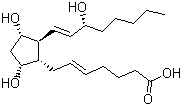 |
| Molecular Formula | C20H34O5 |
| Molecular Weight | 354.48 |
| CAS Registry Number | 551-11-1 |
| EC Number | 684-259-0 |
| SMILES | CCCCC[C@@H](/C=C/[C@H]1[C@@H](C[C@@H]([C@@H]1C/C=CCCCC(=O)O)O)O)O |
| Density | 1.2±0.1 g/cm3 Calc.* |
|---|---|
| Boiling point | 531.0±50.0 °C 760 mmHg (Calc.)* |
| Flash point | 289.0±26.6 °C (Calc.)* |
| Solubility | 10 mM in water, 10 mM in DMSO (Expl.) |
| Index of refraction | 1.569 (Calc.)* |
| * | Calculated using Advanced Chemistry Development (ACD/Labs) Software. |
| Hazard Symbols |   GHS07;GHS08 Danger Details GHS07;GHS08 Danger Details | ||||||||||||||||||||||||||||
|---|---|---|---|---|---|---|---|---|---|---|---|---|---|---|---|---|---|---|---|---|---|---|---|---|---|---|---|---|---|
| Risk Statements | H302-H319-H360-H370-H372 Details | ||||||||||||||||||||||||||||
| Safety Statements | P203-P260-P264-P264+P265-P270-P280-P301+P317-P305+P351+P338-P308+P316-P318-P319-P321-P330-P337+P317-P405-P501 Details | ||||||||||||||||||||||||||||
| Hazard Classification | |||||||||||||||||||||||||||||
| |||||||||||||||||||||||||||||
| SDS | Available | ||||||||||||||||||||||||||||
 chemBlink Chemical Story
|
Prostaglandin F2α (PGF2α) is an endogenous bioactive lipid belonging to the prostaglandin family, which is derived from arachidonic acid through enzymatic oxidation pathways involving cyclooxygenase (COX) enzymes. It is a member of the eicosanoid class of signaling molecules and plays important roles in smooth muscle regulation, reproductive physiology, and inflammatory processes. Prostaglandins are produced in mammalian tissues from arachidonic acid, a 20-carbon polyunsaturated fatty acid released from membrane phospholipids. The cyclooxygenase pathway converts arachidonic acid into prostaglandin H2 (PGH2), which serves as a common precursor for various prostaglandins, including prostaglandin F2α. Tissue-specific enzymes then catalyze the formation of PGF2α from PGH2 or related intermediates. Prostaglandin F2α is structurally characterized by a cyclopentane ring bearing hydroxyl substituents and two aliphatic side chains. It contains multiple stereocenters, and its biological activity is highly dependent on its three-dimensional configuration. The “alpha” designation refers to the stereochemistry of the hydroxyl group at the relevant position on the cyclopentane ring, which is critical for receptor binding and biological function. As a signaling molecule, prostaglandin F2α exerts its effects primarily through the prostanoid FP receptor, a G protein–coupled receptor expressed in various tissues. Activation of this receptor leads to intracellular signaling cascades involving phospholipase C activation, increased intracellular calcium levels, and downstream effects on smooth muscle contraction and gene expression. One of the most well-established physiological roles of prostaglandin F2α is in smooth muscle contraction. It induces contraction in uterine smooth muscle, and this activity has been exploited in clinical medicine for inducing labor or controlling postpartum hemorrhage. In the reproductive system, PGF2α also participates in luteolysis, the regression of the corpus luteum, thereby influencing the estrous and menstrual cycles in various species. In ocular physiology, prostaglandin F2α and its synthetic analogues play a significant role in regulating intraocular pressure. While endogenous PGF2α itself is rapidly metabolized and not used therapeutically, its structural analogues have been developed into highly effective drugs for glaucoma treatment by enhancing aqueous humor outflow. The biosynthesis and metabolism of prostaglandin F2α are tightly regulated. It is rapidly inactivated in tissues and circulation through enzymatic oxidation, reduction, and beta-oxidation-like pathways. This short biological half-life ensures that its signaling effects are localized and transient. From a chemical perspective, prostaglandin F2α is a flexible, oxygenated lipid with multiple hydroxyl groups and a carboxylic acid terminus. Its amphiphilic nature allows it to interact with membrane-associated receptors and lipid environments. The presence of multiple chiral centers results in stereospecific receptor interactions, making precise stereochemistry essential for biological activity. Prostaglandin F2α has been extensively studied in both physiological and pharmacological contexts due to its potent biological activity. Its synthetic analogues, such as latanoprost, travoprost, and bimatoprost, have been developed to improve stability, receptor selectivity, and pharmacokinetic properties while retaining the ability to modulate FP receptor signaling. Overall, prostaglandin F2α is a naturally occurring eicosanoid signaling molecule that regulates smooth muscle contraction, reproductive function, and ocular physiology through activation of FP receptors. Its significance lies in its central role in prostaglandin biology and as a structural and functional template for important therapeutic agents. References 2026. Thromboxane signalling links immune activation to enhanced glucose uptake in skeletal muscle. Diabetologia. URL: https://www.ncbi.nlm.nih.gov/pmc/articles/PMC13109283 2026. The potential role of COX-2/PGs signaling pathway in epileptogenesis and associated neuroinflammation: collusions or serendipity. Neurological sciences : official journal of the Italian Neurological Society and of the Italian Society of Clinical Neurophysiology. PMID: 41622366 |
| Market Analysis Reports |