
Online Database of Chemicals from Around the World
| wuhan chemi Pharmacy Chemical Technology Co., Ltd. | China | |||
|---|---|---|---|---|
 | www.chemipharm.com.cn | |||
 | +86 13971619949 | |||
 | gmn424@chemipharm.com.cn | |||
 | QQ Chat | |||
 | WeChat: 13971619949 | |||
| Chemical manufacturer since 2014 | ||||
| chemBlink Standard supplier since 2026 | ||||
| Classification | Organic raw materials >> Carboxylic compounds and derivatives |
|---|---|
| Name | 2-(3-Phenylpropyl)propanedioic acid |
| Molecular Structure | 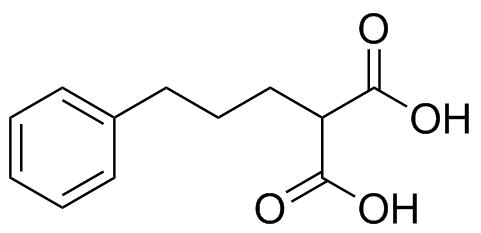 |
| Molecular Formula | C12H14O4 |
| Molecular Weight | 222.24 |
| CAS Registry Number | 5454-06-8 |
| SMILES | C1=CC=C(C=C1)CCCC(C(=O)O)C(=O)O |
| Density | 1.2±0.1 g/cm3 Calc.* |
|---|---|
| Boiling point | 455.9±45.0 °C 760 mmHg (Calc.)* |
| Flash point | 243.6±25.2 °C (Calc.)* |
| Index of refraction | 1.559 (Calc.)* |
| * | Calculated using Advanced Chemistry Development (ACD/Labs) Software. |
| Hazard Symbols |  GHS07 Warning Details GHS07 Warning Details |
|---|---|
| Risk Statements | H302-H315-H319-H335 Details |
| Safety Statements | P261-P305+P351+P338 Details |
| SDS | Available |
 chemBlink Chemical Story
|
2-(3-Phenylpropyl)propanedioic acid is a substituted malonic acid derivative in which one of the hydrogen atoms at the 2-position of propanedioic acid (malonic acid) is replaced by a 3-phenylpropyl group. It belongs to the class of α-alkylated malonic acids, which are widely recognized as versatile intermediates in organic synthesis due to their ability to undergo decarboxylation and carbon–carbon bond-forming reactions. The chemistry of malonic acid and its derivatives has been extensively studied since the nineteenth century, when malonic acid was first isolated and its reactivity characterized. The malonic acid framework, consisting of two carboxylic acid groups flanking a central methylene carbon, is notable for its relatively acidic methylene protons. This acidity enables enolate formation, which is the basis for malonic ester synthesis and related alkylation strategies. These reactions became foundational in the development of carbon–carbon bond construction methodologies in classical organic synthesis. Substitution at the 2-position of propanedioic acid, as in 2-(3-phenylpropyl)propanedioic acid, introduces a bulky hydrophobic substituent onto the malonic acid backbone. The 3-phenylpropyl group consists of a three-carbon alkyl chain terminated by a phenyl ring, combining aliphatic flexibility with aromatic stability. This structural motif is commonly encountered in synthetic intermediates used to introduce extended hydrophobic side chains into target molecules. Compounds of this type are typically prepared through alkylation of malonic acid derivatives or malonate esters using appropriate alkyl halides or related electrophiles. The malonic ester synthesis, developed in the late nineteenth century, allows for the controlled introduction of alkyl substituents at the central carbon atom of malonic acid equivalents, followed by hydrolysis and decarboxylation steps to yield substituted acetic acid derivatives or retained dicarboxylic acids depending on reaction conditions. The presence of two carboxylic acid groups in 2-(3-phenylpropyl)propanedioic acid imparts strong polarity and the ability to engage in hydrogen bonding interactions. These functional groups also enable the compound to participate in further chemical transformations such as esterification, amidation, and decarboxylative reactions. In synthetic organic chemistry, malonic acid derivatives are often used as precursors to more complex carboxylic acids through controlled decarboxylation processes. The 3-phenylpropyl substituent contributes significantly to the hydrophobic character of the molecule and introduces an aromatic ring capable of π–π interactions. Such structural features are often exploited in medicinal chemistry and materials science, where modulation of hydrophobicity and aromatic content can influence molecular recognition and aggregation behavior. However, specific biological activity depends strongly on the broader molecular context in which this fragment is incorporated. From a physicochemical standpoint, 2-(3-phenylpropyl)propanedioic acid is expected to exhibit relatively high polarity due to the presence of two carboxylic acid groups, balanced by the hydrophobic phenylpropyl substituent. This amphiphilic character can influence solubility behavior in polar and nonpolar media. The compound is also capable of forming intramolecular and intermolecular hydrogen bonds, which can affect its solid-state structure and melting properties. In synthetic applications, substituted malonic acids such as this compound are valuable intermediates for constructing more complex molecular frameworks. The malonic acid moiety serves as a functional handle for decarboxylative transformations, while the alkyl substituent provides structural diversity. These properties make such compounds useful building blocks in the preparation of pharmaceuticals, agrochemicals, and specialty organic molecules. Overall, 2-(3-phenylpropyl)propanedioic acid is a substituted malonic acid derivative that reflects the long-established utility of malonic acid chemistry in organic synthesis. Its significance lies in its role as a functional intermediate capable of undergoing a variety of carbon–carbon bond-forming and decarboxylation reactions, enabling the construction of structurally diverse organic compounds. References 2024. Synthesis, Structrure, and Eletrochemical Properties of a Copper(II) Complex with 3-Phenylpropylmalonic Acid. Journal of Structural Chemistry. DOI: 10.1134/s0022476624050135 2010. Impact of the Carbon Chain Length of Novel Palladium(II) Complexes on Interaction with DNA and Cytotoxic Activity. Inorganic Chemistry. DOI: 10.1021/ic902176e 1982. Intramolecular interactions II. Monatshefte für Chemie / Chemical Monthly. DOI: 10.1007/bf00800269 |
| Market Analysis Reports |