
Online Database of Chemicals from Around the World
| Taizhou Crene Biotechnology Co., Ltd. | China | |||
|---|---|---|---|---|
 | www.pharm-intermediates.com | |||
 | +86 (576) 8881-3233 8820-5808 +86 13396860566 | |||
 | +86 (576) 8822-9589 | |||
 | sales@pharm-intermediates.com | |||
 | QQ Chat | |||
| Chemical manufacturer since 2011 | ||||
| chemBlink Standard supplier since 2009 | ||||
| BOC Sciences | USA | |||
|---|---|---|---|---|
| www.bocsci.com | |||
| +1 (631) 485-4226 | |||
| +1 (631) 614-7828 | |||
| info@bocsci.com | |||
| Chemical manufacturer | ||||
| chemBlink Standard supplier since 2010 | ||||
| Hangzhou Leap Chem Co., Ltd. | China | |||
|---|---|---|---|---|
| www.leapchem.com | |||
| +86 (571) 8771-1850 | |||
| market19@leapchem.com | |||
| QQ Chat | |||
| Chemical manufacturer since 2006 | ||||
| chemBlink Standard supplier since 2015 | ||||
| Shanghai Forever Synthesis Co.,Ltd. | China | |||
|---|---|---|---|---|
| www.foreversyn.com | |||
| +86 (551) 6288-8437 +86 18096409024 | |||
| sales@foreversyn.com sales02@foreversyn.com | |||
| QQ Chat | |||
 | Skype Chat | |||
| Chemical distributor since 2013 | ||||
| chemBlink Standard supplier since 2018 | ||||
| Shanghai Finetech pharm Co., Ltd. | China | |||
|---|---|---|---|---|
| www.finetechpharm.cn | |||
| +86 18221039705 | |||
| ad@finetechpharm.cn | |||
| Chemical manufacturer since 2016 | ||||
| chemBlink Standard supplier since 2026 | ||||
| Classification | API >> Inhibitor drug |
|---|---|
| Name | Bimatoprost acid |
| Synonyms | 17-Phenyl-18,19,20-trinor-PGF2alpha; 17-Phenyl-18,19,20-trinorprostaglandin F2alpha; Bimatoprost acid; PhXA 70; U 35687 |
| Molecular Structure | 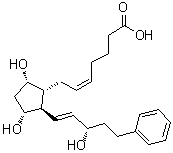 |
| Molecular Formula | C23H32O5 |
| Molecular Weight | 388.50 |
| CAS Registry Number | 38344-08-0 |
| EC Number | 806-621-0 |
| SMILES | C1[C@@H]([C@@H]([C@H]([C@@H]1O)/C=C/[C@H](CCC2=CC=CC=C2)O)C/C=CCCCC(=O)O)O |
| Solubility | Practically insoluble (0.066 g/L) (25 °C), Calc.* |
|---|---|
| Density | 1.219±0.06 g/cm3 (20 °C 760 Torr), Calc.* |
| Boiling point | 597.4±50.0 °C 760 mmHg (Calc.)* |
| Flash point | 329.1±26.6 °C (Calc.)* |
| Index of refraction | 1.616 (Calc.)* |
| * | Calculated using Advanced Chemistry Development (ACD/Labs) Software. |
| Hazard Symbols |   GHS07;GHS08 Danger Details GHS07;GHS08 Danger Details | ||||||||||||
|---|---|---|---|---|---|---|---|---|---|---|---|---|---|
| Risk Statements | H302-H319-H340-H360-H361-H362 Details | ||||||||||||
| Safety Statements | P203-P260-P263-P264-P264+P265-P270-P280-P301+P317-P305+P351+P338-P318-P330-P337+P317-P405-P501 Details | ||||||||||||
| Hazard Classification | |||||||||||||
| |||||||||||||
| SDS | Available | ||||||||||||
 chemBlink Chemical Story
|
Bimatoprost acid is the pharmacologically active free acid form of bimatoprost, a synthetic prostamide used in ophthalmology to reduce elevated intraocular pressure in conditions such as glaucoma and ocular hypertension. It belongs to a group of lipid-like compounds structurally related to prostaglandins, but distinguished by an amide-linked modification rather than the classical prostaglandin carboxylic acid framework. Bimatoprost was developed through research into prostaglandin analogues and prostamide biology aimed at identifying compounds that could effectively enhance aqueous humor outflow in the eye. After topical administration, bimatoprost acts primarily as a prodrug; enzymatic hydrolysis of its ester group in ocular tissues produces bimatoprost acid, which is considered the main active species responsible for its pharmacological effects. Bimatoprost acid exerts its action by interacting with prostanoid-related receptors in ocular tissues, particularly those involved in regulating aqueous humor dynamics. Although its exact receptor profile has been more complex than classical prostaglandin F2α analogues, its net physiological effect is well established: increased outflow of aqueous humor through both the uveoscleral and trabecular meshwork pathways, leading to reduced intraocular pressure. The lowering of intraocular pressure is clinically important because elevated pressure is a major risk factor for optic nerve damage and progressive vision loss in glaucoma. By enhancing outflow rather than suppressing aqueous humor production, bimatoprost acid provides a mechanism complementary to other classes of ocular hypotensive agents such as beta-blockers and carbonic anhydrase inhibitors. Structurally, bimatoprost acid retains the long hydrophobic carbon chain characteristic of prostaglandin-related molecules, along with multiple hydroxyl groups that contribute to hydrogen bonding and receptor interactions. Compared with classical prostaglandin F2α analogues, prostamides such as bimatoprost incorporate an amide linkage rather than a free carboxylic acid in the parent drug, but the hydrolyzed acid form is more polar and more directly involved in receptor-level activity. The conversion of bimatoprost to bimatoprost acid involves enzymatic hydrolysis of the ester group following corneal penetration. This metabolic activation step is essential for its biological function. The acid form exhibits increased polarity relative to the parent compound, which influences its distribution within ocular tissues and its interaction with target proteins. Prostaglandin-related ocular hypotensive agents, including bimatoprost, are among the most effective first-line therapies for glaucoma. Their ability to provide sustained intraocular pressure reduction with once-daily dosing has made them widely used in clinical practice. Bimatoprost acid is central to this therapeutic effect, as it represents the form that directly engages the biological pathways responsible for increased aqueous humor drainage. From a chemical perspective, bimatoprost acid is a flexible, polyfunctional lipid-like molecule with multiple stereocenters, hydroxyl groups, and a carboxylic acid moiety. This structural complexity contributes to its high degree of stereospecific interaction with biological targets. The three-dimensional arrangement of functional groups is critical for activity, as prostanoid-related signaling systems are highly stereoselective. Like other prostaglandin derivatives, bimatoprost acid is highly lipophilic in its intact esterified form but becomes more polar upon hydrolysis. This balance between lipophilicity and polarity supports efficient corneal penetration followed by effective receptor interaction in ocular tissues. Its pharmacological activity is localized primarily to the eye, minimizing systemic exposure under normal dosing conditions. Overall, bimatoprost acid is the active metabolite of the prostamide drug bimatoprost and is responsible for its intraocular pressure–lowering effects. Its significance lies in its role in enhancing aqueous humor outflow through multiple pathways in the eye, making it an important agent in the management of glaucoma and ocular hypertension, and in illustrating the functional importance of metabolic activation in prostaglandin-related ophthalmic therapies. References 2026. The LOTUS Initiative for Open Natural Products Research: frozen dataset union wikidata (with metadata). . DOI: 10.5281/zenodo.5794106 |
| Market Analysis Reports |