
Online Database of Chemicals from Around the World
| wuhan chemi Pharmacy Chemical Technology Co., Ltd. | China | |||
|---|---|---|---|---|
 | www.chemipharm.com.cn | |||
 | +86 13971619949 | |||
 | gmn424@chemipharm.com.cn | |||
 | QQ Chat | |||
 | WeChat: 13971619949 | |||
| Chemical manufacturer since 2014 | ||||
| chemBlink Standard supplier since 2026 | ||||
| Classification | Organic raw materials >> Alcohols, phenols, phenolic compounds and derivatives |
|---|---|
| Name | (5-Bromo-1-benzofuran-2-yl)methanol |
| Molecular Structure | 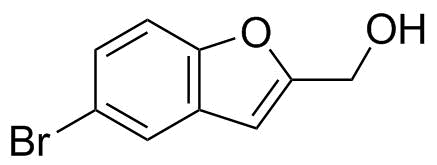 |
| Molecular Formula | C9H7BrO2 |
| Molecular Weight | 227.05 |
| CAS Registry Number | 38220-77-8 |
| SMILES | C1=CC2=C(C=C1Br)C=C(O2)CO |
| Density | 1.7±0.1 g/cm3 Calc.* |
|---|---|
| Boiling point | 332.6±27.0 °C 760 mmHg (Calc.)* |
| Flash point | 155.0±23.7 °C (Calc.)* |
| Index of refraction | 1.663 (Calc.)* |
| * | Calculated using Advanced Chemistry Development (ACD/Labs) Software. |
| Hazard Symbols |  GHS07 Warning Details GHS07 Warning Details |
|---|---|
| Risk Statements | H302-H315-H319-H335 Details |
| Safety Statements | P261-P264-P270-P271-P280-P301+P312-P302+P352-P304+P340-P305+P351+P338-P330-P332+P313-P337+P313-P362-P403+P233-P405-P501 Details |
| SDS | Available |
 chemBlink Chemical Story
|
(5-Bromo-1-benzofuran-2-yl)methanol is a substituted benzofuran derivative containing a bromine atom on the aromatic benzofuran ring and a hydroxymethyl substituent at the 2-position. Benzofuran compounds consist of a fused bicyclic system combining a benzene ring and a furan ring, forming a heteroaromatic structure that is commonly encountered in natural products, medicinal chemistry intermediates, and functional organic materials. The development of benzofuran chemistry is closely tied to advances in heterocyclic compound synthesis during the twentieth century. Benzofuran frameworks were widely investigated due to their presence in biologically active natural products and their suitability for structural modification. Halogenated benzofurans, in particular, became important intermediates because the introduction of halogen substituents allows controlled reactivity in subsequent functionalization reactions, especially in cross-coupling chemistry. (5-Bromo-1-benzofuran-2-yl)methanol features a bromine atom at the 5-position of the benzofuran ring. Halogen substitution on aromatic heterocycles is a key strategy in organic synthesis, as carbon–halogen bonds, especially carbon–bromine bonds, serve as reactive sites for palladium-catalyzed cross-coupling reactions. These transformations enable the formation of carbon–carbon and carbon–heteroatom bonds, allowing complex molecular architectures to be constructed from relatively simple starting materials. The hydroxymethyl group at the 2-position provides an additional functional handle for chemical modification. Primary alcohol groups can undergo oxidation to aldehydes or carboxylic acids, esterification with carboxylic acids, or conversion into leaving groups for substitution reactions. In heterocyclic synthesis, such functional groups are often introduced to enable further derivatization of the core scaffold. Benzofuran derivatives are commonly encountered in medicinal chemistry research due to their ability to interact with biological targets through π–π stacking, hydrogen bonding, and hydrophobic interactions. The planar aromatic system allows benzofuran compounds to fit into enzyme binding sites and receptor pockets, making them useful scaffolds in drug discovery programs. Substituents such as bromine and hydroxymethyl groups are often used to tune physicochemical properties and improve synthetic accessibility. The brominated benzofuran framework is particularly valuable in structure diversification strategies. In modern synthetic chemistry, halogenated heterocycles are frequently used as intermediates in library synthesis, where systematic modification of a core structure is performed to explore structure–activity relationships. The presence of both a bromine atom and a hydroxymethyl group in (5-bromo-1-benzofuran-2-yl)methanol makes it suitable for sequential or orthogonal functionalization strategies. From a physicochemical perspective, benzofuran derivatives exhibit moderate polarity due to the presence of the oxygen atom in the furan ring, while also maintaining significant hydrophobic character from the aromatic system. The hydroxymethyl group increases polarity and hydrogen-bonding capability, which can influence solubility and intermolecular interactions. Bromine substitution increases molecular weight and polarizability, which can affect reactivity and binding behavior in biological contexts. In synthetic applications, compounds of this type are often used as intermediates in the preparation of more complex benzofuran-based molecules. The bromine substituent can participate in cross-coupling reactions, while the hydroxymethyl group can be transformed into a wide range of functional groups, enabling stepwise construction of multifunctional derivatives. This dual functionality makes such molecules valuable building blocks in heterocyclic chemistry. Overall, (5-Bromo-1-benzofuran-2-yl)methanol is a multifunctional benzofuran derivative combining a halogenated aromatic system with a reactive alcohol side chain. Its significance lies in its role as a versatile synthetic intermediate for heterocycle modification and in its relevance to broader benzofuran chemistry used in medicinal chemistry and organic synthesis. References 2014. Rational design of novel CYP2A6 inhibitors. Bioorganic & Medicinal Chemistry. DOI: 10.1016/j.bmc.2014.10.001 |
| Market Analysis Reports |