
Online Database of Chemicals from Around the World
| V-Ran Biotechnology Co., Ltd. | China | |||
|---|---|---|---|---|
 | www.v-ran.com | |||
 | +86 (0531) 8851-6570 | |||
 | jt@weiran-sw.com | |||
 | WeChat: 86-17753131700 | |||
| Chemical manufacturer since 2014 | ||||
| chemBlink Standard supplier since 2026 | ||||
| Classification | Chemical reagent >> Organic reagent >> Acid halide |
|---|---|
| Name | 3,5-Dichloro-4-methoxybenzoyl chloride |
| Molecular Structure | 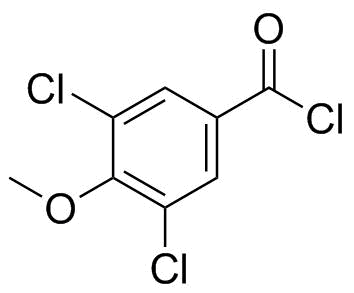 |
| Molecular Formula | C8H5Cl3O2 |
| Molecular Weight | 239.48 |
| CAS Registry Number | 29568-76-1 |
| EC Number | 679-413-9 |
| SMILES | COC1=C(C=C(C=C1Cl)C(=O)Cl)Cl |
| Density | 1.5±0.1 g/cm3 Calc.* |
|---|---|
| Melting point | 63 - 65 °C (Expl.) |
| Boiling point | 313.5±37.0 °C 760 mmHg (Calc.)* |
| Flash point | 136.0±25.5 °C (Calc.)* |
| Index of refraction | 1.56 (Calc.)* |
| * | Calculated using Advanced Chemistry Development (ACD/Labs) Software. |
| Hazard Symbols |  GHS05 Danger Details GHS05 Danger Details |
|---|---|
| Risk Statements | H314 Details |
| Safety Statements | P260-P264-P280-P301+P330+P331-P302+P361+P354-P304+P340-P305+P354+P338-P316-P321-P363-P405-P501 Details |
| SDS | Available |
 chemBlink Chemical Story
|
3,5-Dichloro-4-methoxybenzoyl chloride (CAS 29568-76-1) is an activated aromatic acid derivative designed for acyl-transfer chemistry. Converting a benzoic acid to its acid chloride replaces the hydroxyl group with chlorine and greatly increases the carbonyl carbon's susceptibility to nucleophilic attack. Amines can therefore convert this reagent into benzamides, while alcohols can give esters. The aromatic ring carries two chlorines flanking a methoxy group, a substitution pattern that strongly shapes steric and electronic behavior in downstream products. Public exact-CAS sources mainly identify it as a synthetic intermediate; they do not establish one dominant end use or an independent biological role. Its Chemical Story is consequently the chemistry of controlled acylation: a preactivated fragment that transfers a substituted benzoyl group into more complex molecules. Chemical identity is more than a name. Closely related salts, isomers, hydrates, metabolites, intermediates, and final products can have different registry numbers and different physical or biological behavior. For a chemical database, keeping those forms separate prevents a property measured for one substance from being silently assigned to another. Synthesis also depends on chemoselectivity. A useful intermediate contains functional groups that can be transformed in a predictable order, allowing chemists to build complexity while protecting parts of the molecule that must remain unchanged. This is why apparently modest building blocks can be important in medicinal, materials, or process chemistry even when they never appear in a finished product. Analytical control is the other half of synthesis. Identity, purity, water or salt content, stereochemistry, and process-related impurities may all matter to reproducibility. Reference standards and well-characterized intermediates therefore have value beyond their immediate reaction step: they allow laboratories to confirm that a route is producing the intended chemical entity. A responsible Chemical Story separates documented application from structural possibility. Familiar motifs can suggest hypotheses, but structural resemblance alone does not prove pharmacological activity, industrial adoption, or regulatory status. Where exact-CAS literature is sparse, the scientifically useful approach is to describe verified chemistry and stop before speculation becomes a claimed fact. Chemical identity is more than a name. Closely related salts, isomers, hydrates, metabolites, intermediates, and final products can have different registry numbers and different physical or biological behavior. For a chemical database, keeping those forms separate prevents a property measured for one substance from being silently assigned to another. Synthesis also depends on chemoselectivity. A useful intermediate contains functional groups that can be transformed in a predictable order, allowing chemists to build complexity while protecting parts of the molecule that must remain unchanged. This is why apparently modest building blocks can be important in medicinal, materials, or process chemistry even when they never appear in a finished product. Analytical control is the other half of synthesis. Identity, purity, water or salt content, stereochemistry, and process-related impurities may all matter to reproducibility. Reference standards and well-characterized intermediates therefore have value beyond their immediate reaction step: they allow laboratories to confirm that a route is producing the intended chemical entity. A responsible Chemical Story separates documented application from structural possibility. Familiar motifs can suggest hypotheses, but structural resemblance alone does not prove pharmacological activity, industrial adoption, or regulatory status. Where exact-CAS literature is sparse, the scientifically useful approach is to describe verified chemistry and stop before speculation becomes a claimed fact. References: 1. Specialist chemical catalogs. CAS 29568-76-1 identity. 2. General organic chemistry literature on aromatic acid chlorides and nucleophilic acyl substitution. |
| Market Analysis Reports |