
Online Database of Chemicals from Around the World
| Taizhou Crene Biotechnology Co., Ltd. | China | |||
|---|---|---|---|---|
 | www.pharm-intermediates.com | |||
 | +86 (576) 8881-3233 8820-5808 +86 13396860566 | |||
 | +86 (576) 8822-9589 | |||
 | sales@pharm-intermediates.com | |||
 | QQ Chat | |||
| Chemical manufacturer since 2011 | ||||
| chemBlink Standard supplier since 2009 | ||||
| BOC Sciences | USA | |||
|---|---|---|---|---|
| www.bocsci.com | |||
| +1 (631) 485-4226 | |||
| +1 (631) 614-7828 | |||
| info@bocsci.com | |||
| Chemical manufacturer | ||||
| chemBlink Standard supplier since 2010 | ||||
| Qingdao Xinnuo Pharmaceutical Chemical Co., Ltd. | China | |||
|---|---|---|---|---|
| www.xinnuopharma.com | |||
| +86 (531) 6656-1050 +86 18615688656 +86 18653156686 | |||
| +86 (531) 6656-1050 | |||
| sales@xinnuopharma.com | |||
| QQ Chat | |||
 | Skype Chat | |||
| Chemical manufacturer since 2013 | ||||
| chemBlink Standard supplier since 2014 | ||||
| Medilink Pharmachem | India | |||
|---|---|---|---|---|
| www.medilinkpharma.com | |||
| +91 (79) 3007-0133 | |||
| +91 (79) 4007-4175 | |||
| exports@medilinkpharma.com | |||
| Chemical distributor since 1996 | ||||
| chemBlink Standard supplier since 2014 | ||||
| Chongqing Land Tower Pharmaceutical Co., Ltd. | China | |||
|---|---|---|---|---|
| www.cqlandtower.com | |||
| +86 (23) 6898-0308 | |||
| +86 (23) 6238-5716 | |||
| business@cqlandtower.com | |||
| Chemical manufacturer since 2010 | ||||
| chemBlink Standard supplier since 2014 | ||||
| Hangzhou Leap Chem Co., Ltd. | China | |||
|---|---|---|---|---|
| www.leapchem.com | |||
| +86 (571) 8771-1850 | |||
| market19@leapchem.com | |||
| QQ Chat | |||
| Chemical manufacturer since 2006 | ||||
| chemBlink Standard supplier since 2015 | ||||
| Shanghai Zehan Biopharma Technology Co., Ltd. | China | |||
|---|---|---|---|---|
| www.zehanbiopharma.com | |||
| +86 (21) 6135-0663 +86 13052117465 | |||
| +86 (21) 6135-0662 | |||
| sales@zehanbiopharma.com | |||
| QQ Chat | |||
| Chemical manufacturer since 2015 | ||||
| chemBlink Standard supplier since 2015 | ||||
| Amadis Chemical Co., Ltd. | China | |||
|---|---|---|---|---|
| www.amadischem.com | |||
| +86 (571) 8992-5085 | |||
| +86 (571) 8992-5065 | |||
| sales@amadischem.com | |||
| Chemical manufacturer since 2010 | ||||
| chemBlink Standard supplier since 2015 | ||||
| Cangzhou Enke Pharma-tech Co., Ltd. | China | |||
|---|---|---|---|---|
| www.enkepharma.com | |||
| +86 (317) 529-6180 510-6597 +86 15533709196 | |||
| +86 (317) 510-6596 | |||
| sale@enkepharma.com enkepharma@126.com | |||
| QQ Chat | |||
| Skype Chat | |||
 | WeChat: ymzhao | |||
| Chemical manufacturer since 2011 | ||||
| chemBlink Standard supplier since 2016 | ||||
| Qufu Haida Tiancheng Biochemical Co., Ltd. | China | |||
|---|---|---|---|---|
| www.hdtchg.com | |||
| +86 (537) 4531868 +86 13345174153 | |||
| qfhdtc@126.com | |||
| QQ Chat | |||
| Chemical manufacturer since 2011 | ||||
| chemBlink Standard supplier since 2020 | ||||
| Lengshi Chemical (Qingzhou) Co., Ltd. | China | |||
|---|---|---|---|---|
| www.xinnuopharma.cn | |||
| +86 18615688656 | |||
| sales@xinnuopharma.com | |||
| WeChat: 18615688656 | |||
| Chemical distributor since 2024 | ||||
| chemBlink Standard supplier since 2026 | ||||
| Porton Corporation | China | |||
|---|---|---|---|---|
| www.porton.cn | |||
| +86 (23) 6763-5888 | |||
| +86 (23) 6703-8513 / 6763-5889 | |||
| porton@porton.cn | |||
| Chemical manufacturer since 2005 | ||||
| Siegfried (USA), Inc. | USA | |||
|---|---|---|---|---|
| www.siegfried.ch | |||
| +1 (877) 763-8630 | |||
| +1 (856) 678-8201 | |||
| info@siegfried-usa.com | |||
| Chemical manufacturer | ||||
| Classification | API >> Special medicine >> Antidote |
|---|---|
| Name | Naltrexone hydrochloride |
| Synonyms | (5alpha)-17-(Cyclopropylmethyl)-4,5-epoxy-3,14-dihydroxymorphinan-6-one hydrochloride |
| Molecular Structure | 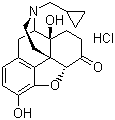 |
| Molecular Formula | C20H23NO4.HCl |
| Molecular Weight | 377.86 |
| CAS Registry Number | 16676-29-2 |
| EC Number | 240-723-0 |
| SMILES | C1CC1CN2CC[C@]34[C@@H]5C(=O)CC[C@]3([C@H]2CC6=C4C(=C(C=C6)O)O5)O.Cl |
| Solubility | DMSO 14 mg/mL, Water 14 mg/mL (Expl.) |
|---|---|
| Hazard Symbols |   GHS07;GHS08 Danger Details GHS07;GHS08 Danger Details | ||||||||||||||||||||||||||||||||||||||||||||||||||||||||||||||||||||||||
|---|---|---|---|---|---|---|---|---|---|---|---|---|---|---|---|---|---|---|---|---|---|---|---|---|---|---|---|---|---|---|---|---|---|---|---|---|---|---|---|---|---|---|---|---|---|---|---|---|---|---|---|---|---|---|---|---|---|---|---|---|---|---|---|---|---|---|---|---|---|---|---|---|---|
| Risk Statements | H302-H312-H317-H332-H334-H341 Details | ||||||||||||||||||||||||||||||||||||||||||||||||||||||||||||||||||||||||
| Safety Statements | P203-P233-P260-P261-P264-P270-P271-P272-P280-P284-P301+P317-P302+P352-P304+P340-P317-P318-P321-P330-P333+P317-P342+P316-P362+P364-P403-P405-P501 Details | ||||||||||||||||||||||||||||||||||||||||||||||||||||||||||||||||||||||||
| Hazard Classification | |||||||||||||||||||||||||||||||||||||||||||||||||||||||||||||||||||||||||
| |||||||||||||||||||||||||||||||||||||||||||||||||||||||||||||||||||||||||
| SDS | Available | ||||||||||||||||||||||||||||||||||||||||||||||||||||||||||||||||||||||||
 chemBlink Chemical Story
|
Naltrexone hydrochloride is the hydrochloride salt form of naltrexone, a synthetic opioid receptor antagonist used in medicine to block the effects of opioid compounds. It is structurally related to morphinan alkaloids and was developed through systematic modification of the opiate scaffold in the search for compounds that could antagonize opioid receptors without producing opioid-like effects. The development of naltrexone is rooted in mid-twentieth-century research on opioid pharmacology, which sought to understand and modulate the actions of morphine and related compounds at opioid receptors. Early work on morphinan derivatives led to the identification of structural modifications that could convert opioid agonists into antagonists. Naltrexone was derived from naloxone-like structures through the introduction of a cyclopropylmethyl group at the nitrogen atom, a modification that contributes to its high receptor affinity and long duration of action. Naltrexone acts primarily as a competitive antagonist at the μ-opioid receptor, with additional activity at κ- and δ-opioid receptors. By binding to these receptors without activating them, it prevents endogenous opioids (such as endorphins) and exogenous opioid drugs from eliciting their pharmacological effects. This receptor blockade underlies its use in the treatment of opioid use disorder, where it helps prevent relapse by blocking the euphoric and analgesic effects of opioids. The hydrochloride salt form, naltrexone hydrochloride, is used to improve the compound’s stability, crystallinity, and water solubility. Salt formation with hydrochloric acid is a common pharmaceutical strategy for amine-containing drugs, as protonation of the basic nitrogen increases aqueous solubility and facilitates formulation into oral tablets or injectable preparations. Structurally, naltrexone belongs to the morphinan class of compounds, which share a rigid, polycyclic scaffold derived from the opiate alkaloid morphine. The molecule contains multiple fused rings, a tertiary amine, and several oxygen-containing functional groups, including hydroxyl and ketone moieties. These features contribute to its strong binding affinity for opioid receptors through a combination of hydrogen bonding, hydrophobic interactions, and ionic interactions at the receptor binding site. The pharmacological action of naltrexone differs from that of opioid agonists in that it lacks intrinsic receptor activation. Instead, it stabilizes the receptor in an inactive state, thereby preventing signaling through G-protein–coupled pathways associated with analgesia, euphoria, and respiratory depression. Its high affinity and relatively long duration of receptor occupancy make it effective for sustained blockade of opioid effects. Naltrexone hydrochloride is administered orally or by long-acting injectable formulations, depending on clinical use. Oral administration results in systemic absorption followed by hepatic metabolism, primarily through reduction and conjugation pathways. Its active metabolite, 6-β-naltrexol, also contributes to pharmacological activity, although it has reduced potency compared with the parent compound. Beyond its established use in opioid dependence, naltrexone has also been investigated for other clinical applications, including alcohol use disorder, where modulation of endogenous opioid signaling is believed to influence reward pathways associated with alcohol consumption. Low-dose regimens of naltrexone have additionally been explored in research contexts for potential immunomodulatory effects, although these uses vary in regulatory acceptance. From a chemical perspective, naltrexone hydrochloride is a polar, crystalline solid due to its protonated amine group and associated chloride counterion. The salt form enhances its handling and formulation properties compared with the free base. Its multiple functional groups and rigid polycyclic structure contribute to a well-defined three-dimensional shape that is essential for high-affinity receptor binding. Overall, naltrexone hydrochloride is a morphinan-derived opioid receptor antagonist used clinically to block opioid effects and support treatment of substance use disorders. Its significance lies in its high receptor affinity, competitive antagonism at opioid receptors, and its role as a key pharmacological tool in addiction medicine and neuropharmacology. References 2023. Multimodal action of KRP203 on phosphoinositide kinases in vitro and in cells. Biochemical and Biophysical Research Communications. URL: https://www.ncbi.nlm.nih.gov/pmc/articles/PMC10559341 2022. A quantitative high-throughput screen identifies compounds that lower expression of the SCA2-and ALS-associated gene ATXN2. The Journal of biological chemistry. URL: https://www.ncbi.nlm.nih.gov/pmc/articles/PMC9356275 |
| Market Analysis Reports |