
Online Database of Chemicals from Around the World
| BOC Sciences | USA | |||
|---|---|---|---|---|
 | www.bocsci.com | |||
 | +1 (631) 485-4226 | |||
 | +1 (631) 614-7828 | |||
 | info@bocsci.com | |||
| Chemical manufacturer | ||||
| chemBlink Standard supplier since 2010 | ||||
| Chengdu Herbpurify Co., Ltd. | China | |||
|---|---|---|---|---|
| www.scstandards.com | |||
| +86 028 8265-1368 | |||
| 2851037747@qq.com | |||
 | QQ Chat | |||
 | WeChat: 18981950076 | |||
| Chemical manufacturer since 2019 | ||||
| chemBlink Standard supplier since 2026 | ||||
| Classification | Natural product >> Terpenes |
|---|---|
| Name | Ganoderiol F |
| Synonyms | (5R,10S,13R,14R,17R)-17-[(2R)-7-hydroxy-6-(hydroxymethyl)hept-5-en-2-yl]-4,4,10,13,14-pentamethyl-1,2,5,6,12,15,16,17-octahydrocyclopenta[a]phenanthren-3-one |
| Molecular Structure | 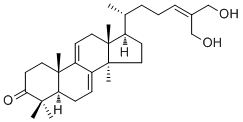 |
| Molecular Formula | C30H46O3 |
| Molecular Weight | 454.70 |
| CAS Registry Number | 114567-47-4 |
| SMILES | C[C@H](CCC=C(CO)CO)[C@H]1CC[C@@]2([C@@]1(CC=C3C2=CC[C@@H]4[C@@]3(CCC(=O)C4(C)C)C)C)C |
| Density | 1.1±0.1 g/cm3 Calc.* |
|---|---|
| Boiling point | 598.3±50.0 °C 760 mmHg (Calc.)* |
| Flash point | 329.7±26.6 °C (Calc.)* |
| Index of refraction | 1.558 (Calc.)* |
| * | Calculated using Advanced Chemistry Development (ACD/Labs) Software. |
| Hazard Symbols |  GHS07 Warning Details GHS07 Warning Details |
|---|---|
| Risk Statements | H315-H319-H335 Details |
| Safety Statements | P261-P264-P264+P265-P271-P280-P302+P352-P304+P340-P305+P351+P338-P319-P321-P332+P317-P337+P317-P362+P364-P403+P233-P405-P501 Details |
| SDS | Available |
 chemBlink Chemical Story
|
Ganoderiol F is a naturally occurring triterpenoid compound isolated from fungi of the genus Ganoderma, particularly Ganoderma lucidum. It belongs to the broad class of lanostane-type triterpenoids, which are highly oxygenated C30 isoprenoid-derived metabolites commonly found in medicinal mushrooms. These compounds are known for their structural diversity and are among the most characteristic secondary metabolites produced by Ganoderma species. The discovery of Ganoderiol F is part of systematic phytochemical investigations of Ganoderma fungi that intensified in the twentieth century. Researchers studying the chemical constituents of Ganoderma extracts isolated numerous triterpenoids using chromatographic separation techniques, followed by structural elucidation using spectroscopic methods such as nuclear magnetic resonance and mass spectrometry. These efforts revealed a large family of structurally related “ganoderiol” compounds, differentiated by variations in hydroxylation and oxidation patterns on the lanostane skeleton. Structurally, Ganoderiol F is derived from the lanostane triterpene framework, which itself originates from the cyclization of squalene via lanosterol biosynthesis. In fungi, lanosterol serves as a key intermediate in sterol biosynthesis, but it can also be diverted into secondary metabolic pathways that produce oxidized triterpenoids. Ganoderiol F contains multiple hydroxyl functional groups distributed across its tetracyclic steroid-like core, reflecting extensive enzymatic oxidation of the parent hydrocarbon skeleton. The lanostane skeleton is a rigid tetracyclic system composed of three six-membered rings and one five-membered ring. This structural motif is common to fungal triterpenoids and sterols, and it provides a stable hydrophobic framework upon which functional groups can be introduced. In Ganoderiol F, hydroxylation increases the polarity of the otherwise hydrophobic triterpene core, influencing solubility and intermolecular interactions. Ganoderiol F, like other Ganoderiol compounds, is part of a chemically diverse group of Ganoderma metabolites that have been studied for their potential biological activities. Research on Ganoderma triterpenoids has reported a range of observed effects in experimental systems, including modulation of inflammatory responses and cytotoxic activity in certain cell-based assays. However, the specific biological properties of individual ganoderiols can vary significantly depending on their precise functional group patterns and stereochemistry. From a physicochemical perspective, Ganoderiol F is expected to be a relatively nonpolar compound overall, despite the presence of multiple hydroxyl groups. The large hydrophobic lanostane core dominates its properties, resulting in low aqueous solubility and higher solubility in organic solvents. The hydroxyl groups enable hydrogen bonding interactions, which can influence both solubility in polar organic media and solid-state packing behavior. The isolation of Ganoderiol F typically involves extraction of fungal biomass with organic solvents followed by multistep chromatographic separation. Due to the structural similarity among lanostane triterpenoids, high-resolution analytical techniques are required for separation and identification. Nuclear magnetic resonance spectroscopy plays a central role in determining the stereochemistry and substitution pattern of these compounds. Ganoderiol F contributes to the broader chemical diversity of Ganoderma species, which are known to produce a wide array of triterpenoids with closely related structures. This diversity is a result of enzymatic oxidation and modification of a common lanosterol-derived precursor, leading to a complex mixture of structurally similar metabolites. Overall, Ganoderiol F is a lanostane-type triterpenoid natural product derived from Ganoderma fungi. Its significance lies in its role as part of the chemically diverse triterpenoid profile of Ganoderma species and its contribution to the study of fungal secondary metabolism, natural product structural diversity, and triterpenoid biosynthesis. References 2026. The LOTUS Initiative for Open Natural Products Research: frozen dataset union wikidata (with metadata). . DOI: 10.5281/zenodo.5794106 2019. Ganoderiol F purified from Ganoderma leucocontextum retards cell cycle progression by inhibiting CDK4/CDK6. Cell cycle (Georgetown, Tex.). URL: https://www.ncbi.nlm.nih.gov/pmc/articles/PMC6791690 2015. Lanostane Triterpenes from the Tibetan Medicinal Mushroom Ganoderma leucocontextum and Their Inhibitory Effects on HMG-CoA Reductase and α-Glucosidase. Journal of Natural Products. DOI: 10.1021/acs.jnatprod.5b00331 |
| Market Analysis Reports |