
Online Database of Chemicals from Around the World
| Chengdu Herbpurify Co., Ltd. | China | |||
|---|---|---|---|---|
 | www.scstandards.com | |||
 | +86 028 8265-1368 | |||
 | 2851037747@qq.com | |||
 | QQ Chat | |||
 | WeChat: 18981950076 | |||
| Chemical manufacturer since 2019 | ||||
| chemBlink Standard supplier since 2026 | ||||
| Classification | Organic raw materials >> Carboxylic compounds and derivatives |
|---|---|
| Name | Ganodermic acid S |
| Synonyms | (E,6R)-6-[(3R,5R,10S,13R,14R,15R,17R)-3,15-diacetyloxy-4,4,10,13,14-pentamethyl-2,3,5,6,12,15,16,17-octahydro-1H-cyclopenta[a]phenanthren-17-yl]-2-methylhept-2-enoic acid |
| Molecular Structure | 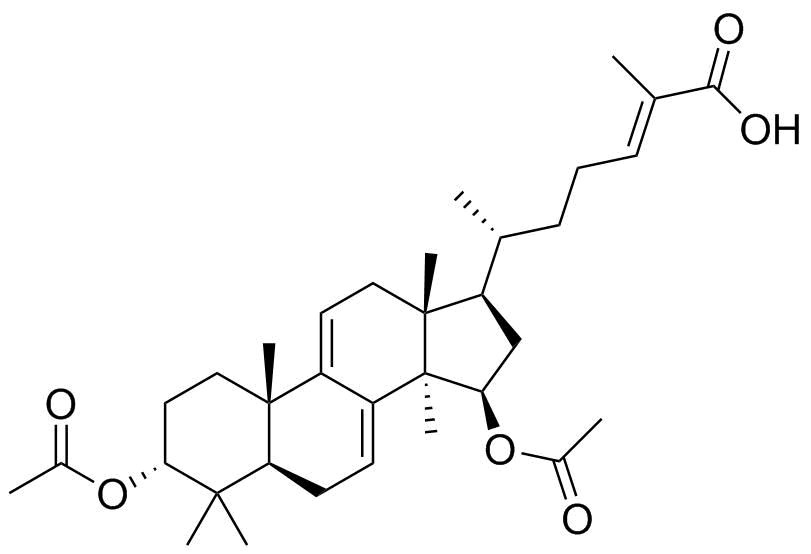 |
| Molecular Formula | C34H50O6 |
| Molecular Weight | 554.76 |
| CAS Registry Number | 112430-63-4 |
| SMILES | C[C@H](CC/C=C(C)/C(=O)O)[C@H]1C[C@H]([C@@]2([C@@]1(CC=C3C2=CC[C@@H]4[C@@]3(CC[C@H](C4(C)C)OC(=O)C)C)C)C)OC(=O)C |
| Density | 1.1±0.1 g/cm3 Calc.* |
|---|---|
| Boiling point | 633.8±55.0 °C 760 mmHg (Calc.)* |
| Flash point | 191.1±25.0 °C (Calc.)* |
| Index of refraction | 1.545 (Calc.)* |
| * | Calculated using Advanced Chemistry Development (ACD/Labs) Software. |
 chemBlink Chemical Story
|
Ganodermic acid S is a lanostane-type triterpenoid that has been isolated from fungi of the genus Ganoderma, particularly Ganoderma lucidum. The compound belongs to a large group of highly oxygenated triterpenes that are characteristic constituents of Ganoderma species. Interest in ganodermic acid S arose from the broader scientific investigation of Ganoderma metabolites, a field that expanded significantly during the second half of the twentieth century as researchers sought to identify the chemical constituents responsible for the biological properties traditionally associated with these medicinal fungi. The discovery of ganodermic acid S was part of systematic phytochemical and mycochemical studies of Ganoderma species. Researchers analyzing extracts of fruiting bodies employed chromatographic separation techniques to isolate individual triterpenoid constituents from complex mixtures. Through the use of spectroscopic methods, including nuclear magnetic resonance spectroscopy and mass spectrometry, numerous structurally related triterpenes were identified and characterized. Ganodermic acid S was among the compounds reported from these investigations and was recognized as a member of the ganodermic acid family, a group of lanostane derivatives distinguished by specific oxidation patterns and functional groups. The identification of ganodermic acid S contributed to a growing understanding of the chemical diversity present in Ganoderma species. Studies demonstrated that triterpenoids constitute one of the major classes of secondary metabolites in these fungi. The isolation and structural characterization of individual compounds such as ganodermic acid S provided researchers with defined substances that could be used in chemical, biological, and pharmacological investigations. This work helped establish a detailed inventory of Ganoderma constituents and enabled comparisons among different species, cultivation conditions, and extraction methods. One important application of ganodermic acid S has been in phytochemical and chemotaxonomic research. The occurrence of specific triterpenoids can serve as a useful marker for the characterization of fungal materials and extracts. Investigators have analyzed ganodermic acid S together with related compounds to evaluate the chemical composition of Ganoderma samples and to support quality assessment studies. Such research has contributed to a more comprehensive understanding of the secondary-metabolite profiles of medicinal fungi. Ganodermic acid S has also been used as a reference compound in analytical studies. Because Ganoderma extracts contain numerous structurally related triterpenoids, accurate identification requires authenticated standards and detailed structural information. The availability of isolated ganodermic acid S has facilitated the development and validation of chromatographic methods for the analysis of fungal extracts. High-performance liquid chromatography and related analytical techniques have been employed to detect and quantify triterpenoid constituents, including ganodermic acid S, in research settings. Another documented application is in biological activity research involving purified Ganoderma triterpenoids. Scientific studies have investigated individual compounds isolated from Ganoderma species in order to determine their biochemical and pharmacological properties. Ganodermic acid S has therefore been examined as part of broader efforts to understand the activities of lanostane-type triterpenes and to distinguish the contributions of individual constituents from those of complex extracts. Such studies have provided valuable information regarding structure-activity relationships within the ganodermic acid family. The compound has additionally been utilized in natural-products chemistry research aimed at elucidating biosynthetic relationships among triterpenoids. Because Ganoderma species produce numerous structurally related metabolites, researchers have examined individual compounds to gain insight into oxidation pathways and the formation of diverse triterpene structures. Ganodermic acid S has contributed to these investigations by serving as one of the characterized members of the triterpenoid network present in Ganoderma fungi. The significance of ganodermic acid S lies primarily in its role as a naturally occurring Ganoderma triterpenoid that has aided the chemical characterization of medicinal fungi. Since its discovery through phytochemical investigations, the compound has been used in analytical chemistry, chemotaxonomic studies, natural-products research, and biological evaluation of purified fungal metabolites. These applications have contributed to a more detailed understanding of the chemical composition and triterpenoid chemistry of Ganoderma species and have supported continuing research into the constituents of this well-studied genus of medicinal fungi. References 2026. The LOTUS Initiative for Open Natural Products Research: frozen dataset union wikidata (with metadata). . DOI: 10.5281/zenodo.5794106 2005. A Prospective, Randomized, Double-Blind, Placebo-Controlled Study of the Platelet and Global Hemostatic Effects of Ganoderma Lucidum (Ling-Zhi) in Healthy Volunteers. Anesthesia and analgesia. DOI: 10.1213/01.ane.0000155286.20467.28 |
| Market Analysis Reports |