
Online Database of Chemicals from Around the World
| Wuhan Carnoss Technology Co., Ltd. | China | |||
|---|---|---|---|---|
 | www.carnoss.com | |||
 | +86 18064039730 | |||
 | +86 (27) 8349-6462 | |||
 | frank@carnosschem.com | |||
 | WeChat: kanuosi_wxid | |||
| Chemical manufacturer since 2012 | ||||
| chemBlink Standard supplier since 2018 | ||||
| Classification | Organic raw materials >> Alcohols, phenols, phenolic compounds and derivatives |
|---|---|
| Name | 2-(2-tert-Butylaminoethoxy)ethanol |
| Synonyms | 2-[2-[(1,1-Dimethylethyl)amino]ethoxy]ethanol |
| Molecular Structure | 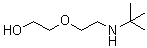 |
| Molecular Formula | C8H19NO2 |
| Molecular Weight | 161.24 |
| CAS Registry Number | 87787-67-5 |
| EC Number | 400-390-6 |
| SMILES | CC(C)(C)NCCOCCO |
| Solubility | Freely soluble (384 g/L) (25 °C), Calc.* |
|---|---|
| Density | 0.930±0.06 g/cm3 (20 °C 760 Torr), Calc.* |
| Boiling point | 233.8±15.0 °C 760 mmHg (Calc.)* |
| Flash point | 95.2±20.4 °C (Calc.)* |
| Index of refraction | 1.443 (Calc.)* |
| * | Calculated using Advanced Chemistry Development (ACD/Labs) Software. |
| Hazard Symbols |   GHS05;GHS07 Danger Details GHS05;GHS07 Danger Details | ||||||||||||||||
|---|---|---|---|---|---|---|---|---|---|---|---|---|---|---|---|---|---|
| Risk Statements | H302-H314 Details | ||||||||||||||||
| Safety Statements | P260-P264-P270-P280-P301+P317-P301+P330+P331-P302+P361+P354-P304+P340-P305+P354+P338-P316-P321-P330-P363-P405-P501 Details | ||||||||||||||||
| Hazard Classification | |||||||||||||||||
| |||||||||||||||||
| SDS | Available | ||||||||||||||||
 chemBlink Chemical Story
|
2-(2-tert-Butylaminoethoxy)ethanol is an amino ether alcohol whose structure combines three kinds of functionality in a compact molecule: a basic secondary amine, an ether oxygen, and a terminal hydroxyl group. That combination makes it simultaneously protonatable, hydrogen-bonding, and chemically derivatizable. It is therefore better understood as a functional intermediate than as a molecule famous for one universal end use. The tert-butyl-substituted amine can accept a proton and form salts with acids, changing water solubility and ionic behavior. The ether oxygen contributes polarity without being strongly reactive under ordinary conditions, while the primary alcohol can be converted into esters, ethers, or other derivatives. Synthetic chemists value molecules of this type because the functional groups can be addressed selectively: one part can control solubility or binding while another is used to connect the molecule to a larger scaffold. Amino alcohol and amino ether motifs recur throughout medicinal and industrial chemistry. They appear in surfactants, curing agents, gas-treatment amines, pharmaceutical intermediates, and ligands because a basic nitrogen placed a few atoms away from oxygen creates a tunable balance between hydrophilic and hydrophobic behavior. The bulky tert-butyl group adds steric shielding and a hydrophobic fragment, altering basicity, volatility, and molecular recognition compared with an unsubstituted aminoethoxyethanol. For CAS 87787-67-5, publicly accessible primary literature is much thinner than for famous drugs or commodity chemicals. That is itself worth stating. Supplier descriptions can list proposed applications, but such claims should not be promoted into established industrial history without independent evidence. The defensible chemical story is the molecule's role as a multifunctional building block and the predictable reactivity created by its amine, ether, and alcohol groups. This compound matters because it shows how synthetic utility can come from orthogonality rather than spectacular reactivity. None of its individual groups is exotic. The value lies in putting a basic center, a stable polar spacer, a reactive OH handle, and a bulky alkyl group into one small structure. Such molecules are the connectors of chemical synthesis: rarely the headline product, but often the pieces that allow a more complex functional molecule to be assembled. References: PubChem and EPA CompTox identity records for CAS 87787-67-5. General medicinal and industrial chemistry literature on amino alcohol and amino ether building blocks. Application claims for this specific CAS should be verified against primary literature before use. |
| Market Analysis Reports |