
Online Database of Chemicals from Around the World
| wuhan chemi Pharmacy Chemical Technology Co., Ltd. | China | |||
|---|---|---|---|---|
 | www.chemipharm.com.cn | |||
 | +86 13971619949 | |||
 | gmn424@chemipharm.com.cn | |||
 | QQ Chat | |||
 | WeChat: 13971619949 | |||
| Chemical manufacturer since 2014 | ||||
| chemBlink Standard supplier since 2026 | ||||
| Classification | Natural product >> Xanthone |
|---|---|
| Name | 2-(Carboxymethoxy)thioxanthone |
| Synonyms | 2-(9-oxothioxanthen-2-yl)oxyacetic acid |
| Molecular Structure | 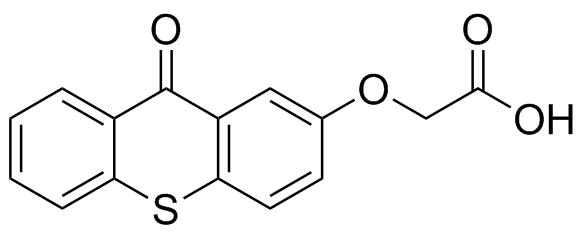 |
| Molecular Formula | C15H10O4S |
| Molecular Weight | 286.30 |
| CAS Registry Number | 84434-05-9 |
| EC Number | 282-803-8 |
| SMILES | C1=CC=C2C(=C1)C(=O)C3=C(S2)C=CC(=C3)OCC(=O)O |
| Density | 1.5±0.1 g/cm3 Calc.* |
|---|---|
| Boiling point | 528.9±50.0 °C 760 mmHg (Calc.)* |
| Flash point | 273.7±30.1 °C (Calc.)* |
| Index of refraction | 1.685 (Calc.)* |
| * | Calculated using Advanced Chemistry Development (ACD/Labs) Software. |
| Hazard Symbols |  GHS09; Details GHS09; Details | ||||||||
|---|---|---|---|---|---|---|---|---|---|
| Risk Statements | H411 Details | ||||||||
| Safety Statements | P273-P391-P501 Details | ||||||||
| Hazard Classification | |||||||||
| |||||||||
| SDS | Available | ||||||||
 chemBlink Chemical Story
|
2-(Carboxymethoxy)thioxanthone is a substituted thioxanthone derivative in which a carboxymethoxy group is attached to the thioxanthone aromatic framework. Thioxanthones are tricyclic aromatic compounds containing a xanthone-like scaffold in which the carbonyl oxygen of xanthone is replaced by sulfur, forming a dibenzo-γ-thiopyrone core. This structural modification significantly alters the photophysical and chemical properties of the parent xanthone system. Thioxanthone compounds were first studied in the context of aromatic ketone photochemistry, where xanthone and its sulfur analogues were recognized for their strong ultraviolet absorption and efficient intersystem crossing behavior. Research into these compounds expanded throughout the twentieth century, particularly with the development of photoinitiators and photochemical reaction systems. Thioxanthones became important chromophoric scaffolds due to their ability to act as efficient photosensitizers under UV and near-UV irradiation. In 2-(carboxymethoxy)thioxanthone, the thioxanthone core is substituted at the 2-position with a carboxymethoxy group, which consists of an ether linkage terminating in a carboxylic acid functionality. This substituent introduces both polarity and potential sites for hydrogen bonding, significantly modifying the solubility and intermolecular interaction profile of the parent aromatic system. The carboxyl group can exist in protonated or deprotonated form depending on pH, allowing for tunable ionic character. The thioxanthone scaffold is characterized by an extended conjugated π-system spanning two fused benzene rings and a central thiocarbonyl-containing heterocycle. This conjugation is responsible for strong absorption in the ultraviolet region and contributes to the compound’s photochemical activity. Upon excitation, thioxanthones typically undergo intersystem crossing to a long-lived triplet state, which can participate in energy transfer or radical-forming processes. Compounds based on the thioxanthone structure, including substituted derivatives such as 2-(carboxymethoxy)thioxanthone, have been widely investigated as photoinitiators in polymer chemistry. In these applications, they absorb ultraviolet light and generate reactive species capable of initiating free-radical polymerization of acrylates and related monomers. The efficiency of these systems depends on the substitution pattern on the aromatic core, which influences absorption wavelength, excited-state lifetime, and solubility in formulation media. The introduction of a carboxymethoxy substituent can enhance compatibility with polar or aqueous systems compared with unsubstituted thioxanthone. Carboxyl-containing substituents also provide opportunities for further chemical modification, such as esterification or salt formation, which can be used to tailor solubility or incorporate the chromophore into larger molecular architectures, including polymeric or surface-bound systems. From a physicochemical standpoint, 2-(carboxymethoxy)thioxanthone combines a rigid hydrophobic aromatic core with a polar functional group. This dual character influences both aggregation behavior and solubility in mixed solvent systems. The aromatic core promotes π–π stacking interactions, while the carboxymethoxy group introduces hydrogen bonding capability, which can modulate solid-state packing and photophysical behavior. Thioxanthone derivatives are also studied in the context of photobiology and medicinal chemistry due to their ability to generate reactive oxygen species under light exposure. While 2-(carboxymethoxy)thioxanthone itself is primarily a functional photochemical intermediate rather than a bioactive agent, its structural class is relevant to photodynamic systems and light-activated chemical processes. Analytical characterization of thioxanthone derivatives typically involves ultraviolet-visible spectroscopy, which reveals strong absorption bands associated with π–π* transitions of the conjugated system. Infrared spectroscopy confirms the presence of carbonyl and carboxyl functional groups, while nuclear magnetic resonance spectroscopy provides detailed structural information regarding substitution patterns on the aromatic framework. Overall, 2-(carboxymethoxy)thioxanthone is a functionalized thioxanthone derivative that integrates a highly conjugated photochemically active core with a polar carboxymethoxy substituent. Its significance lies in its role as a modified chromophore used in photochemical systems, particularly in polymerization chemistry and materials applications where tunable solubility and light absorption properties are required. |
| Market Analysis Reports |