
Online Database of Chemicals from Around the World
| Beijing Dezhong Wanquan Medicines Technological Development Co., Ltd. | China | |||
|---|---|---|---|---|
 | www.venturepharm.com | |||
 | +86 (10) 8850-0088 ex 206 | |||
 | +86 (10) 8850-0080 | |||
 | scd1@venturepharm.net | |||
| Chemical manufacturer | ||||
| chemBlink Standard supplier since 2006 | ||||
| Guangzhou Topwork Chemical Co., Ltd. | China | |||
|---|---|---|---|---|
| www.topworkchem.com | |||
| +86 (20) 8731-7062 +86 13544492387 | |||
| +86 (20) 8731-7061 | |||
| sales@topworkchem.com topwork2004@hotmail.com | |||
 | QQ Chat | |||
 | Skype Chat | |||
 | WeChat: 13544492387 | |||
 | WhatsApp:13544492387 | |||
| Chemical manufacturer since 2004 | ||||
| chemBlink Standard supplier since 2006 | ||||
| Jinan Chenghui-Shuangda Chemical Co., Ltd. | China | |||
|---|---|---|---|---|
| www.jnchsd.com | |||
| +86 (531) 5889-7051 +86 15053146086 | |||
| +86 (531) 5889-7093 | |||
| jnchsd@qq.com | |||
| QQ Chat | |||
| Chemical manufacturer since 2002 | ||||
| chemBlink Standard supplier since 2007 | ||||
| Shanghai Shinchem Co., Ltd. | China | |||
|---|---|---|---|---|
| www.silanol.com | |||
| +86 (21) 5116-8386 | |||
| +86 (21) 5437-1452 | |||
| johnson.zhang@silanol.com | |||
| Chemical distributor | ||||
| chemBlink Standard supplier since 2007 | ||||
| Simagchem Corporation | China | |||
|---|---|---|---|---|
| www.simagchem.com | |||
| +86 13806087780 | |||
| +86 (592) 268-0237 | |||
| sale@simagchem.com | |||
| Chemical manufacturer since 2002 | ||||
| chemBlink Standard supplier since 2008 | ||||
| Shanghai Qingsong Pharmaceutical Co., Ltd. | China | |||
|---|---|---|---|---|
| www.qspharm.com | |||
| +86 (21) 3133-5220 | |||
| +86 (21) 3133-5221 | |||
| sales@qspharm.com | |||
| Chemical manufacturer since 2005 | ||||
| chemBlink Standard supplier since 2009 | ||||
| BOC Sciences | USA | |||
|---|---|---|---|---|
| www.bocsci.com | |||
| +1 (631) 485-4226 | |||
| +1 (631) 614-7828 | |||
| info@bocsci.com | |||
| Chemical manufacturer | ||||
| chemBlink Standard supplier since 2010 | ||||
| Novelab Ltd. | China | |||
|---|---|---|---|---|
| www.novelab.com.cn | |||
| +86 (22) 2740-9838 | |||
| +86 (22) 2740-9495 | |||
| novelab2000@gmail.com | |||
| Chemical manufacturer | ||||
| chemBlink Standard supplier since 2012 | ||||
| Hangzhou Leap Chem Co., Ltd. | China | |||
|---|---|---|---|---|
| www.leapchem.com | |||
| +86 (571) 8771-1850 | |||
| market19@leapchem.com | |||
| QQ Chat | |||
| Chemical manufacturer since 2006 | ||||
| chemBlink Standard supplier since 2015 | ||||
| Carbosynth China Ltd. | China | |||
|---|---|---|---|---|
| www.carbosynth.cn | |||
| +86 (512) 6260-5585 | |||
| +86 (512) 6260-5576 | |||
| sales@carbosynth.com | |||
| QQ Chat | |||
| Chemical manufacturer since 2006 | ||||
| chemBlink Standard supplier since 2016 | ||||
| Kessie Chemical Co., Ltd. | China | |||
|---|---|---|---|---|
| www.kessiechem.com | |||
| +86 (519) 8698-7916 +86 15851999766 | |||
| +86 (519) 8690-8212 | |||
| info@kessiechem.com | |||
| QQ Chat | |||
| Skype Chat | |||
| Chemical manufacturer since 2006 | ||||
| chemBlink Standard supplier since 2018 | ||||
| Neostar United (Changzhou) Industrial Co., Ltd. | China | |||
|---|---|---|---|---|
| www.neostarunited.com | |||
| +86 (519) 8555-7386 +86 18015025600 | |||
| +86 (519) 8555-7389 | |||
| marketing1@neostarunited.com | |||
| Chemical distributor since 2014 | ||||
| chemBlink Standard supplier since 2020 | ||||
| Lengshi Chemical (Qingzhou) Co., Ltd. | China | |||
|---|---|---|---|---|
| www.xinnuopharma.cn | |||
| +86 18615688656 | |||
| sales@xinnuopharma.com | |||
| WeChat: 18615688656 | |||
| Chemical distributor since 2024 | ||||
| chemBlink Standard supplier since 2026 | ||||
| Taizhou Baida Pharmaceutical Co., Ltd. | China | |||
|---|---|---|---|---|
| www.chinahormone.com | |||
| +86 (571) 8511-4466 8511-4477 8521-5531 | |||
| +86 (571) 8775-0020 | |||
| info@chinahormone.com | |||
| Chemical manufacturer | ||||
| Classification | Biochemical >> Inhibitor >> Endocrinology & hormones >> Glucocorticoid receptor agonist |
|---|---|
| Name | Loteprednol etabonate |
| Synonyms | Chloromethyl 17-ethoxycarbonyloxy-11-hydroxy-10,13-dimethyl-3-oxo-7,8,9,11,12,14,15,16-octahydro-6H-cyclopenta[a]phenanthrene-17-carboxylate |
| Molecular Structure | 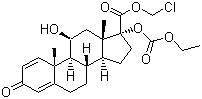 |
| Molecular Formula | C24H31ClO7 |
| Molecular Weight | 466.96 |
| CAS Registry Number | 82034-46-6 |
| EC Number | 639-474-4 |
| SMILES | CCOC(=O)O[C@@]1(CC[C@@H]2[C@@]1(C[C@@H]([C@H]3[C@H]2CCC4=CC(=O)C=C[C@]34C)O)C)C(=O)OCCl |
| Density | 1.3±0.1 g/cm3 Calc.* |
|---|---|
| Boiling point | 600.1±55.0 °C 760 mmHg (Calc.)* |
| Flash point | 316.7±31.5 °C (Calc.)* |
| Solubility | DMSO 90 mg/mL, Water <1 mg/mL (Expl.) |
| Index of refraction | 1.571 (Calc.)* |
| * | Calculated using Advanced Chemistry Development (ACD/Labs) Software. |
| Hazard Symbols |   GHS07;GHS08 Warning Details GHS07;GHS08 Warning Details | ||||||||||||||||||||||||||||||||
|---|---|---|---|---|---|---|---|---|---|---|---|---|---|---|---|---|---|---|---|---|---|---|---|---|---|---|---|---|---|---|---|---|---|
| Risk Statements | H302-H312-H332-H361-H362-H373-H413 Details | ||||||||||||||||||||||||||||||||
| Safety Statements | P203-P260-P261-P263-P264-P270-P271-P273-P280-P301+P317-P302+P352-P304+P340-P317-P318-P319-P321-P330-P362+P364-P405-P501 Details | ||||||||||||||||||||||||||||||||
| Hazard Classification | |||||||||||||||||||||||||||||||||
| |||||||||||||||||||||||||||||||||
| SDS | Available | ||||||||||||||||||||||||||||||||
 chemBlink Chemical Story
|
Loteprednol etabonate is a topical corticosteroid used primarily in ophthalmology and dermatology for the treatment of inflammatory conditions. It belongs to the “soft steroid” class, meaning it is designed to exert strong local anti-inflammatory effects while undergoing rapid inactivation after achieving its therapeutic action, thereby reducing the risk of steroid-related side effects such as elevated intraocular pressure. Corticosteroids act by modulating gene expression through binding to intracellular glucocorticoid receptors. Once the drug–receptor complex enters the nucleus, it influences transcription of anti-inflammatory proteins while suppressing pro-inflammatory mediators such as cytokines, prostaglandins, and leukotrienes. This results in reduced inflammation, edema, and immune cell activation. Loteprednol etabonate is structurally derived from prednisolone, but it incorporates specific modifications that distinguish it from traditional corticosteroids. A key feature is the presence of an ester group at the 17-position (etabonate ester) and a metabolically labile design that promotes rapid hydrolysis into inactive metabolites after exerting its effect. This structural strategy is central to its improved safety profile. Unlike many corticosteroids that contain a ketone at the C-20 position contributing to prolonged receptor activation and systemic persistence, loteprednol is designed through “retrometabolic” drug design principles. It is rapidly converted by tissue esterases into inactive carboxylic acid metabolites, limiting systemic absorption and reducing the likelihood of long-term adverse effects. In ophthalmic use, loteprednol etabonate is commonly formulated as eye drops to treat conditions such as allergic conjunctivitis, postoperative inflammation, uveitis, and other steroid-responsive inflammatory eye diseases. Its ability to penetrate ocular tissues allows it to act on the anterior segment of the eye, reducing swelling, redness, and immune-mediated irritation. The drug exerts its effects by inhibiting phospholipase A2 indirectly through induction of lipocortin (annexin-1), which reduces the release of arachidonic acid from membrane phospholipids. This decreases downstream production of prostaglandins and leukotrienes, key mediators of inflammation. This mechanism complements nonsteroidal anti-inflammatory drugs such as nepafenac, which directly inhibit cyclooxygenase enzymes. From a physicochemical standpoint, loteprednol etabonate is a lipophilic molecule, which enhances its ability to penetrate ocular tissues such as the corneal epithelium. Its ester functionality also contributes to controlled activation and deactivation within biological systems. A major clinical advantage of loteprednol over traditional corticosteroids is its reduced tendency to elevate intraocular pressure (IOP), a common side effect associated with prolonged steroid use that can lead to steroid-induced glaucoma. Because of its rapid metabolism to inactive forms, systemic and ocular exposure is minimized. In addition to ophthalmic applications, corticosteroids as a class are widely used in dermatology, respiratory medicine, and autoimmune disease management. However, loteprednol is primarily optimized for local ocular use due to its safety profile and formulation characteristics. Overall, loteprednol etabonate is a structurally modified corticosteroid designed for targeted anti-inflammatory activity with rapid metabolic deactivation. Its significance lies in its effectiveness in treating ocular inflammation while minimizing the adverse effects typically associated with long-term corticosteroid therapy. References 2026. [Ocular rosacea : Clinical aspects, diagnostics, management and treatment]. Dermatologie (Heidelberg, Germany). DOI: 10.1007/s00105-026-05664-8 2026. Corneal biomechanical and tomographic outcomes following accelerated cross-linking in keratoconus: a focus on cone localization. Japanese Journal of Ophthalmology. DOI: 10.1007/s10384-026-01338-z 2026. Therapeutic effects of Chelidonium majus on ocular surface inflammation and tear film homeostasis in a benzalkonium chloride–induced rat model of dry eye disease. International Ophthalmology. DOI: 10.1007/s10792-026-04021-x |
| Market Analysis Reports |