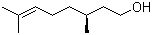
(-)-beta-Citronellol is a reminder that smell is three-dimensional chemistry. Citronellol is a monoterpene alcohol found in essential oils and widely used in fragrance compositions for its fresh, citrus-floral, rose-like character. CAS 7540-51-4 refers specifically to the levorotatory beta-citronellol enantiomer, not merely to an undefined mixture of citronellol stereoisomers.
The molecule seems simple: a flexible ten-carbon chain, one double bond, one methyl-substituted stereogenic center, and a terminal alcohol. Yet odor receptors recognize molecular shape, functional groups, flexibility, and dynamic conformations. Studies of beta-citronellol and oxygenated derivatives show that apparently small structural changes can leave the general odor family recognizable while shifting odor threshold by more than an order of magnitude. The alcohol group is especially important for receptor interactions.
Modern receptor studies add another layer. The human olfactory receptor OR1A1 responds to citronellol and related terpenes. Fluorinated analog studies have been used as molecular probes to test how the hydroxyl group and local electronic environment contribute to receptor activation. Both citronellol enantiomers can activate OR1A1, and this receptor does not show extreme stereochemical discrimination for them. Chirality matters in odor chemistry, but not every receptor responds to every stereocenter in the same way.
Citronellol also belongs to plant terpene metabolism. Its carbon skeleton ultimately derives from isoprenoid biosynthesis, and essential oils containing citronellol are associated with rose, geranium, and related aromatic plants. Fragrance chemistry therefore brings together biosynthesis and synthetic chemistry. Industry may isolate natural material, transform related terpenes, or prepare defined stereochemical material, but final sensory performance still depends on purity, enantiomeric composition, trace impurities, and the larger fragrance matrix.
Citronellol also shows why natural does not mean chemically uniform. An essential oil may contain citronellol together with citronellal, geraniol, esters, and many trace terpenes; botanical source, harvest conditions, and processing can change those ratios. A perfumer evaluating isolated (-)-beta-citronellol is therefore studying a more defined material than a plant oil carrying the same odor note. Both are useful, but they answer different formulation needs. Analytical gas chromatography and chiral methods help connect sensory quality with actual molecular composition.
What makes (-)-beta-citronellol memorable is that an odor is not a label attached to a formula. A molecule has to enter the vapor phase, reach the olfactory epithelium, bind a set of receptors, and generate a neural pattern interpreted as fresh, floral, or rose-like. Citronellol's simple structure therefore opens a surprisingly deep question: how does a three-dimensional organic molecule become a smell?
References:
1. Fragrance material review on l-citronellol. Food and Chemical Toxicology. 2008.
2. Influence of chemical structure on odor characters of beta-citronellol derivatives. Food Chemistry. 2017. DOI: 10.1016/j.foodchem.2017.04.053.
3. Zhuang H, O'Hagan D. Organic Letters. 2022. DOI: 10.1021/acs.orglett.2c01635.
4. General monoterpene biosynthesis literature for citronellol-containing essential oils.
|






 GHS07 Warning Details
 chemBlink Chemical Story