
Online Database of Chemicals from Around the World
| Alfa Chemistry | USA | |||
|---|---|---|---|---|
 | www.alfa-chemistry.com | |||
 | +1 (516) 734-6573 | |||
 | +1 (516) 927-0118 | |||
 | support@alfa-chemistry.com | |||
| Chemical manufacturer since 2005 | ||||
| chemBlink Standard supplier since 2012 | ||||
| Nanjing Wali Chemical Technology Co., Ltd. | China | |||
|---|---|---|---|---|
| www.njwali.com | |||
| 18005141382 | |||
| 18005141382@163.com | |||
 | QQ Chat | |||
 | WeChat: 18005141382 | |||
| Chemical manufacturer since 2008 | ||||
| chemBlink Standard supplier since 2026 | ||||
| Classification | Organic raw materials >> Heterocyclic compound >> Triazines |
|---|---|
| Name | Triazine B |
| Synonyms | 2-(4'-Methoxynaphthyl)-4,6-bis(trichloromethyl)-1,3,5-triazine; BU 1557; TAZ 106 |
| Molecular Structure | 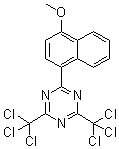 |
| Molecular Formula | C16H9Cl6N3O |
| Molecular Weight | 471.98 |
| CAS Registry Number | 69432-40-2 |
| EC Number | 689-231-1 |
| SMILES | COC1=CC=C(C2=CC=CC=C21)C3=NC(=NC(=N3)C(Cl)(Cl)Cl)C(Cl)(Cl)Cl |
| Solubility | Insoluble (9.0E-4 g/L) (25 °C), Calc.* |
|---|---|
| Density | 1.599±0.06 g/cm3 (20 °C 760 Torr), Calc.* |
| * | Calculated using Advanced Chemistry Development (ACD/Labs) Software V11.02 (©1994-2013 ACD/Labs) |
| Hazard Symbols |  GHS09; Details | ||||||||
|---|---|---|---|---|---|---|---|---|---|
| Risk Statements | H411 Details | ||||||||
| Safety Statements | P273-P391-P501 Details | ||||||||
| Hazard Classification | |||||||||
| |||||||||
| SDS | Available | ||||||||
 chemBlink Chemical Story
|
A useful light-sensitive ingredient can make one imaging formulation worse rather than better. Triazine B provides a documented example of that apparently surprising result. The name refers here to CAS 69432-40-2, 2-(4-methoxynaphthalen-1-yl)-4,6-bis(trichloromethyl)-1,3,5-triazine. Its extended aromatic group is joined to a nitrogen-containing ring bearing two trichloromethyl groups. The short commercial name is convenient, but the structural name and CAS number are what distinguish this compound from other numbered or lettered triazines. Its historical setting is the development of materials in which exposure changes color or solubility. A photoacid generator supplies acid in response to an appropriate excitation process, and another component converts that chemical event into an observable result. The molecule that absorbs the exposure light need not be identical to the component responsible for the final reaction. A sensitizer, resin, acid-sensitive additive and developer can each influence whether an image is produced successfully. Patent literature identifies this exact CAS among acid-generating candidates for laser-markable security articles. One proposed approach combines an acid generator with a leuco dye, a color precursor whose state can change under suitable chemical conditions. The resulting concept is different from adding a permanently colored pigment. The material initially contains the components needed to generate a color response at selected locations. Inclusion in a patent's candidate list documents a proposed formulation role, rather than proof that every listed combination has been tested commercially. A more revealing comparison appears in a published patent on near-infrared-sensitive, positive-working printing materials. The investigators added Triazine B to coatings containing a novolac resin, an infrared-absorbing dye and ketal additives, and compared the results with corresponding coatings without the triazine. In that particular system, the addition slightly reduced photospeed rather than improving it. The authors also reported increased sensitivity to ordinary white light, creating a need for dark or yellow-light handling before imaging. Those observations do not establish that Triazine B is an ineffective photoactive chemical. They show that a component's useful reactivity must be matched to the intended process. A film can become easier to alter under room lighting without becoming better at the desired image-forming step. The exposure wavelength, reaction pathway and dissolution behavior are connected variables, and optimizing one does not automatically optimize the others. The patent therefore supplies an especially valuable counterexample to the assumption that adding another photoactive ingredient always improves sensitivity. The molecular structure makes the design problem understandable. The methoxynaphthyl group contributes an extended conjugated framework, while the chlorinated substituents belong to the reactive architecture of halomethyltriazines. Changing the aromatic portion can alter electronic behavior, but a structure diagram alone cannot specify the response of a coated film. The same compound can encounter very different partners and physical environments in a dye-forming layer and a printing-plate formulation. Selectivity in exposure has a practical meaning here: an image should form where the intended light is delivered, while the rest of the sheet remains usable. Unwanted background changes reduce that distinction, even if the reacting ingredient is chemically active. Performance also has more than one dimension. An imaging layer must survive storage and handling, respond to the intended exposure and produce a useful difference between exposed and unexposed regions. A material that is too sensitive to unintended light can be inconvenient even if its fundamental chemistry is effective. Triazine B's documented story is consequently about experimental comparison: the exact identity makes results traceable, while the complete formulation determines whether those results are beneficial. References: 1. High molecular compound, monomer, and polymer composition. US20030235781A1. TAZ-106, CAS 69432-40-2, listed among photoacid generators. https://patents.google.com/patent/US20030235781A1/en 2. Near-infrared sensitive, positive-working, image forming composition and photographic element containing a 1,1-di[(alkylphenoxy)ethoxy]cyclohexane. US20130196267A1. Examples 6-8 and Comparative Example KG. https://patents.google.com/patent/US20130196267A1/en 3. Laser markable security articles and documents. US10265995B2. Acid-generator/leuco-dye candidate combinations. https://patents.google.com/patent/US10265995B2/en |
| Market Analysis Reports |