
Online Database of Chemicals from Around the World
| wuhan chemi Pharmacy Chemical Technology Co., Ltd. | China | |||
|---|---|---|---|---|
 | www.chemipharm.com.cn | |||
 | +86 13971619949 | |||
 | gmn424@chemipharm.com.cn | |||
 | QQ Chat | |||
 | WeChat: 13971619949 | |||
| Chemical manufacturer since 2014 | ||||
| chemBlink Standard supplier since 2026 | ||||
| Classification | Biochemical >> Amino acids and their derivatives |
|---|---|
| Name | 6-((Aminoiminomethyl)amino)hexanoic acid |
| Synonyms | 6-Guanidinocaproic acid |
| Molecular Structure | 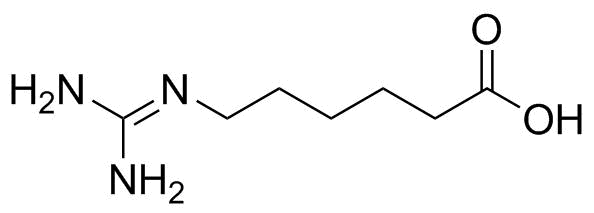 |
| Molecular Formula | C7H15N3O2 |
| Molecular Weight | 173.21 |
| CAS Registry Number | 6659-35-4 |
| EC Number | 229-696-6 |
| SMILES | C(CCC(=O)O)CCN=C(N)N |
| Density | 1.3±0.1 g/cm3 Calc.* |
|---|---|
| Melting point | 310 °C (Decomposes) (Expl.) |
| Boiling point | 338.5±44.0 °C 760 mmHg (Calc.)* |
| Flash point | 158.5±28.4 °C (Calc.)* |
| Index of refraction | 1.541 (Calc.)* |
| * | Calculated using Advanced Chemistry Development (ACD/Labs) Software. |
| Hazard Symbols |  GHS07 Warning Details GHS07 Warning Details |
|---|---|
| Risk Statements | H302-H315-H319-H335 Details |
| Safety Statements | P261-P305+P351+P338 Details |
| SDS | Available |
 chemBlink Chemical Story
|
6-((Aminoiminomethyl)amino)hexanoic acid is a guanidino-substituted aliphatic amino acid derivative structurally related to 6-aminocaproic acid, in which the terminal amino group of a six-carbon carboxylic acid chain is converted into a guanidino functionality. The molecule contains a linear hexanoic acid backbone terminated by a carboxylic acid group and a strongly basic guanidine moiety at the opposite end, giving it a zwitterionic or highly polar character depending on pH conditions. Guanidino groups are among the most strongly basic neutral functional groups in organic chemistry and are commonly found in biologically important molecules such as arginine and related derivatives. The chemical class of guanidino compounds has a long history in organic and biochemical research. Guanidine itself was first isolated in the nineteenth century through degradation studies of natural products such as guanine, and subsequent synthetic investigations established a broad family of guanidino derivatives with diverse structural and functional properties. The introduction of guanidino groups into aliphatic chains, as seen in 6-((aminoiminomethyl)amino)hexanoic acid, represents a logical extension of this chemistry, combining a flexible hydrocarbon backbone with a highly basic functional group capable of strong ionic interactions. The hexanoic acid scaffold is closely related to 6-aminocaproic acid, a well-known lysine analogue used in biochemical and pharmaceutical contexts. In the present compound, the terminal amino group is transformed into a guanidino group, which significantly increases basicity and hydrogen-bonding capacity. The guanidino functionality is characterized by resonance stabilization of the positive charge over three nitrogen atoms when protonated, which leads to strong cationic behavior under physiological conditions. This property is central to the behavior of many guanidino-containing biomolecules, including the amino acid arginine, which plays important roles in protein structure and enzyme catalysis. The synthesis of guanidino-substituted carboxylic acids is typically achieved through the reaction of primary amines with guanidinylating reagents, such as O-methylisourea derivatives, cyanamides, or other activated guanidine precursors. These methods allow selective conversion of terminal amino groups into guanidine functionalities while preserving the integrity of the carboxylic acid group. The development of such transformations is part of a broader field of amine functionalization chemistry that has been widely used in peptide modification and small-molecule synthesis. Compounds of this type are frequently encountered as intermediates in biochemical research and medicinal chemistry. The guanidino group confers strong interactions with negatively charged biological targets such as phosphate groups, carboxylates, and sulfates, making such molecules useful in the design of enzyme inhibitors and receptor ligands. Guanidinium-containing compounds are also known to participate in strong hydrogen bonding networks, which can influence molecular recognition and binding affinity in biological systems. In addition to their biological relevance, guanidino-functionalized carboxylic acids serve as useful building blocks in peptide and polymer chemistry. The presence of both a carboxylic acid group and a highly basic guanidino group allows for incorporation into larger molecular frameworks through standard amide bond formation reactions. Once incorporated, the guanidino group can impart cationic character to peptides or synthetic polymers, influencing solubility, charge distribution, and interaction with biomolecules. The physicochemical properties of 6-((aminoiminomethyl)amino)hexanoic acid are dominated by its ionic nature. The carboxylic acid group can exist in deprotonated form under neutral or basic conditions, while the guanidino group is typically protonated under physiological pH, resulting in a net zwitterionic state. This dual functionality leads to high water solubility and strong interaction with polar solvents. The flexible aliphatic chain also allows conformational adaptability, which can be important in molecular binding contexts. From a structural perspective, the guanidino group exhibits resonance stabilization, with positive charge delocalized across the three nitrogen atoms. This delocalization contributes to the relative stability of the protonated form and is a defining feature of guanidine chemistry. The interplay between this cationic group and the carboxylate functionality in the same molecule creates an internal balance of charges that can influence aggregation and solid-state behavior. Overall, 6-((aminoiminomethyl)amino)hexanoic acid is a guanidino-substituted aliphatic carboxylic acid that exemplifies the combination of flexible hydrocarbon scaffolds with strongly basic functional groups. Its significance lies in its structural relationship to biologically important guanidino amino acids and its utility as a functional building block in biochemical research, peptide modification, and synthetic organic chemistry where controlled introduction of cationic functionality is required. References 2026. The LOTUS Initiative for Open Natural Products Research: frozen dataset union wikidata (with metadata). . DOI: 10.5281/zenodo.5794106 |
| Market Analysis Reports |