
Online Database of Chemicals from Around the World
| Hangzhou Verychem Science And Technology Co., Ltd. | China | |||
|---|---|---|---|---|
 | www.verychem.com | |||
 | +86 (571) 8816-2785 +86 13606544505 | |||
 | +86 (571) 8816-2787 | |||
 | lucy@verychem.com | |||
| Chemical manufacturer since 2004 | ||||
| chemBlink Massive supplier since 2021 | ||||
| EnBridge PharmTech (Wuxi) Co., Ltd. | China | |||
|---|---|---|---|---|
| www.enbridgepharm.com | |||
| +86 (510) 8359-1909 +86 18018392058 | |||
| +86 (510) 8359-1909 | |||
| info@enbridgepharm.com | |||
 | QQ Chat | |||
| Chemical distributor since 2013 | ||||
| chemBlink Standard supplier since 2020 | ||||
| Bydone (Shanghai) Biochemical Co., Ltd. | China | |||
|---|---|---|---|---|
| www.bydone-chem.com | |||
| +86 15826115498 | |||
| sales@bydonechem.com | |||
| QQ Chat | |||
| Chemical distributor since 2020 | ||||
| chemBlink Standard supplier since 2022 | ||||
| Jiangxi Xingao Medical Co., Ltd. | China | |||
|---|---|---|---|---|
| www.xingaopharma.com | |||
| +86 (0576) 8980-6670 | |||
| william@xingaopharma.com | |||
 | WeChat: 008613867636668 | |||
| Chemical manufacturer since 2021 | ||||
| chemBlink Standard supplier since 2023 | ||||
| Classification | Organic raw materials >> Carboxylic compounds and derivatives |
|---|---|
| Name | 4-Acetyl-2-methylbenzoic acid |
| Molecular Structure | 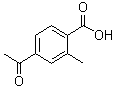 |
| Molecular Formula | C10H10O3 |
| Molecular Weight | 178.19 |
| CAS Registry Number | 55860-35-0 |
| EC Number | 856-079-4 |
| SMILES | CC1=C(C=CC(=C1)C(=O)C)C(=O)O |
| Density | 1.2±0.1 g/cm3 Calc.* |
|---|---|
| Boiling point | 352.7±30.0 °C 760 mmHg (Calc.)* |
| Flash point | 181.3±21.1 °C (Calc.)* |
| Index of refraction | 1.555 (Calc.)* |
| * | Calculated using Advanced Chemistry Development (ACD/Labs) Software. |
| Hazard Symbols |  GHS07 Warning Details GHS07 Warning Details | ||||||||
|---|---|---|---|---|---|---|---|---|---|
| Risk Statements | H319 Details | ||||||||
| Safety Statements | P264+P265-P280-P305+P351+P338-P337+P317 Details | ||||||||
| Hazard Classification | |||||||||
| |||||||||
| SDS | Available | ||||||||
 chemBlink Chemical Story
|
Aromatic intermediates often look unremarkable until one asks what substitution pattern they are preserving. 4-Acetyl-2-methylbenzoic acid, CAS 55860-35-0, carries three groups on a benzene ring: a carboxylic acid, a methyl group next to it, and an acetyl group para to the acid. That arrangement makes the compound a useful intermediate in the synthesis of fluralaner, an isoxazoline ectoparasiticide used in veterinary medicine. Fluralaner's story is based on selective disruption of arthropod neurotransmission. Isoxazoline ectoparasiticides act on ligand-gated chloride channels in insects and mites, particularly gamma-aminobutyric acid- and glutamate-gated systems, leading to uncontrolled nervous activity in susceptible parasites. The final drug is structurally much more complex than 4-acetyl-2-methylbenzoic acid, but the substituted benzoic-acid fragment has to be assembled correctly before it can be incorporated into that architecture. The intermediate is also a good example of why process chemistry is different from drawing a synthetic route on paper. A medicinal chemist may accept a route that uses rare starting materials, multiple protecting-group operations, hazardous reagents, or difficult chromatography to make milligrams. Industrial manufacture must instead consider cost, availability, worker safety, waste, pressure, temperature, and reproducibility on much larger scales. Patent literature on CAS 55860-35-0 reflects exactly this problem. Earlier routes to the fluralaner intermediate used sequences involving less accessible starting materials and, in some cases, carbonylation chemistry. A later Chinese patent described a route from o-bromotoluene: Friedel-Crafts acylation establishes the acetyl group, followed by palladium-catalyzed carbonylation to install the carboxylic acid. The attraction was not the novelty of any single functional group, but a shorter, more scalable path to the required substitution pattern. That is the memorable chemistry of 4-acetyl-2-methylbenzoic acid. Its three substituents act like coordinates on a map. If any one of them occupies the wrong ring position, later steps lead toward the wrong molecule. Industrial intermediate synthesis is therefore often an exercise in preserving positional information through economical transformations. This compound reminds us that the path to a modern veterinary drug is not made only of the active pharmacophore. It also depends on small route-enabling molecules whose main job is to carry the correct carbon skeleton and substitution pattern from inexpensive feedstocks into the advanced stages of manufacture. References: 1. PubChem, 4-Acetyl-2-methylbenzoic acid, CID 53435554. 2. CN118324623A, A synthesis method of 2-methyl-4-acetylbenzoic acid. 3. EP2172462A1, isoxazoline compounds and related synthetic routes. 4. Gassel M. et al. Insect Biochem Mol Biol. 2014, 45, 111-124. DOI: 10.1016/j.ibmb.2013.11.009. |
| Market Analysis Reports |