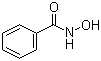
Benzohydroxamic acid demonstrates how one small functional group can turn an ordinary aromatic molecule into a selective metal-binding reagent. The hydroxamic acid group, -C(=O)NHOH, contains neighboring oxygen atoms that can cooperate in coordination to metal ions. This chelating ability is the central reason benzohydroxamic acid has attracted attention in analytical chemistry, coordination chemistry, and especially mineral flotation.
In froth flotation, the challenge is not merely to make particles float. A collector must adsorb preferentially on the valuable mineral while leaving unwanted gangue relatively hydrophilic. Oxidized copper minerals are difficult because their surfaces are chemically heterogeneous and often do not respond well to collectors used for sulfide ores. Hydroxamate collectors became important because deprotonated hydroxamate groups can coordinate surface metal centers, creating a more hydrophobic mineral surface.
Modern surface studies make this idea visible at molecular scale. Work on copper minerals such as malachite and chrysocolla has combined flotation tests, zeta-potential measurements, spectroscopy, and surface analysis. Benzohydroxamic acid can chemisorb through copper-hydroxamate coordination, while adsorption on minerals lacking suitable exposed copper sites is much weaker. The aromatic ring helps provide a hydrophobic tail, but selectivity comes from the metal-binding head group.
The same chemistry connects mineral processing to biochemistry. Hydroxamate groups are powerful ligands for iron and other metals; nature uses hydroxamate-containing siderophores to capture scarce Fe(III), and medicinal chemists use hydroxamate motifs in several metalloenzyme inhibitors. Benzohydroxamic acid is simpler than those biological molecules, but the underlying concept is the same: arrange oxygen donors so they can bind a metal center in a favorable chelate geometry.
Collector selectivity is also affected by solution chemistry. Hydroxamic acid deprotonation changes with pH, while mineral surfaces themselves gain or lose protons and may expose different metal-hydroxo sites. The same BHA concentration can therefore behave differently as pH changes. This is why flotation studies measure recovery together with zeta potential and spectroscopy: a successful collector is not simply hydrophobic, but must reach the surface in the right protonation state and form sufficiently stable bonds under the actual pulp conditions.
What makes benzohydroxamic acid memorable is this bridge between a molecular coordination motif and a macroscopic separation process. A mining plant separates tonnes of mineral particles, yet the decision about which particle joins a rising bubble can depend on coordination bonds formed at a surface only a few atoms thick. Benzohydroxamic acid is therefore more than a flotation additive. It is a clear example of how chelation chemistry can be translated into selective control of interfaces.
References:
1. Wiley Encyclopedia of Reagents for Organic Synthesis. Benzohydroxamic acid. DOI: 10.1002/047084289X.rb028.
2. Mohammadi-Jam S et al. Colloids and Interfaces. 2026;10:58. DOI: 10.3390/colloids10040058.
3. Rao SR. Surface Chemistry of Froth Flotation. Springer.
4. Surface-spectroscopic literature on hydroxamate adsorption on oxidized copper minerals.
|





 GHS07;GHS08 Warning Details
 chemBlink Chemical Story