
Online Database of Chemicals from Around the World
| Changzhou Ditong Chemical Co., Ltd. | China | |||
|---|---|---|---|---|
 | www.edengenechem.com | |||
 | +86 (519) 8829-8848 +86 18118010980 | |||
 | info@edengenechem.com sale@edengenechem.com | |||
 | QQ Chat | |||
 | WeChat: 18118010980 | |||
| Chemical manufacturer since 2006 | ||||
| chemBlink Premium supplier since 2026 | ||||
| Classification | Chemical reagent >> Organic reagent >> Aromatic hydrocarbon reagent |
|---|---|
| Name | Triptycene |
| Synonyms | 9,10-o-Benzeno-9,10-dihydroanthracene; RCL S60268 |
| Molecular Structure | 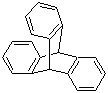 |
| Molecular Formula | C20H14 |
| Molecular Weight | 254.32 |
| CAS Registry Number | 477-75-8 |
| EC Number | 207-519-3 |
| SMILES | C1=CC=C2C3C4=CC=CC=C4C(C2=C1)C5=CC=CC=C35 |
| Density | 1.2±0.1 g/cm3 Calc.* |
|---|---|
| Melting point | 252 - 254 °C (Expl.) |
| Boiling point | 371.8±37.0 °C 760 mmHg (Calc.)* |
| Flash point | 171.7±20.6 °C (Calc.)* |
| Index of refraction | 1.689 (Calc.)* |
| * | Calculated using Advanced Chemistry Development (ACD/Labs) Software. |
| Hazard Symbols |  GHS07 Warning Details GHS07 Warning Details |
|---|---|
| Risk Statements | H302 Details |
| Safety Statements | P264-P270-P301+P312-P330-P501 Details |
| SDS | Available |
 chemBlink Chemical Story
|
Triptycene is a polycyclic aromatic hydrocarbon with a distinctive three-dimensional rigid framework. It consists of three benzene rings connected through a central bicyclo[2.2.2]octane unit, producing a propeller-like molecular structure. The compound is recognized as an important framework in physical organic chemistry, supramolecular chemistry, and materials science because of its unusual rigidity, high symmetry, and ability to provide a well-defined three-dimensional molecular architecture. Triptycene was first synthesized in the twentieth century during research into strained and highly organized aromatic systems. Its discovery was associated with efforts to prepare molecules with unusual three-dimensional structures based on the anthracene framework. The synthesis of triptycene demonstrated that aromatic units could be arranged around a rigid central core to produce stable molecules with significant steric organization. This work contributed to the development of modern concepts in molecular architecture and stereochemistry. The structure of triptycene is derived from three benzene rings arranged around a central bicyclic framework. The three aromatic rings are positioned approximately perpendicular to one another, creating a three-dimensional arrangement rather than the flat structure commonly observed in many polycyclic aromatic hydrocarbons. This geometry gives triptycene its characteristic paddlewheel-like appearance and prevents free rotation between the aromatic units. A key feature of triptycene is its exceptional molecular rigidity. The central bicyclo[2.2.2]octane framework locks the relative orientation of the three benzene rings, resulting in limited conformational flexibility. Because of this rigid structure, triptycene has been widely used as a molecular scaffold for designing compounds where precise spatial arrangement of functional groups is required. Triptycene has played an important role in the study of physical organic chemistry. Researchers have used the molecule as a model system for investigating steric effects, molecular motion, and the relationship between structure and reactivity. Its fixed geometry allows scientists to examine how the arrangement of aromatic rings influences electronic interactions and chemical behavior. One major application of triptycene is as a building block in supramolecular chemistry. The rigid three-dimensional structure allows functional groups to be positioned in predictable orientations, making triptycene derivatives useful for constructing molecular receptors, host molecules, and organized assemblies. Researchers have incorporated triptycene units into larger molecular systems to control molecular recognition and intermolecular interactions. Triptycene derivatives have also been studied extensively in materials chemistry. The rigid framework can improve the structural stability of polymers and influence properties such as free volume, porosity, and thermal behavior. Triptycene-containing polymers have been investigated for applications including gas separation membranes, porous materials, and high-performance engineering materials. The three-dimensional shape of triptycene creates internal spaces and prevents efficient packing of molecules in some solid-state structures. This characteristic has been used in the design of polymers with increased free volume, which can enhance the transport of small molecules through polymer membranes. Such materials have attracted interest for applications in separation technologies. In organic synthesis, triptycene serves as a versatile scaffold for introducing multiple functional groups at defined positions. Substituted triptycenes can be prepared through modification of the aromatic rings, allowing the creation of molecules with tailored chemical and physical properties. These derivatives have been used in the development of catalysts, molecular sensors, and advanced organic materials. The aromatic rings of triptycene contribute to its stability and allow participation in reactions typical of benzene derivatives. Functionalization of the aromatic positions enables the attachment of various chemical groups without disrupting the rigid central framework. Overall, triptycene is a unique three-dimensional aromatic hydrocarbon whose significance arises from its rigid, highly organized molecular structure. Since its discovery, it has become an important platform in organic chemistry, supramolecular chemistry, and materials science. Its ability to provide precise spatial control, structural stability, and tunable functionality has made it a valuable framework for designing advanced molecular and polymeric systems. References 2026. An organic spiking artificial neuron with excitatory and inhibitory synapses: towards soft and flexible organic neuromorphic processing. npj Flexible Electronics. DOI: 10.1038/s41528-025-00512-6 2026. Improved circularly polarized electroluminescence achieved using self-assembled aggregation-induced emission active chiral polymer dots. Science China Materials. DOI: 10.1007/s40843-025-3650-6 2025. High-strength conjugated polymer framework membranes for ultrafast and precise separations. Nature Sustainability. DOI: 10.1038/s41893-025-01705-7 |
| Market Analysis Reports |