
Online Database of Chemicals from Around the World
| Taizhou Crene Biotechnology Co., Ltd. | China | |||
|---|---|---|---|---|
 | www.pharm-intermediates.com | |||
 | +86 (576) 8881-3233 8820-5808 +86 13396860566 | |||
 | +86 (576) 8822-9589 | |||
 | sales@pharm-intermediates.com | |||
 | QQ Chat | |||
| Chemical manufacturer since 2011 | ||||
| chemBlink Standard supplier since 2009 | ||||
| BOC Sciences | USA | |||
|---|---|---|---|---|
| www.bocsci.com | |||
| +1 (631) 485-4226 | |||
| +1 (631) 614-7828 | |||
| info@bocsci.com | |||
| Chemical manufacturer | ||||
| chemBlink Standard supplier since 2010 | ||||
| Shanghai Forever Synthesis Co.,Ltd. | China | |||
|---|---|---|---|---|
| www.foreversyn.com | |||
| +86 (551) 6288-8437 +86 18096409024 | |||
| sales@foreversyn.com sales02@foreversyn.com | |||
| QQ Chat | |||
 | Skype Chat | |||
| Chemical distributor since 2013 | ||||
| chemBlink Standard supplier since 2018 | ||||
| Shanghai Finetech pharm Co., Ltd. | China | |||
|---|---|---|---|---|
| www.finetechpharm.cn | |||
| +86 18221039705 | |||
| ad@finetechpharm.cn | |||
| Chemical manufacturer since 2016 | ||||
| chemBlink Standard supplier since 2026 | ||||
| Dalton Pharma Services | Canada | |||
|---|---|---|---|---|
| www.dalton.com | |||
| +1 (416) 661-2102 | |||
| +1 (416) 661-2108 | |||
| chemist@dalton.com | |||
| Chemical manufacturer | ||||
| Cayman Chemical Company | USA | |||
|---|---|---|---|---|
| www.caymanchem.com | |||
| +1 (734) 971-3335 | |||
| +1 (734) 971-3640 | |||
| sales@caymanchem.com | |||
| Chemical manufacturer | ||||
| Santa Cruz Biotechnology, Inc. | USA | |||
|---|---|---|---|---|
| www.scbt.com | |||
| +1 (831) 457-3800 | |||
| +1 (831) 457-3801 | |||
| scbt@scbt.com | |||
| Chemical manufacturer | ||||
| Classification | API >> Inhibitor drug |
|---|---|
| Name | 15-Ketotravoprost |
| Synonyms | (5Z)-7-[(1R,2R,3R,5S)-3,5-Dihydroxy-2-[(1E)-3-oxo-4-[3-(trifluoromethyl)phenoxy]-1-buten-1-yl]cyclopentyl]-5-heptenoic acid 1-methylethyl ester |
| Molecular Structure | 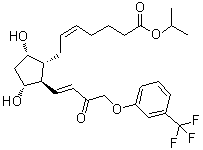 |
| Molecular Formula | C26H33F3O6 |
| Molecular Weight | 498.53 |
| CAS Registry Number | 404830-45-1 |
| EC Number | 690-685-8 |
| SMILES | CC(C)OC(=O)CCC/C=CC[C@H]1[C@H](C[C@H]([C@@H]1/C=C/C(=O)COC2=CC=CC(=C2)C(F)(F)F)O)O |
| Solubility | Insoluble (5.5E-3 g/L) (25 °C), Calc.* |
|---|---|
| Density | 1.242±0.06 g/cm3 (20 °C 760 Torr), Calc.* |
| Boiling point | 577.5±50.0 °C 760 mmHg (Calc.)* |
| Flash point | 303.1±30.1 °C (Calc.)* |
| Index of refraction | 1.541 (Calc.)* |
| * | Calculated using Advanced Chemistry Development (ACD/Labs) Software. |
| Hazard Symbols |  GHS07 Warning Details GHS07 Warning Details | ||||||||
|---|---|---|---|---|---|---|---|---|---|
| Risk Statements | H302 Details | ||||||||
| Safety Statements | P264-P270-P301+P317-P330-P501 Details | ||||||||
| Hazard Classification | |||||||||
| |||||||||
| SDS | Available | ||||||||
 chemBlink Chemical Story
|
15-Ketotravoprost is an oxidized analogue of travoprost, a synthetic prostaglandin F2α (PGF2α) derivative used in ophthalmology for lowering intraocular pressure in glaucoma and ocular hypertension. The compound is characterized by the presence of a ketone functional group at the C15 position of the prostaglandin backbone, replacing the corresponding hydroxyl group found in related prostaglandin analogues. Travoprost and its related prostaglandin analogues are structurally derived from endogenous prostaglandins, which are lipid mediators biosynthesized from arachidonic acid. These molecules regulate a wide range of physiological processes, including inflammation, vascular tone, and smooth muscle contraction. In the eye, prostaglandin analogues are particularly important for modulating aqueous humor dynamics and thereby influencing intraocular pressure. 15-Ketotravoprost is typically understood as a metabolically oxidized form of travoprost, where the hydroxyl group at carbon 15 is converted to a carbonyl (ketone). This type of oxidation can occur through enzymatic pathways involving dehydrogenase activity, as prostaglandins are known to undergo extensive metabolic transformations in ocular and systemic tissues. The change from hydroxyl to ketone alters both the hydrogen-bonding capacity and stereochemical interaction potential of the molecule. In prostaglandin biology, the C15 position is a critical stereocenter that strongly influences receptor binding. The native prostaglandin F2α framework contains a 15-hydroxyl group whose stereochemistry is essential for high-affinity interaction with prostanoid FP receptors. Conversion to a ketone removes this stereocenter and changes the electronic properties of the functional group, typically reducing or eliminating agonist activity at FP receptors compared with the parent active acid forms. Travoprost itself is administered as an ester prodrug, which is hydrolyzed in ocular tissues to release the active free acid. The free acid form binds prostanoid FP receptors located in the ciliary body and other ocular tissues. Activation of these receptors leads to remodeling of the extracellular matrix within the uveoscleral outflow pathway and, in some cases, the trabecular meshwork, resulting in increased outflow of aqueous humor and reduced intraocular pressure. 15-Ketotravoprost, as an oxidized derivative, is generally considered part of the metabolic degradation pathway rather than the primary pharmacologically active species. Prostaglandins are rapidly metabolized in vivo through oxidation, reduction, and beta-oxidation–like processes, which serve to terminate biological activity and facilitate elimination. Oxidation at C15 is one of the key steps in inactivation of prostaglandin signaling. From a structural perspective, prostaglandin analogues such as travoprost contain a cyclopentane core with two aliphatic side chains and multiple hydroxyl groups. The stereochemistry of these substituents is critical for receptor recognition. Modification of a hydroxyl group to a ketone at a stereocenter significantly alters the three-dimensional shape and hydrogen-bonding pattern of the molecule. The physicochemical properties of 15-ketotravoprost are influenced by the increased polarity of the ketone group relative to the hydroxyl it replaces. However, the molecule remains largely lipophilic due to its long hydrocarbon backbone. This amphiphilic balance is characteristic of prostaglandin derivatives and contributes to their ability to partition into biological membranes. In the broader context of prostaglandin pharmacology, oxidized metabolites such as 15-keto derivatives are important for understanding drug metabolism, duration of action, and tissue clearance. They help define the metabolic stability of prostaglandin analogues and provide insight into enzymatic pathways involved in ocular drug disposition. Overall, 15-Ketotravoprost is an oxidized metabolite of travoprost featuring a ketone substitution at the C15 position of the prostaglandin backbone. It is associated with metabolic inactivation of prostaglandin signaling and illustrates the role of oxidative transformation in regulating the biological activity and elimination of prostaglandin-based ophthalmic agents. |
| Market Analysis Reports |