
Online Database of Chemicals from Around the World
| INA Pharmaceuticals Pvt. Ltd. | India | |||
|---|---|---|---|---|
 | inapharma.in | |||
 | +91 7815933367 | |||
 | rd@inapharma.in | |||
| Chemical manufacturer since 2018 | ||||
| chemBlink Standard supplier since 2026 | ||||
| Classification | Pharmaceutical intermediate >> Heterocyclic compound intermediate >> Piperazine |
|---|---|
| Name | Piperazine-2,6-dione hydrochloride |
| Molecular Structure | 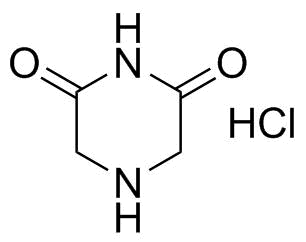 |
| Molecular Formula | C4H7ClN2O2 |
| Molecular Weight | 150.56 |
| CAS Registry Number | 35975-30-5 |
| EC Number | 889-816-3 |
| SMILES | C1C(=O)NC(=O)CN1.Cl |
| Hazard Symbols |  GHS07 Warning Details GHS07 Warning Details | ||||||||||||||||||||
|---|---|---|---|---|---|---|---|---|---|---|---|---|---|---|---|---|---|---|---|---|---|
| Risk Statements | H302-H315-H319-H335 Details | ||||||||||||||||||||
| Safety Statements | P261-P264-P264+P265-P270-P271-P280-P301+P317-P302+P352-P304+P340-P305+P351+P338-P319-P321-P330-P332+P317-P337+P317-P362+P364-P403+P233-P405-P501 Details | ||||||||||||||||||||
| Hazard Classification | |||||||||||||||||||||
| |||||||||||||||||||||
 chemBlink Chemical Story
|
Piperazine-2,6-dione hydrochloride, CAS 35975-30-5, is the hydrochloride salt of piperazine-2,6-dione, a small nitrogen-containing heterocycle with two carbonyl groups incorporated into a six-membered ring. Its molecular formula is C4H7ClN2O2 and its molecular weight is 150.56. Although it is primarily encountered as a research and synthetic building block rather than as a finished pharmaceutical or industrial product, the underlying piperazine-2,6-dione structure belongs to a chemically interesting family of cyclic diamides with important connections to medicinal chemistry. The parent compound, piperazine-2,6-dione, can be viewed as a six-membered heterocyclic ring containing two nitrogen atoms and two amide carbonyl groups. This arrangement gives the molecule characteristics of both a nitrogen heterocycle and a cyclic diamide. The hydrochloride form represents protonation of the basic portion of the molecule accompanied by chloride as the counterion. Commercial suppliers consequently list CAS 35975-30-5 as piperazine-2,6-dione hydrochloride or 2,6-piperazinedione hydrochloride and supply it principally as a synthesis or research building block. Piperazine-2,6-dione chemistry is especially interesting because the ring is closely related to the bisdioxopiperazine family. Bisdioxopiperazines contain two such cyclic dione units linked through an appropriate molecular framework. One of the best-known members is dexrazoxane, a clinically used cardioprotective drug associated with anthracycline chemotherapy. This connection has made piperazine-2,6-dione a useful starting framework for researchers interested in preparing and modifying bisdioxopiperazine structures. In 2016, Roh and coworkers reported an efficient large-scale preparation of piperazine-2,6-dione and demonstrated its synthetic utility by using it to prepare a novel dexrazoxane analogue. Their work emphasized inexpensive starting materials, satisfactory yields, convenient isolation, and avoidance of chromatographic purification. The study is particularly valuable because it provides direct published evidence for the role of piperazine-2,6-dione as a practical synthetic intermediate rather than assigning speculative biological activity to the simple ring itself. Dexrazoxane provides the broader medicinal context. Anthracyclines such as doxorubicin are highly important anticancer agents, but their clinical use can be limited by cumulative cardiotoxicity. Dexrazoxane belongs to the bisdioxopiperazine class and has been used clinically to reduce anthracycline-associated cardiac injury in specified settings. Researchers have therefore investigated related structures in an effort to understand how changes in the bisdioxopiperazine framework affect chemical and biological properties. This is where a simple intermediate such as piperazine-2,6-dione becomes useful. Medicinal chemistry often proceeds by breaking a complicated molecular target into smaller fragments that can be prepared, modified, and reassembled. A small heterocyclic building block may have little fame or practical application by itself, yet it can provide the structural foundation needed to explore a much more complex pharmacophore. The two carbonyl groups in the ring are also important from the perspective of synthetic chemistry. Together with the nitrogen atoms, they create several positions at which substituents can be introduced or the heterocyclic framework incorporated into larger structures. Roh and coworkers noted that their synthetic procedure could be adapted to prepare 1-substituted piperazine-2,6-dione derivatives, demonstrating how the simple ring can serve as a platform for structural diversification. It is nevertheless important to distinguish the chemistry of the parent ring from that of molecules derived from it. Piperazine-2,6-dione hydrochloride should not be described as dexrazoxane, as a cardioprotective drug, or as having the pharmacological properties of dexrazoxane. The relationship is synthetic and structural: this small heterocycle provides chemistry that can be incorporated into more elaborate molecules whose biological properties must be evaluated independently. That distinction illustrates a fundamental principle of medicinal chemistry. The molecules appearing in laboratory catalogs are often not medicines themselves. They are the vocabulary from which medicinal chemists construct and test new molecular ideas. Some provide aromatic fragments, some introduce stereochemistry, and others, such as piperazine-2,6-dione, provide an entire heterocyclic framework. Piperazine-2,6-dione hydrochloride therefore represents the less visible infrastructure behind drug discovery. Its structure is simple, its commercial role is largely that of a research building block, and it may never appear in a finished medicine. Yet the chemistry of its ring has helped researchers construct molecules related to an important class of cardioprotective agents. In medicinal chemistry, a small ring can sometimes be valuable not because of what it does itself, but because of what scientists can build around it. References 1. Roh, J.; Karabanovich, G.; Novakova, V.; Simunek, T.; Vavrova, K. (2016). "Large-Scale Synthesis of Piperazine-2,6-dione and Its Use in the Synthesis of Dexrazoxane Analogues." Synthesis, 48, 4580-4588. https://doi.org/10.1055/s-0035-1562618 2. U.S. National Library of Medicine, PubChem. Piperazine-2,6-dione hydrochloride, CID 12476478. CAS 35975-30-5. 3. LGC Standards. 2,6-Piperazinedione Hydrochloride, CAS 35975-30-5. Product category: Building Blocks / Synthesis Tools. |
| Market Analysis Reports |