
Online Database of Chemicals from Around the World
| BOC Sciences | USA | |||
|---|---|---|---|---|
 | www.bocsci.com | |||
 | +1 (631) 485-4226 | |||
 | +1 (631) 614-7828 | |||
 | info@bocsci.com | |||
| Chemical manufacturer | ||||
| chemBlink Standard supplier since 2010 | ||||
| Chembridge International Corp. Taipei / Dongguan / Nanjing | China | |||
|---|---|---|---|---|
| www.chembridge.com.tw | |||
| +886 (2) 2649-6320 +86 (769) 2250-4087 +86 (25) 8471-2192 | |||
| +886 (2) 2704-3915 / +86 (769) 2246-8225 / +86 (25) 8471-2052 | |||
| cnservice@chembridge.net | |||
| Chemical manufacturer | ||||
| chemBlink Standard supplier since 2011 | ||||
| Hangzhou Leap Chem Co., Ltd. | China | |||
|---|---|---|---|---|
| www.leapchem.com | |||
| +86 (571) 8771-1850 | |||
| market19@leapchem.com | |||
 | QQ Chat | |||
| Chemical manufacturer since 2006 | ||||
| chemBlink Standard supplier since 2015 | ||||
| Nanjing Wali Chemical Technology Co., Ltd. | China | |||
|---|---|---|---|---|
| www.njwali.com | |||
| 18005141382 | |||
| 18005141382@163.com | |||
| QQ Chat | |||
 | WeChat: 18005141382 | |||
| Chemical manufacturer since 2008 | ||||
| chemBlink Standard supplier since 2026 | ||||
| Classification | Organic raw materials >> Heterocyclic compound >> Triazines |
|---|---|
| Name | 2-(4-Methoxyphenyl)-4,6-bis(trichloromethyl)-1,3,5-triazine |
| Molecular Structure | 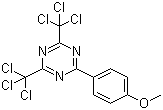 |
| Molecular Formula | C12H7Cl6N3O |
| Molecular Weight | 421.92 |
| CAS Registry Number | 3584-23-4 |
| EC Number | 222-711-7 |
| SMILES | COC1=CC=C(C=C1)C2=NC(=NC(=N2)C(Cl)(Cl)Cl)C(Cl)(Cl)Cl |
| Hazard Symbols |  GHS07 Warning Details | ||||||||||||
|---|---|---|---|---|---|---|---|---|---|---|---|---|---|
| Risk Statements | H315-H319 Details | ||||||||||||
| Safety Statements | P264-P264+P265-P280-P302+P352-P305+P351+P338-P321-P332+P317-P337+P317-P362+P364 Details | ||||||||||||
| Hazard Classification | |||||||||||||
| |||||||||||||
| SDS | Available | ||||||||||||
 chemBlink Chemical Story
|
A light-sensitive formulation does not require every component to absorb the light used for exposure. That distinction is central to the story of 2-(4-methoxyphenyl)-4,6-bis(trichloromethyl)-1,3,5-triazine, CAS 3584-23-4. It combines a methoxy-substituted aromatic group with a triazine bearing two trichloromethyl groups. Its documented role in photopolymer research is particularly useful for understanding how a sensitizer and a reactive component can work together. A specific historical example appears in United States patent US5147758A, published in 1992 and entitled Red sensitive photopolymerizable compositions. The document identifies this exact compound as triazine T-7 and explicitly provides its CAS number. It places the triazine within a multicomponent formulation, alongside a sensitizing dye, other initiating components, polymerizable material and a binder. This is stronger evidence than a generic statement that all chlorinated triazines are useful photoinitiators, because the named substance can be traced to a defined experimental system. The patent's comparative examples include T-7 in work on holographic recording. A coating receives an optical exposure and subsequently undergoes additional processing to form the recorded material. The relevant output is a property of the complete film and process. The observation does not mean that a neat sample of T-7 necessarily has the same response to red light. In a sensitized system, the dye can provide the optical entry point, while the other components determine whether excitation is converted into productive chemistry. The structure helps explain the separation of roles. The methoxyphenyl group influences the electronic character of the aromatic-triazine framework. The trichloromethyl groups introduce multiple carbon-chlorine bonds into the molecule and are associated with the reactive behavior of this photoinitiator family. Changing one substituent can affect light absorption or interaction with a sensitizer without removing the reactive framework. However, a structural argument alone cannot supply a numerical absorption maximum, quantum yield or formulation sensitivity. There is also a distinction between initiating radical polymerization and generating acid. Halogenated triazines are discussed in more than one photochemical context, but identifying a compound family does not establish which reactive species controls a particular formulation. The polymerizable groups, co-components and exposure conditions have to be specified. This is why the patent's evidence is most accurately described as the use of the exact triazine in a sensitized photopolymerizable composition, rather than as a universal performance claim. The compound's practical story concerns a cooperative chemical system. The absorbing component, reactive partners and film-forming material jointly determine the recording response. The verified patent example documents one such application, without establishing present commercial adoption, an exact discovery date or suitability for every modern curing source. Its value as a chemical example is that it makes the boundary between molecular identity and formulation performance unusually clear. References: 1. PubChem. 2-(4-Methoxyphenyl)-4,6-bis(trichloromethyl)-1,3,5-triazine, CID 19163; CAS 3584-23-4. https://pubchem.ncbi.nlm.nih.gov/compound/19163 2. Red sensitive photopolymerizable compositions. United States patent US5147758A. Published 1992-09-15. Triazine T-7 and comparative recording examples. https://patents.google.com/patent/US5147758A/en |
| Market Analysis Reports |