
Online Database of Chemicals from Around the World
| Nanjing Chemph Co., Ltd. | China | |||
|---|---|---|---|---|
 | www.chemph.com | |||
 | +86 (25) 8622-8738 | |||
 | +86 (25) 8622-7638 | |||
 | chemsigma_sactg@outlook.com | |||
| Chemical manufacturer | ||||
| chemBlink Standard supplier since 2009 | ||||
| Wuhan Kemi-works Chemical Co., Ltd. | China | |||
|---|---|---|---|---|
| www.kemiworks.net | |||
| +86 (27) 8573-6489 | |||
| +86 (27) 8573-6485 | |||
| info@kemiworks.net sales@kemiworks.com | |||
| Chemical manufacturer | ||||
| chemBlink Standard supplier since 2011 | ||||
| wuhan chemi Pharmacy Chemical Technology Co., Ltd. | China | |||
|---|---|---|---|---|
| www.chemipharm.com.cn | |||
| +86 13971619949 | |||
| gmn424@chemipharm.com.cn | |||
 | QQ Chat | |||
 | WeChat: 13971619949 | |||
| Chemical manufacturer since 2014 | ||||
| chemBlink Standard supplier since 2026 | ||||
| Ryan Scientific, Inc. | USA | |||
|---|---|---|---|---|
| www.ryansci.com | |||
| +1 (843)-884-4911 | |||
| +1 (843) 884-5568 | |||
| sales@ryansci.com | |||
| Chemical manufacturer | ||||
| Classification | Organic raw materials >> Carboxylic compounds and derivatives |
|---|---|
| Name | 1,3-Thiazolane-2,4-dicarboxylic acid |
| Synonyms | Thiazolidine-2,4-dicarboxylic acid |
| Molecular Structure | 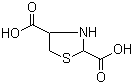 |
| Molecular Formula | C5H7NO4S |
| Molecular Weight | 177.18 |
| CAS Registry Number | 30097-06-4 |
| EC Number | 250-048-3 |
| SMILES | C1C(NC(S1)C(=O)O)C(=O)O |
| Density | 1.6±0.1 g/cm3 Calc.* |
|---|---|
| Boiling point | 524.3±50.0 °C 760 mmHg (Calc.)* |
| Flash point | 270.9±30.1 °C (Calc.)* |
| Index of refraction | 1.607 (Calc.)* |
| * | Calculated using Advanced Chemistry Development (ACD/Labs) Software. |
| Hazard Symbols |  GHS07 Warning Details GHS07 Warning Details | ||||||||||||||||
|---|---|---|---|---|---|---|---|---|---|---|---|---|---|---|---|---|---|
| Risk Statements | H315-H319-H335 Details | ||||||||||||||||
| Safety Statements | P261-P264-P264+P265-P271-P280-P302+P352-P304+P340-P305+P351+P338-P319-P321-P332+P317-P337+P317-P362+P364-P403+P233-P405-P501 Details | ||||||||||||||||
| Hazard Classification | |||||||||||||||||
| |||||||||||||||||
| SDS | Available | ||||||||||||||||
 chemBlink Chemical Story
|
1,3-Thiazolane-2,4-dicarboxylic acid is a saturated five-membered heterocyclic compound containing one sulfur atom and one nitrogen atom in the ring, with carboxylic acid substituents at the 2- and 4-positions. The thiazolane framework is the fully hydrogenated analogue of thiazole, and it is a flexible heterocycle commonly encountered in synthetic and bioorganic chemistry due to the presence of both a soft sulfur donor and a nitrogen atom within a constrained ring system. The formation and study of thiazolane derivatives are closely related to classical heterocycle chemistry involving amino thiols and carbonyl compounds. In many cases, thiazolane rings can be formed through cyclization reactions between cysteine-like substrates and aldehydes or ketones, producing stable five-membered rings containing both nitrogen and sulfur. This structural motif is also relevant to amino acid chemistry and has been observed in derivatives of naturally occurring sulfur-containing biomolecules. In 1,3-thiazolane-2,4-dicarboxylic acid, the two carboxylic acid groups significantly increase the polarity and hydrogen-bonding capacity of the molecule. Carboxylic acids can exist in equilibrium between protonated and deprotonated forms depending on pH, and this acid–base behavior strongly influences solubility and intermolecular interactions. In aqueous environments, the compound is expected to readily form carboxylate salts, which enhances water solubility and ionic interactions. The heterocyclic ring itself is non-aromatic, meaning it does not possess a delocalized π-electron system. As a result, the ring is conformationally flexible compared with aromatic heterocycles. It typically adopts puckered conformations that reduce torsional strain. The presence of sulfur and nitrogen introduces heteroatom effects, including differences in electronegativity and lone pair availability, which influence the electronic distribution of the ring and its ability to engage in hydrogen bonding and coordination chemistry. The carboxylic acid substituents at positions 2 and 4 also introduce asymmetry in the electronic environment of the ring. These substituents are strongly electron-withdrawing through both inductive and resonance effects, which can influence the acidity of nearby functional groups and the overall stability of the molecule in different chemical environments. Compounds containing both carboxylic acid groups and heteroatoms such as nitrogen and sulfur are often of interest in coordination chemistry. The oxygen atoms of carboxylate groups can coordinate to metal ions, while the nitrogen and sulfur atoms in the ring may also participate in metal binding depending on geometry and oxidation state. As a result, such molecules can act as multidentate ligands capable of forming stable metal complexes, which are relevant in materials chemistry and catalysis research. From a physicochemical perspective, 1,3-thiazolane-2,4-dicarboxylic acid is expected to be a highly polar compound with strong hydrogen-bonding capability. The presence of two carboxylic acid groups allows for extensive intermolecular hydrogen bonding, which can lead to high melting points and crystalline solid-state structures. Solubility behavior is expected to be strongly dependent on pH, with increased solubility in basic conditions due to formation of carboxylate salts. In synthetic chemistry, thiazolane derivatives are often used as intermediates or scaffolds for further functionalization. The presence of two carboxylic acid groups provides convenient handles for derivatization, such as esterification or amide formation, enabling incorporation into larger molecular frameworks. The heterocyclic core can also be modified through oxidation or substitution reactions depending on synthetic strategy. Overall, 1,3-thiazolane-2,4-dicarboxylic acid is a saturated sulfur–nitrogen heterocycle bearing two carboxylic acid substituents, characterized by high polarity, conformational flexibility, and strong hydrogen-bonding capacity. Its significance lies in its structural versatility as a multifunctional building block in heterocyclic and coordination chemistry, where both its ring heteroatoms and carboxyl groups can participate in a wide range of chemical interactions. References 2018. Thermokinetic profile of NDM-1 and its inhibition by small carboxylic acids. Bioscience Reports. URL: https://www.ncbi.nlm.nih.gov/pmc/articles/PMC5897741 2013. Pharmacological evaluation of some novel synthesized compounds derived from spiro(cyclohexane-1,2′-thiazolidines). Medicinal Chemistry Research. DOI: 10.1007/s00044-013-0830-y 2013. Synthesis and Chirality Control of Bulk Crystals and Nanocrystals: From a Right-Handed Nonpolar Chain to a Left-Handed Polar Chain. Inorganic Chemistry. DOI: 10.1021/ic302711b |
| Market Analysis Reports |