
Online Database of Chemicals from Around the World
| BOC Sciences | USA | |||
|---|---|---|---|---|
 | www.bocsci.com | |||
 | +1 (631) 485-4226 | |||
 | +1 (631) 614-7828 | |||
 | info@bocsci.com | |||
| Chemical manufacturer | ||||
| chemBlink Standard supplier since 2010 | ||||
| V-Ran Biotechnology Co., Ltd. | China | |||
|---|---|---|---|---|
| www.v-ran.com | |||
| +86 (0531) 8851-6570 | |||
| jt@weiran-sw.com | |||
 | WeChat: 86-17753131700 | |||
| Chemical manufacturer since 2014 | ||||
| chemBlink Standard supplier since 2026 | ||||
| Chem-Impex International, Inc. | USA | |||
|---|---|---|---|---|
| www.chemimpex.com | |||
| +1 (630) 766-2112 | |||
| +1 (630) 766-2218 | |||
| sales@chemimpex.com | |||
| Chemical manufacturer since 1981 | ||||
| HDH Pharma, Inc. | USA | |||
|---|---|---|---|---|
| www.hdhpharma.com | |||
| +1 (858) 451-2028 | |||
| +1 (858) 451-2048 | |||
| catalog@hdhpharma.com | |||
| Chemical manufacturer since 2008 | ||||
| Anichem LLC | USA | |||
|---|---|---|---|---|
| www.anichemllc.com | |||
| +1 (732) 821-6500 | |||
| +1 (732) 821-6008 | |||
| sales@anichemllc.com | |||
| Chemical manufacturer | ||||
| Classification | Organic raw materials >> Carboxylic compounds and derivatives >> Carboxylic esters and their derivatives |
|---|---|
| Name | Methyl 4-(piperidin-4-yl)benzoate |
| Synonyms | 4-Piperidin-4-ylbenzoic acid methyl ester |
| Molecular Structure | 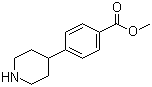 |
| Molecular Formula | C13H17NO2 |
| Molecular Weight | 219.28 |
| CAS Registry Number | 281235-04-9 |
| EC Number | 635-428-2 |
| SMILES | COC(=O)C1=CC=C(C=C1)C2CCNCC2 |
| Density | 1.1±0.1 g/cm3 Calc.* |
|---|---|
| Boiling point | 340.3±42.0 °C 760 mmHg (Calc.)* |
| Flash point | 159.6±27.9 °C (Calc.)* |
| Index of refraction | 1.524 (Calc.)* |
| * | Calculated using Advanced Chemistry Development (ACD/Labs) Software. |
| Hazard Symbols |  GHS07 Warning Details GHS07 Warning Details | ||||||||||||||||
|---|---|---|---|---|---|---|---|---|---|---|---|---|---|---|---|---|---|
| Risk Statements | H315-H319-H335 Details | ||||||||||||||||
| Safety Statements | P261-P305+P351+P338 Details | ||||||||||||||||
| Hazard Classification | |||||||||||||||||
| |||||||||||||||||
| SDS | Available | ||||||||||||||||
 chemBlink Chemical Story
|
Methyl 4-(piperidin-4-yl)benzoate (CAS 281235-04-9) combines a piperidine ring with a para-substituted methyl benzoate. Both motifs are common in medicinal chemistry: piperidine provides a basic, three-dimensional nitrogen-containing ring that can be further substituted, while the aromatic ester offers a rigid linker and a functional group that can be hydrolyzed or transformed into amides and other derivatives. The carbon-carbon bond connecting the piperidine 4-position to the para position of the benzene ring creates a useful scaffold for building larger molecules without placing the ring nitrogen directly next to the aromatic system. Public exact-CAS information is largely catalog and synthesis based, so the compound should be treated as a pharmaceutical/research intermediate rather than assigned an unsupported biological target. Exact chemical identity matters because free forms, salts, stereoisomers, hydrates, metabolites, intermediates, and finished products can carry different registry numbers even when their names are closely related. These distinctions affect molecular weight, physical properties, analytical standards, formulation, and interpretation of literature. A reliable chemical database therefore follows the exact substance instead of automatically transferring every property of a related form. Functional groups are also a map of intended reactivity. Carbonyls, alcohols, amines, halides, alkenes, and heterocycles provide different opportunities for bond formation, while hydrocarbon frameworks influence shape and solubility. In multistep synthesis, the usefulness of an intermediate often comes from being able to transform one position selectively while leaving another group available for a later operation. Modern chemical development depends as much on characterization as on synthesis. Identity, purity, stereochemistry, water or salt content, and process-related impurities may all need control. Well-characterized intermediates and reference materials therefore matter even when they never become a final commercial product: they make complex manufacturing and research reproducible. A responsible Chemical Story distinguishes documented use from structural possibility. A familiar molecular scaffold can suggest a hypothesis, but resemblance alone does not establish a biological target, approved indication, or commercial application. When exact-CAS literature is limited, verified chemistry and clearly documented uses are more informative than speculation. Seen broadly, practical performance emerges from the whole molecular system. Structure, stereochemistry, physical form, synthetic route, reaction environment, and, for biological molecules, metabolism can all determine what a substance actually does. Connecting these details to a documented historical, industrial, or biological role turns a registry entry into a meaningful chemical story. Exact chemical identity matters because free forms, salts, stereoisomers, hydrates, metabolites, intermediates, and finished products can carry different registry numbers even when their names are closely related. These distinctions affect molecular weight, physical properties, analytical standards, formulation, and interpretation of literature. A reliable chemical database therefore follows the exact substance instead of automatically transferring every property of a related form. Functional groups are also a map of intended reactivity. Carbonyls, alcohols, amines, halides, alkenes, and heterocycles provide different opportunities for bond formation, while hydrocarbon frameworks influence shape and solubility. In multistep synthesis, the usefulness of an intermediate often comes from being able to transform one position selectively while leaving another group available for a later operation. Modern chemical development depends as much on characterization as on synthesis. Identity, purity, stereochemistry, water or salt content, and process-related impurities may all need control. Well-characterized intermediates and reference materials therefore matter even when they never become a final commercial product: they make complex manufacturing and research reproducible. References: 1. Specialist chemical catalogs. CAS 281235-04-9 identity. 2. General medicinal-chemistry literature on piperidine-containing building blocks. |
| Market Analysis Reports |