
Online Database of Chemicals from Around the World
| Shijiazhuang Lemandou Chemicals Co., Ltd. | China | |||
|---|---|---|---|---|
 | www.lemandou.com | |||
 | +86 (311) 8778-7400 | |||
 | +86 (311) 8778-7409 | |||
 | sales@lemandou.com lemandou@hotmail.com | |||
| Chemical manufacturer since 2002 | ||||
| chemBlink Standard supplier since 2007 | ||||
| Simagchem Corporation | China | |||
|---|---|---|---|---|
| www.simagchem.com | |||
| +86 13806087780 | |||
| +86 (592) 268-0237 | |||
| sale@simagchem.com | |||
| Chemical manufacturer since 2002 | ||||
| chemBlink Standard supplier since 2008 | ||||
| Hefei TNJ Chemical Industry Co., Ltd. | China | |||
|---|---|---|---|---|
| www.tnjchem.com | |||
| +86 (551) 6541-8684 | |||
| +86 (551) 6541-8697 | |||
| sales@tnjchem.com | |||
| Chemical manufacturer since 2001 | ||||
| chemBlink Standard supplier since 2010 | ||||
| Wuhan Silworld Chemical Co., Ltd. | China | |||
|---|---|---|---|---|
| www.silworldchemical.com | |||
| +86 (27) 8561-3400 +86 15827173649 | |||
| +86 (27) 8561-3419 | |||
| info@silworldchemical.com | |||
 | QQ Chat | |||
| Chemical manufacturer since 2012 | ||||
| chemBlink Standard supplier since 2010 | ||||
| Ningbo EST Chemical Co., Ltd. | China | |||
|---|---|---|---|---|
| www.estchemical.com | |||
| +86 18868651166 | |||
| +86 (574) 5670-2932 | |||
| sales@estchemical.com | |||
| Chemical manufacturer | ||||
| chemBlink Standard supplier since 2010 | ||||
| BOC Sciences | USA | |||
|---|---|---|---|---|
| www.bocsci.com | |||
| +1 (631) 485-4226 | |||
| +1 (631) 614-7828 | |||
| info@bocsci.com | |||
| Chemical manufacturer | ||||
| chemBlink Standard supplier since 2010 | ||||
| Shanghai Fuqi Industrial & Trading Co., Ltd. | China | |||
|---|---|---|---|---|
| www.fqsh.com | |||
| +86 (21) 6631-0933 | |||
| +86 (21) 6631-0933 | |||
| fqchem@126.com | |||
| Chemical distributor since 2002 | ||||
| chemBlink Standard supplier since 2013 | ||||
| Hangzhou Leap Chem Co., Ltd. | China | |||
|---|---|---|---|---|
| www.leapchem.com | |||
| +86 (571) 8771-1850 | |||
| market19@leapchem.com | |||
| QQ Chat | |||
| Chemical manufacturer since 2006 | ||||
| chemBlink Standard supplier since 2015 | ||||
| Shanghai Haohong Biomedical Technology Co., Ltd. | China | |||
|---|---|---|---|---|
| www.leyan.com | |||
| +86 4008210725 | |||
| malulu@leyan.com | |||
| QQ Chat | |||
| Chemical manufacturer since 2011 | ||||
| chemBlink Standard supplier since 2022 | ||||
| Hubei Yihua New Materials Technology Co., Ltd. | China | |||
|---|---|---|---|---|
| yianchem.com | |||
| +44 07892 880081 | |||
| contact@yianchem.com | |||
 | WhatsApp:+44 07892 880081 | |||
| Chemical distributor since 2025 | ||||
| chemBlink Standard supplier since 2026 | ||||
| Shanghai Worldyang Chemical Co., Ltd. | China | |||
|---|---|---|---|---|
| www.worldyachem.com | |||
| +86 13651600618 +86 (21) 5679-5779 | |||
| +86 (21) 5679-5266 | |||
| sales7777@worldyachem.com | |||
| QQ Chat | |||
 | WeChat: 13651600618 | |||
| WhatsApp:+86 13651600618 | |||
| Chemical manufacturer since 2012 | ||||
| Chiron AS | Norway | |||
|---|---|---|---|---|
| www.chiron.no | |||
| +47 (73) 874-490 | |||
| +47 (73) 874-499 | |||
| chiron@chiron.no | |||
| Chemical manufacturer | ||||
| Classification | Surfactant >> Anionic surfactant >> Sulfonate type |
|---|---|
| Name | Sodium dodecylbenzenesulphonate |
| Synonyms | Sodium 4-dodecylbenzenesulphonate; Dodecylbenzenesulfonic acid sodium salt |
| Molecular Structure | 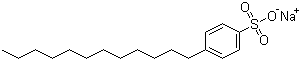 |
| Molecular Formula | C18H29NaO3S |
| Molecular Weight | 348.48 |
| CAS Registry Number | 25155-30-0 |
| EC Number | 246-680-4 |
| SMILES | CCCCCCCCCCCCC1=CC=CC=C1S(=O)(=O)[O-].[Na+] |
| Hazard Symbols |   GHS05;GHS07 Danger Details GHS05;GHS07 Danger Details | ||||||||||||||||||||||||||||||||||||||||||||||||||||||||
|---|---|---|---|---|---|---|---|---|---|---|---|---|---|---|---|---|---|---|---|---|---|---|---|---|---|---|---|---|---|---|---|---|---|---|---|---|---|---|---|---|---|---|---|---|---|---|---|---|---|---|---|---|---|---|---|---|---|
| Risk Statements | H302-H312-H315-H318-H319-H335-H412 Details | ||||||||||||||||||||||||||||||||||||||||||||||||||||||||
| Safety Statements | P261-P264-P264+P265-P270-P271-P273-P280-P301+P317-P302+P352-P304+P340-P305+P351+P338-P305+P354+P338-P317-P319-P321-P330-P332+P317-P337+P317-P362+P364-P403+P233-P405-P501 Details | ||||||||||||||||||||||||||||||||||||||||||||||||||||||||
| Hazard Classification | |||||||||||||||||||||||||||||||||||||||||||||||||||||||||
| |||||||||||||||||||||||||||||||||||||||||||||||||||||||||
| SDS | Available | ||||||||||||||||||||||||||||||||||||||||||||||||||||||||
 chemBlink Chemical Story
|
Sodium dodecylbenzenesulphonate is an anionic surfactant composed of a hydrophobic alkylbenzene group and a hydrophilic sulfonate head group associated with a sodium counterion. It belongs to the class of alkylbenzene sulfonates, which are among the most widely used synthetic surfactants in industrial and domestic applications, particularly in detergents and cleaning formulations. The development of alkylbenzene sulfonate surfactants began in the early to mid-twentieth century, when advances in petrochemical processing enabled the large-scale production of linear and branched alkylbenzenes. Sulfonation of these aromatic hydrocarbons followed by neutralization with sodium hydroxide or similar bases led to the formation of sodium alkylbenzene sulfonates. These compounds became key components of modern synthetic detergents, replacing earlier soap-based systems in many applications due to their improved performance in hard water and a broader range of operating conditions. Structurally, sodium dodecylbenzenesulphonate consists of a dodecyl (C₁₂) hydrocarbon chain attached to a benzene ring, which is further substituted with a sulfonate group. The sulfonate moiety is strongly polar and remains ionized over a wide pH range, contributing to the compound’s high water solubility and surfactant behavior. The long alkyl chain provides hydrophobic character, enabling interaction with oils, greases, and nonpolar substances. The amphiphilic nature of sodium dodecylbenzenesulphonate allows it to reduce surface tension in aqueous solutions. Molecules of this surfactant tend to accumulate at interfaces between water and nonpolar phases, such as air or oil. At sufficient concentrations, they form micelles, which are aggregates in which hydrophobic tails are sequestered inward while hydrophilic sulfonate groups remain in contact with water. This micellization process is fundamental to its cleaning and emulsifying properties. In detergent applications, sodium dodecylbenzenesulphonate plays a central role in removing organic soils and oils from surfaces. The surfactant molecules solubilize hydrophobic contaminants within micelles, allowing them to be dispersed in water and washed away. Its effectiveness in both soft and hard water conditions is due to the stability of the sulfonate group, which does not readily form insoluble precipitates with calcium or magnesium ions, unlike traditional soap carboxylates. From a chemical standpoint, the benzene ring provides structural rigidity and contributes to the overall hydrophobic character of the molecule. The position of the alkyl chain on the aromatic ring can vary depending on the synthetic route, often resulting in a mixture of positional isomers in commercial products. The sulfonation step introduces the strongly acidic sulfonate group, which remains fully dissociated in aqueous solution, giving the molecule its anionic surfactant properties. The physical properties of sodium dodecylbenzenesulphonate are strongly influenced by its amphiphilic structure. It typically appears as a solid or viscous material depending on formulation and purity. In aqueous solution, it exhibits strong foaming behavior and significant surface activity at relatively low concentrations, characteristics that are important in household detergents, industrial cleaners, and emulsification systems. Beyond household cleaning products, sodium dodecylbenzenesulphonate is also used in industrial processes such as textile processing, leather treatment, and emulsion polymerization. In polymer chemistry, it can act as an emulsifying agent to stabilize latex dispersions, enabling controlled polymer particle formation in aqueous media. Environmental considerations have also played a role in the development and optimization of alkylbenzene sulfonate surfactants. Linear alkylbenzene sulfonates, including sodium dodecylbenzenesulphonate, are generally more biodegradable than earlier branched-chain analogues, making them more suitable for widespread use in consumer products. Overall, sodium dodecylbenzenesulphonate is a widely used anionic surfactant characterized by a hydrophobic alkylbenzene tail and a strongly hydrophilic sulfonate head group. Its significance lies in its ability to reduce surface tension, form micelles, and solubilize hydrophobic substances, making it a key ingredient in detergents, industrial formulations, and various cleaning and emulsification applications. References 2026. Hollow ZIF-8 microcapsules loaded with tannic acid for smart self-healing anticorrosion coatings. Surface Science and Technology. DOI: 10.1007/s44251-025-00118-0 2026. Beyond persistence: SERS-driven strategies for PFAS detection and monitoring. Nano Convergence. URL: https://www.ncbi.nlm.nih.gov/pmc/articles/PMC12957689 2026. High-performance photothermal conversion and thermal management via interfacial regulation of 3D network in BC/MXene films. Journal of Polymer Research. DOI: 10.1007/s10965-026-04824-7 |
| Market Analysis Reports |