
Online Database of Chemicals from Around the World
| Huangshan Taida Chemical Co., Ltd. | China | |||
|---|---|---|---|---|
 | www.td-chem.cn | |||
 | +86 (559) 213-0785 | |||
 | +86 (559) 213-1132 | |||
 | sale@td-chem.cn | |||
| Chemical manufacturer | ||||
| chemBlink Standard supplier since 2006 | ||||
| Huangshan Deping Chemical Co., Ltd. | China | |||
|---|---|---|---|---|
| www.depingchem.com | |||
| +86 (559) 651-0092 651-0095 | |||
| +86 (559) 673-3528 | |||
| janice@depingchem.com | |||
| Chemical manufacturer since 1998 | ||||
| chemBlink Standard supplier since 2006 | ||||
| F&F Chemical Co., Ltd. | China | |||
|---|---|---|---|---|
| www.fnfchem.com | |||
| +86 (10) 6444-6910 | |||
| +86 (10) 6444-6915 | |||
| heyifnfchem@163.com heyi@fnfchem.com | |||
 | QQ Chat | |||
| Chemical manufacturer since 1997 | ||||
| chemBlink Standard supplier since 2006 | ||||
| CAC Shanghai (Group) Co., Ltd. | China | |||
|---|---|---|---|---|
| www.cacch.com | |||
| +86 (21) 6239-8696 | |||
| +86 (21) 6239-3490 | |||
| service@cacch.com | |||
| Chemical distributor since 1992 | ||||
| chemBlink Standard supplier since 2006 | ||||
| Simagchem Corporation | China | |||
|---|---|---|---|---|
| www.simagchem.com | |||
| +86 13806087780 | |||
| +86 (592) 268-0237 | |||
| sale@simagchem.com | |||
| Chemical manufacturer since 2002 | ||||
| chemBlink Standard supplier since 2008 | ||||
| Hangzhou Right Chemical Co., Ltd. | China | |||
|---|---|---|---|---|
| www.ruikechem.com | |||
| +86 (571) 882-55188 | |||
| +86 (571) 8825-5208 | |||
| info@ruikechem.com | |||
| Chemical distributor since 2004 | ||||
| chemBlink Standard supplier since 2008 | ||||
| Huangshan Huahui Fine Chemical Co., Ltd. | China | |||
|---|---|---|---|---|
| www.huahuichem.com | |||
| +86 (559) 351-1812 | |||
| +86 (559) 351-6889 | |||
| sales@huahuichem.com | |||
| Chemical manufacturer | ||||
| chemBlink Standard supplier since 2008 | ||||
| Hefei TNJ Chemical Industry Co., Ltd. | China | |||
|---|---|---|---|---|
| www.tnjchem.com | |||
| +86 (551) 6541-8684 | |||
| +86 (551) 6541-8697 | |||
| sales@tnjchem.com | |||
| Chemical manufacturer since 2001 | ||||
| chemBlink Standard supplier since 2010 | ||||
| Ring Specialty Chemicals Inc. | Canada | |||
|---|---|---|---|---|
| www.ringchemicals.com | |||
| +1 (416) 493-6870 | |||
| info@ringchemicals.com | |||
| Chemical distributor | ||||
| chemBlink Standard supplier since 2010 | ||||
| BOC Sciences | USA | |||
|---|---|---|---|---|
| www.bocsci.com | |||
| +1 (631) 485-4226 | |||
| +1 (631) 614-7828 | |||
| info@bocsci.com | |||
| Chemical manufacturer | ||||
| chemBlink Standard supplier since 2010 | ||||
| Chembridge International Corp. Taipei / Dongguan / Nanjing | China | |||
|---|---|---|---|---|
| www.chembridge.com.tw | |||
| +886 (2) 2649-6320 +86 (769) 2250-4087 +86 (25) 8471-2192 | |||
| +886 (2) 2704-3915 / +86 (769) 2246-8225 / +86 (25) 8471-2052 | |||
| cnservice@chembridge.net | |||
| Chemical manufacturer | ||||
| chemBlink Standard supplier since 2011 | ||||
| Tianjin Icason Technology Co., Ltd. | China | |||
|---|---|---|---|---|
| www.icason.com | |||
| +86 (22) 6093-8150 | |||
| +86 (22) 2562-1236 | |||
| icason002@icason.com | |||
| Chemical distributor since 1990 | ||||
| chemBlink Standard supplier since 2014 | ||||
| LEAPChem | China | |||
|---|---|---|---|---|
| www.leapchem.com | |||
| +86 (571) 8771-1850 | |||
| market19@leapchem.com | |||
| QQ Chat | |||
| Chemical manufacturer since 2006 | ||||
| chemBlink Standard supplier since 2015 | ||||
| Guangzhou Taiji New Materials Co., Ltd.. | China | |||
|---|---|---|---|---|
| www.taijichem.com | |||
| +86 18620003222 | |||
| +86 (20) 8755-3522 | |||
| tailuck@qq.com | |||
| Chemical manufacturer since 2016 | ||||
| chemBlink Standard supplier since 2019 | ||||
| Riverland Trading LLC. | USA | |||
|---|---|---|---|---|
| www.riverlandtrading.com | |||
| +1 (336).944-2293 | |||
| bens@riverlandtrading.com | |||
| Chemical distributor | ||||
| chemBlink Standard supplier since 2023 | ||||
| Longwoods Chemical Company Limited | China | |||
|---|---|---|---|---|
| www.longwoods.cn | |||
| +86 (28) 6310-8508 | |||
| sale@longwoods.cn | |||
 | WhatsApp:+86 156 82536350 | |||
| Chemical distributor since 2022 | ||||
| chemBlink Standard supplier since 2026 | ||||
| Hangzhou Taixin pharmachem Co., Ltd. | China | |||
|---|---|---|---|---|
| www.taixinpharm.com | |||
| +86 (571) 8721-9022 8721-9021 | |||
| +86 (571) 8721-9118 | |||
| taixin@taixinpharm.com | |||
| Chemical manufacturer since 2001 | ||||
| Dalian Trico Chemical Co., Ltd. | China | |||
|---|---|---|---|---|
| www.tricochemical.com | |||
| +86 (411) 8751-8000 8751-9854 8751-9864 | |||
| +86 (411) 8751-9824 / 8751-9900 | |||
| jameswang@tricochemical.com | |||
| Chemical manufacturer since 2002 | ||||
| Classification | Chemical reagent >> Organic reagent >> Cyanate ester / isocyanate |
|---|---|
| Name | 1,3,5-Triglycidyl isocyanurate |
| Synonyms | 1,3,5-Tris(oxiranylmethyl)-1,3,5-triazine-2,4,6(1H,3H,5H)-trione; Araldite PT-810; Teroxirone; TGIC; XB 2615 |
| Molecular Structure | 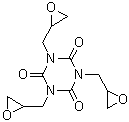 |
| Molecular Formula | C12H15N3O6 |
| Molecular Weight | 297.27 |
| CAS Registry Number | 2451-62-9 |
| EC Number | 219-514-3 |
| SMILES | C1C(O1)CN2C(=O)N(C(=O)N(C2=O)CC3CO3)CC4CO4 |
| Density | 1.6±0.1 g/cm3 Calc.* |
|---|---|
| Melting point | 108 °C (Expl.) |
| Boiling point | 501.1±15.0 °C 760 mmHg (Calc.)* |
| Flash point | 256.9±20.4 °C (Calc.)* |
| Solubility | water: <0.1 g/100 mL (20 °C) (Expl.) |
| Index of refraction | 1.635 (Calc.)* |
| * | Calculated using Advanced Chemistry Development (ACD/Labs) Software. |
| Hazard Symbols |    GHS05;GHS06;GHS08 Danger Details | ||||||||||||||||||||||||||||||||
|---|---|---|---|---|---|---|---|---|---|---|---|---|---|---|---|---|---|---|---|---|---|---|---|---|---|---|---|---|---|---|---|---|---|
| Risk Statements | H301-H317-H318-H331-H340-H373-H412 Details | ||||||||||||||||||||||||||||||||
| Safety Statements | P203-P260-P261-P264-P264+P265-P270-P271-P272-P273-P280-P301+P316-P302+P352-P304+P340-P305+P354+P338-P316-P317-P318-P319-P321-P330-P333+P317-P362+P364-P403+P233-P405-P501 Details | ||||||||||||||||||||||||||||||||
| Hazard Classification | |||||||||||||||||||||||||||||||||
| |||||||||||||||||||||||||||||||||
| SDS | Available | ||||||||||||||||||||||||||||||||
 chemBlink Chemical Story
|
Triglycidyl isocyanurate, commonly shortened to TGIC, places three reactive epoxide rings around a central isocyanurate framework. Each of the three ring nitrogens carries a glycidyl group. The center is a six-membered ring containing three carbonyl groups, while each outer epoxide is a strained three-membered ring containing oxygen. The formula C₁₂H₁₅N₃O₆ counts both sets of oxygens. It is the three outer epoxides, rather than three free isocyanate groups, that explain the best-known curing application. The word isocyanurate can otherwise be misleading. An isocyanate functional group has the connection –N=C=O. An isocyanurate is a ring framework with a different bonding pattern. The name of the central ring does not mean that TGIC supplies three unreacted isocyanate groups. Distinguishing those structures is necessary to understand which reaction links the curing agent to a polymer. Its documented industrial context is polyester powder coating. Technical information for carboxyl-functional polyester resins lists TGIC among compatible curing partners. The powder is applied as a formulated material, then heated so that the resin can flow and the curing reactions can build a network. This is different from simply drying a solution of an already completed polymer film. Flow, film formation and chemical conversion all contribute to the outcome, but describe different processes. A carboxyl group can react with an epoxide to open its three-membered ring, forming an ester linkage and a hydroxyl-containing product. Because TGIC has three epoxide functions, it can connect more than one polymer segment when the other components provide suitable carboxyl groups. That functionality allows a small molecule to contribute to a much larger three-dimensional network. The product is no longer a collection of unchanged TGIC molecules merely mixed with polyester. Covalent connections have altered the molecular architecture. The number three is important without being sufficient to predict a coating's properties. The number of available acid groups in the resin, the extent of reaction and the distribution of connections influence the network that actually forms. A ring that has not reacted is not equivalent to a completed junction. Likewise, merely heating a powder does not establish that all functional groups have been consumed. Performance claims about a particular coating require evidence on the formulated and cured material rather than a count of the starting reagent's epoxides. The distinction between starting powder and cured material also matters in discussing exposure. The UK Health and Safety Executive identifies TGIC as a mutagenic substance of concern in specialist coating powders. Its guidance considers exposure during activities such as handling, application and cleaning. These observations are about the uncured chemical and the workplace situations in which it may be encountered. They should not be replaced by the assumption that a useful coating ingredient is harmless, or by an untested claim that every cured coating contains the same amount of accessible starting material. That distinction also explains why melting and curing cannot be treated as synonyms. Melting changes the mobility of the formulated material so it can spread. Crosslinking changes which molecular segments are covalently connected. Once an extended network has formed, returning to the initial temperature does not simply restore the original independent resin and curing-agent molecules. The irreversible connectivity change is the basis of the thermosetting behavior being sought. TGIC is thus a clear example of chemical functionality turned into material structure. Three small strained rings provide potential connections; a carboxyl-functional resin supplies their partners; curing converts a mixture into a network. Understanding that sequence explains both the industrial value of the molecule and why the properties and exposure context of its different stages deserve separate descriptions. References: 1. PubChem. Triglycidyl isocyanurate, CID 17142. https://pubchem.ncbi.nlm.nih.gov/compound/17142 2. allnex. SETAPOLL SP103 carboxyl-functional polyester resin technical information. https://allnex.com/getattachment/Info-Hub/Brochures/SETAPOLL-SP-103/730AL_291-SETAPOLL-SP-103.pdf?disposition=attachment&lang=en-US 3. UK Health and Safety Executive. Specialist powders, TGIC and occupational hazards. https://www.hse.gov.uk/surfaceengineering/specialist-powders.htm |
| Market Analysis Reports |