
Online Database of Chemicals from Around the World
| Shanghai PI Chemicals Ltd. | China | |||
|---|---|---|---|---|
 | www.pipharm.com | |||
 | +86 (21) 58953700 | |||
 | +86 (21) 58953701 | |||
 | sales@pipharm.com | |||
| Chemical distributor since 2007 | ||||
| chemBlink Standard supplier since 2026 | ||||
| Classification | Organic raw materials >> Carboxylic compounds and derivatives |
|---|---|
| Name | 1-((2-(2,6-Dioxopiperidin-3-yl)-1,3-dioxoisoindolin-4-yl)oxy)-2-oxo-6,9,12,15-tetraoxa-3-azaoctadecan-18-oic acid |
| Synonyms | 3-[2-[2-[2-[2-[[2-[2-(2,6-dioxopiperidin-3-yl)-1,3-dioxoisoindol-4-yl]oxyacetyl]amino]ethoxy]ethoxy]ethoxy]ethoxy]propanoic acid |
| Molecular Structure | 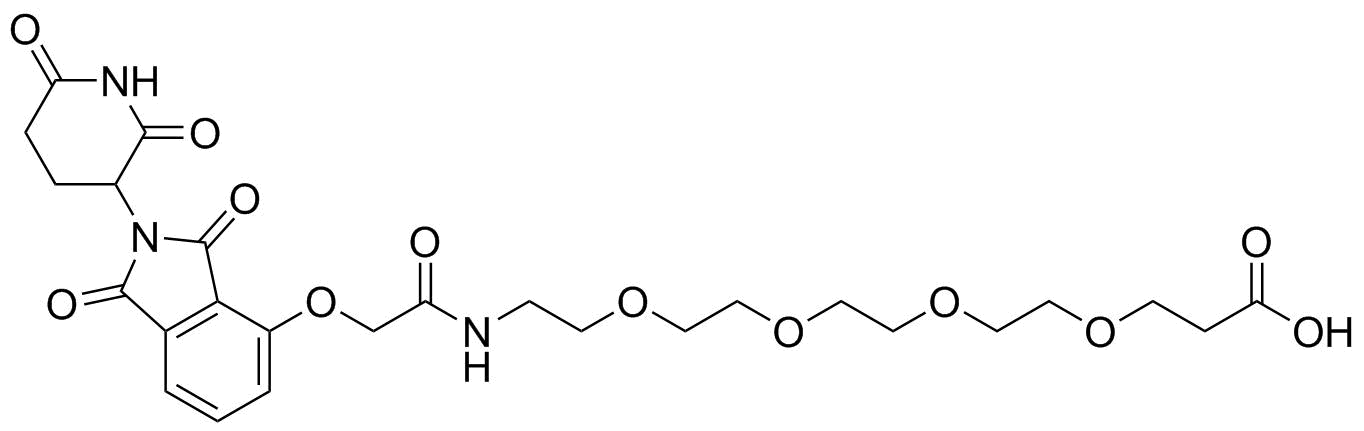 |
| Molecular Formula | C26H33N3O12 |
| Molecular Weight | 579.56 |
| CAS Registry Number | 2353563-50-3 |
| SMILES | C1CC(=O)NC(=O)C1N2C(=O)C3=C(C2=O)C(=CC=C3)OCC(=O)NCCOCCOCCOCCOCCC(=O)O |
| Density | 1.4±0.1 g/cm3 Calc.* |
|---|---|
| Boiling point | 862.2±65.0 °C 760 mmHg (Calc.)* |
| Flash point | 475.2±34.3 °C (Calc.)* |
| Index of refraction | 1.565 (Calc.)* |
| * | Calculated using Advanced Chemistry Development (ACD/Labs) Software. |
| Hazard Symbols |  GHS07 Warning Details |
|---|---|
| Risk Statements | H302-H315-H319 Details |
| Safety Statements | P501-P270-P264-P280-P302+P352-P337+P313-P305+P351+P338-P362+P364-P332+P313-P301+P312+P330 Details |
| SDS | Available |
 chemBlink Chemical Story
|
The long systematic name associated with CAS 2353563-50-3 identifies a thalidomide-derived scaffold linked through oxygen and an acetamide to a PEG-containing acid. A shorter catalog name is thalidomide-O-acetamido-PEG4-C2-acid. The sequence matters: an aromatic oxygen leads to a methylene, then a carbonyl and amide nitrogen, before the ether spacer. This differs from a pomalidomide-derived linker attached directly through an aromatic amino group. The two may serve related research purposes, but their attachment chemistry and complete structures are different. At the scaffold end, the molecule contains both a glutarimide ring and a phthalimide system. Such scaffolds are used in cereblon-recruiting building blocks for targeted protein degradation research. At the other end, a carboxylic acid supplies a synthetic handle for introducing a target-binding component. The oxygen-rich chain separates the two regions and allows conformational freedom. The free acid still lacks a defined second recognition element, so its name alone cannot tell which protein a finished conjugate would address. The development of phthalimide-linked degraders supplies a meaningful historical setting. Winter and colleagues reported dBET1 in 2015, showing that a conjugated cereblon-recruiting element could redirect degradation toward BET proteins in their experimental systems. That observation concerns dBET1, not this oxygen-linked acetamide building block. It supports the strategy of combining recruitment and target recognition while leaving the performance of each new conjugate to be demonstrated experimentally. The precise connection also changes how neighboring compounds should be compared. A chain linked through an ether and amide has a different hydrogen-bonding arrangement from one linked through an amine, even if both have four ether oxygens. An unspecific description such as thalidomide-PEG-acid loses that information. The publicly accessible record does not provide a verified discovery history, a degradation potency for the isolated acid or a clinical application. The supported account is a structurally defined research intermediate whose value lies in how it can be assembled into, and distinguished from, more complex molecules. References: 1. PubChem. Compound 138689178, CAS 2353563-50-3. https://pubchem.ncbi.nlm.nih.gov/compound/138689178 2. JenKem Technology. Monodisperse PEG and PROTAC building-block table. https://jenkemusa.com/monodisperse-peg-products 3. Winter GE et al. Selective target protein degradation via phthalimide conjugation. Science. 2015;348:1376–1381. https://doi.org/10.1126/science.aab1433 |
| Market Analysis Reports |