
Online Database of Chemicals from Around the World
| Nanjing Wali Chemical Technology Co., Ltd. | China | |||
|---|---|---|---|---|
 | www.njwali.com | |||
 | 18005141382 | |||
 | 18005141382@163.com | |||
 | QQ Chat | |||
 | WeChat: 18005141382 | |||
| Chemical manufacturer since 2008 | ||||
| chemBlink Standard supplier since 2026 | ||||
| Classification | Organic raw materials >> Heterocyclic compound >> Carbazoles |
|---|---|
| Name | 6,11-Dihydro-5H-benzo(a)carbazole |
| Molecular Structure | 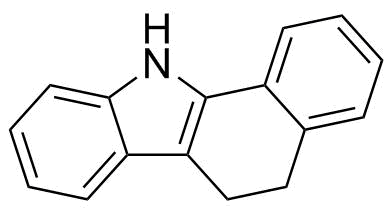 |
| Molecular Formula | C16H13N |
| Molecular Weight | 219.28 |
| CAS Registry Number | 21064-49-3 |
| EC Number | 999-178-9 |
| SMILES | C1CC2=C(C3=CC=CC=C31)NC4=CC=CC=C24 |
| Hazard Symbols |  GHS07 Warning Details |
|---|---|
| Risk Statements | H302-H315-H319-H335 Details |
| Safety Statements | P261-P264-P270-P271-P280-P302+P352-P304+P340-P305+P351+P338-P312-P330-P362-P403+P233-P501 Details |
| SDS | Available |
 chemBlink Chemical Story
|
Adding two hydrogen atoms to a fused aromatic framework changes the bonding pattern without changing the number of rings. The compound 6,11-dihydro-5H-benzo[a]carbazole, CAS 21064-49-3, provides a compact example. Its formula is C16H13N, compared with C16H11N for the fully aromatic benzo[a]carbazole framework. The difference is not another benzene-fusion isomer; it is a different degree of hydrogenation within the same named fused-ring arrangement. The deposited structure shows two methylene carbons in the partially saturated ring. Those atoms no longer participate in a continuous aromatic circuit in the same way as the corresponding unsaturated positions. The rest of the molecule still contains aromatic substructures and a nitrogen-bearing ring. Describing the whole compound simply as aromatic or saturated would therefore hide the mixed bonding character that defines it. The ring-fusion label remains important. Benzo[a] and benzo[b] frameworks connect their rings differently, even if both appear in literature on carbazole derivatives. Similarly, adding carbonyl groups or substituting the nitrogen produces new compounds whose biological or materials properties cannot be assigned to this parent. The hydrogenation prefix, indicated-hydrogen notation and bracketed fusion letter each convey a different piece of structural information. This makes the molecule useful for explaining how structural comparisons should be organized in heterocyclic chemistry. A comparison with benzo[a]carbazole asks what changing hydrogenation does while retaining the fusion pattern. A comparison with another benzocarbazole isomer asks what changing connectivity does. These are different chemical questions. The presence of methylene groups can change available conformations and interrupt extended conjugation, but numerical optical or biological consequences require measurements on the actual compound. PubChem records establish its identity and deposited structure. The sources reviewed here do not verify an approved therapeutic use, a specific commercial electronic application or a distinctive discovery history for this exact CAS. It is therefore presented as a structurally defined research heterocycle, without borrowing the applications of more elaborately substituted carbazoles. Its clearest educational contribution is the distinction between ring fusion, hydrogenation and substitution in a closely related family of molecules. References: 1. PubChem. 6,11-Dihydro-5H-benzo(a)carbazole, CID 297591; CAS 21064-49-3. Deposited structure and identifiers. https://pubchem.ncbi.nlm.nih.gov/compound/297591 2. FDA GSRS. 6,11-Dihydro-5H-benzo[a]carbazole; UNII 9PA95SS8HV. Identity record. https://precision.fda.gov/uniisearch/srs/unii/9PA95SS8HV |
| Market Analysis Reports |