
Online Database of Chemicals from Around the World
| SRI Neelima Laboratories | India | |||
|---|---|---|---|---|
 | www.srineelimalaboratories.com | |||
 | +91 (984) 973-6989 | |||
 | sales@srineelimalaboratories.com | |||
| Chemical manufacturer | ||||
| chemBlink Standard supplier since 2011 | ||||
| Valiant Co., Ltd. | China | |||
|---|---|---|---|---|
| www.valiant-cn.com | |||
| +86 (535) 610-1878 | |||
 | +86 (535) 638-6989 | |||
| jiangyanan@valiant-cn.com chenxiaowei@valiant-cn.com | |||
| Chemical manufacturer since 1992 | ||||
| chemBlink Standard supplier since 2012 | ||||
| NetQem, LLC | USA | |||
|---|---|---|---|---|
| www.netqem.us | |||
| +1 (919) 544-4122 | |||
| +1 (919) 544-4109 | |||
| sales@netqem.us | |||
| Chemical distributor since 2013 | ||||
| chemBlink Standard supplier since 2014 | ||||
| R&D Scientific Inc. | Canada | |||
|---|---|---|---|---|
| www.rdscientific.com | |||
| +1 (226) 600-0236 | |||
| sales@rdscientific.com | |||
| Chemical manufacturer since 2016 | ||||
| chemBlink Standard supplier since 2023 | ||||
| HuNan Huibaiyi New Materials Co; Ltd. | China | |||
|---|---|---|---|---|
| www.hbsjxcl.com | |||
| +86 13319523173 | |||
| ivy@hnhbsj.com | |||
 | QQ Chat | |||
 | WeChat: 13319523173 | |||
| Chemical manufacturer since 2014 | ||||
| chemBlink Standard supplier since 2026 | ||||
| SBS Genetech Co., Ltd. | China | |||
|---|---|---|---|---|
| www.sbsbio.com | |||
| +86 (10) 8278-4296 8278-4292 6296-9345 | |||
| +86 (10) 8278-4290 | |||
| info@sbsbio.com | |||
| Chemical manufacturer | ||||
| Indofine Chemical Company, Inc. | USA | |||
|---|---|---|---|---|
| www.indofinechemical.com | |||
| +1 (888) 463-6346 | |||
| +1 (908) 359-1179 | |||
| info@indofinechemical.com | |||
| Chemical manufacturer since 1981 | ||||
| Apollo Scientific Ltd. | UK | |||
|---|---|---|---|---|
| www.apolloscientific.co.uk | |||
| +44 (161) 406-0505 | |||
| +44 (161) 406-0506 | |||
| sales@apolloscientific.co.uk | |||
| Chemical manufacturer | ||||
| Classification | Biochemical >> Carbohydrate >> Monosaccharide |
|---|---|
| Name | X-Gluc Dicyclohexylamine |
| Synonyms | 5-Bromo-4-chloro-3-indolyl-beta-D-glucuronide dicyclohexylammonium salt |
| Molecular Structure | 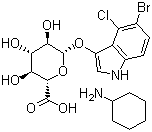 |
| Molecular Formula | C26H36BrClN2O7 |
| Molecular Weight | 603.93 |
| CAS Registry Number | 18656-96-7 |
| SMILES | O=C([C@@H]1[C@@H](O)[C@H](O)[C@@H](O)[C@H](OC2=CNC3=C2C(Cl)=C(Br)C=C3)O1)O.C4(NC5CCCCC5)CCCCC4 |
| Solubility | DMSO: 10Mm (Expl.) |
|---|---|
| Hazard Symbols |  GHS07 Warning Details GHS07 Warning Details |
|---|---|
| Risk Statements | H317-H319 Details |
| Safety Statements | P280-P305+P351+P338-P411 Details |
| SDS | Available |
 chemBlink Chemical Story
|
5-Bromo-4-chloro-3-indolyl-β-D-glucuronide cyclohexylammonium salt is a synthetic indoxyl glucuronide derivative designed as a chromogenic substrate for the detection of β-glucuronidase activity in biochemical, microbiological, and histochemical applications. The compound consists of a halogenated indolyl aglycone linked through a glycosidic bond to a D-glucuronic acid moiety, with the resulting glucuronate present as a cyclohexylammonium salt. The molecule contains two major structural components: a substituted indolyl chromogenic portion and a glucuronide portion. The indole-derived moiety forms the hydrophobic aromatic region of the structure, while the glucuronic acid fragment provides strong hydrophilic character and enzyme-recognition capability. The indole framework is a bicyclic aromatic heterocycle composed of a six-membered benzene ring fused to a five-membered pyrrole ring containing one nitrogen atom. In this compound, the aromatic system bears bromine and chlorine substituents at the 5- and 4-positions respectively. These halogen atoms modify the electronic properties of the aromatic ring through inductive electron-withdrawing effects and increase molecular polarizability. Bromine and chlorine also contribute substantially to molecular mass and can influence the spectral properties of oxidation products formed after enzymatic cleavage. The indolyl portion is linked at the 3-position through an oxygen atom to a β-D-glucuronic acid residue. The β designation specifies the stereochemistry of the glycosidic linkage at the anomeric carbon of the sugar. D-Glucuronic acid is structurally related to glucose, differing in that the terminal primary alcohol carbon has been oxidized to a carboxylic acid. This modification introduces an ionizable functional group that exists predominantly as a carboxylate under many conditions. The glucuronide portion contains several hydroxyl groups distributed around a six-membered sugar ring. These hydroxyl groups contribute extensive hydrogen-bonding capability and substantial hydrophilicity. Together with the carboxylate functionality, they make the glucuronide region highly polar and compatible with aqueous systems. The compound exists as a cyclohexylammonium salt rather than as a free acid. Cyclohexylammonium is formed by protonation of cyclohexylamine and serves as a positively charged counterion that balances the negatively charged glucuronate group. The cyclohexyl portion consists of a saturated six-membered carbon ring that contributes hydrophobic character, while the ammonium center provides ionic interactions. The glycosidic bond linking the indolyl aglycone and glucuronic acid is the key reactive feature for its intended function. β-Glucuronidase enzymes selectively hydrolyze this bond, releasing the corresponding halogenated indoxyl derivative. Following cleavage, the liberated indoxyl intermediate undergoes oxidation and subsequent dimerization reactions, producing colored indigoid products that can be detected visually or spectrophotometrically. Structurally, the molecule exhibits strong amphiphilic character. The glucuronide component contributes extensive polarity and hydrogen-bonding capability, whereas the halogenated indole and cyclohexyl portions contribute hydrophobic regions. This balance enables compatibility with aqueous assay systems while maintaining substrate properties suitable for enzyme recognition. Chemically, the glycosidic linkage is stable under ordinary conditions but undergoes selective enzymatic hydrolysis. The released indoxyl species is chemically reactive toward oxidation, and this conversion forms the basis of the compound's chromogenic behavior. Overall, 5-Bromo-4-chloro-3-indolyl-β-D-glucuronide cyclohexylammonium salt is a halogenated indole-based glucuronide substrate combining an enzyme-cleavable glycosidic linkage, a highly polar glucuronic acid moiety, and a cyclohexylammonium counterion. Its principal importance lies in its use as a chromogenic reagent for detecting β-glucuronidase activity through formation of visible colored products after enzymatic hydrolysis. |
| Market Analysis Reports |