
Online Database of Chemicals from Around the World
| BOC Sciences | USA | |||
|---|---|---|---|---|
 | www.bocsci.com | |||
 | +1 (631) 485-4226 | |||
 | +1 (631) 614-7828 | |||
 | info@bocsci.com | |||
| Chemical manufacturer | ||||
| chemBlink Standard supplier since 2010 | ||||
| Hangzhou Leap Chem Co., Ltd. | China | |||
|---|---|---|---|---|
| www.leapchem.com | |||
| +86 (571) 8771-1850 | |||
| market19@leapchem.com | |||
 | QQ Chat | |||
| Chemical manufacturer since 2006 | ||||
| chemBlink Standard supplier since 2015 | ||||
| INA Pharmaceuticals Pvt. Ltd. | India | |||
|---|---|---|---|---|
| inapharma.in | |||
| +91 7815933367 | |||
| rd@inapharma.in | |||
| Chemical manufacturer since 2018 | ||||
| chemBlink Standard supplier since 2026 | ||||
| Classification | Pharmaceutical intermediate >> Heterocyclic compound intermediate >> Quinoline compound |
|---|---|
| Name | 7-Bromo-1,2,3,4-tetrahydroisoquinoline |
| Molecular Structure | 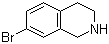 |
| Molecular Formula | C9H10BrN |
| Molecular Weight | 212.09 |
| CAS Registry Number | 17680-55-6 |
| EC Number | 681-601-0 |
| SMILES | C1CNCC2=C1C=CC(=C2)Br |
| Density | 1.4±0.1 g/cm3 Calc.* |
|---|---|
| Melting point | 32 - 35 °C (Expl.) |
| Boiling point | 282.9±40.0 °C 760 mmHg (Calc.)* |
| Flash point | 124.9±27.3 °C (Calc.)* |
| Index of refraction | 1.581 (Calc.)* |
| * | Calculated using Advanced Chemistry Development (ACD/Labs) Software. |
| Hazard Symbols |  GHS07 Warning Details GHS07 Warning Details | ||||||||||||||||
|---|---|---|---|---|---|---|---|---|---|---|---|---|---|---|---|---|---|
| Risk Statements | H302-H315-H319-H335 Details | ||||||||||||||||
| Safety Statements | P261-P264-P264+P265-P270-P271-P280-P301+P317-P302+P352-P304+P340-P305+P351+P338-P319-P321-P330-P332+P317-P337+P317-P362+P364-P403+P233-P405-P501 Details | ||||||||||||||||
| Hazard Classification | |||||||||||||||||
| |||||||||||||||||
| SDS | Available | ||||||||||||||||
 chemBlink Chemical Story
|
7-Bromo-1,2,3,4-tetrahydroisoquinoline, CAS 17680-55-6, is a brominated nitrogen heterocycle used primarily as a pharmaceutical and medicinal-chemistry intermediate. Its molecular formula is C9H10BrN and its molecular weight is 212.09. The molecule combines a 1,2,3,4-tetrahydroisoquinoline framework with a bromine atom at the 7-position of its aromatic ring. These two structural features give it a dual character: the tetrahydroisoquinoline portion is a biologically important molecular scaffold, while the bromine provides a useful position for further synthetic modification. Tetrahydroisoquinoline, commonly abbreviated THIQ, consists of a benzene ring fused to a partially saturated six-membered nitrogen-containing ring. This architecture occupies an interesting position between a flat aromatic heterocycle and a fully flexible amine. The aromatic portion provides a relatively rigid surface, while the saturated nitrogen-containing ring introduces basicity and three-dimensional shape. The THIQ framework occurs in numerous natural products and biologically active compounds. Tetrahydroisoquinoline alkaloids constitute a large family of natural substances, and variations of the scaffold have been investigated in medicinal chemistry for effects on enzymes, receptors, ion channels, and other biological targets. This does not mean that every THIQ derivative has similar biological activity. Rather, the scaffold provides a compact molecular framework on which different substituents can be positioned and systematically investigated. 7-Bromo-1,2,3,4-tetrahydroisoquinoline is especially useful because it contains two chemically distinct sites that can be modified independently. The secondary amine can undergo N-alkylation, N-acylation, sulfonylation, reductive amination, and other transformations. At the same time, the aromatic carbon-bromine bond provides a second synthetic handle for transition-metal-catalyzed reactions. The bromine atom is particularly valuable in medicinal chemistry because aryl bromides can participate in Suzuki-Miyaura and related cross-coupling reactions. In such transformations, the carbon-bromine bond is replaced by a new carbon-carbon or carbon-heteroatom bond. A medicinal chemist can therefore begin with the same 7-bromo-THIQ core and attach many different aromatic, heteroaromatic, or other substituents at the 7-position. This approach is central to structure-activity relationship, or SAR, research. Instead of synthesizing every candidate molecule through an entirely different route, researchers often prepare a versatile common intermediate and diversify one position repeatedly. Biological testing of the resulting analogs then reveals how changes in size, polarity, electronic character, or molecular shape influence activity. The 7-position of the THIQ scaffold has itself been the subject of such investigations. Classical medicinal-chemistry studies examined substituted tetrahydroisoquinolines as inhibitors of phenylethanolamine N-methyltransferase, commonly abbreviated PNMT. PNMT is the enzyme that catalyzes the methylation of norepinephrine to form epinephrine, the final enzymatic step in epinephrine biosynthesis. These studies showed that substitution on the aromatic portion of tetrahydroisoquinoline could substantially alter binding to PNMT. 7-Bromo-1,2,3,4-tetrahydroisoquinoline was among the compounds investigated. The significance of such experiments extends beyond this particular molecule: they demonstrate how changing a single atom or substituent at one defined position can alter the interaction between a small molecule and an enzyme binding site. The bromine therefore has two quite different identities depending on the experiment. In one context, it is part of the molecule being evaluated biologically, where its size, polarizability, and hydrophobic character can affect molecular recognition. In another context, it is deliberately temporary: chemists use the carbon-bromine bond as a synthetic connection point, remove the bromine during cross-coupling, and replace it with a completely different molecular fragment. The secondary amine creates an additional dimension of chemical diversity. Researchers can modify the nitrogen while leaving the 7-bromo substituent unchanged, or protect the nitrogen while performing chemistry on the aromatic ring. Sequential manipulation of these two positions allows libraries of related THIQ derivatives to be assembled efficiently. Published synthesis also illustrates the importance of protecting-group chemistry in preparing the compound. One reported route uses an N-trifluoroacetyl-protected 7-bromotetrahydroisoquinoline intermediate. Treatment with methanol and aqueous sodium carbonate removes the trifluoroacetyl protecting group and releases the free secondary amine. A reported preparation afforded 7-bromo-1,2,3,4-tetrahydroisoquinoline in 85% yield. Protecting groups are temporary molecular masks. A reactive amine may interfere with a transformation intended for another part of a molecule, so chemists temporarily convert it into a less reactive derivative. Once the required chemistry is complete, the protecting group is removed. In the case of 7-bromo-THIQ, this strategy allows the nitrogen chemistry and aromatic-ring chemistry to be controlled separately. Commercial suppliers consequently describe CAS 17680-55-6 primarily as a pharmaceutical intermediate or research building block. This is an important distinction. Although the THIQ scaffold appears in many biologically active compounds and 7-bromo-THIQ itself has appeared in enzyme-inhibition studies, the commercial reagent should not be confused with an approved pharmaceutical product. Its principal value is as a starting point for research and further synthesis. 7-Bromo-1,2,3,4-tetrahydroisoquinoline therefore illustrates two complementary philosophies of medicinal chemistry. A molecular scaffold provides a recognizable three-dimensional framework that can interact with biological targets, while a synthetic handle allows chemists to change that framework systematically. In this molecule, the tetrahydroisoquinoline ring is the platform and bromine is both a substituent and an invitation. Chemists can ask what bromine itself does to biological recognition, or they can remove it and replace it with dozens of other groups. One small molecule can therefore serve simultaneously as a candidate for studying molecular recognition and as a starting point for building the next generation of candidates. References 1. PubChem. 7-Bromo-1,2,3,4-tetrahydroisoquinoline, CID 10729255. CAS 17680-55-6. 2. Grunewald, G. L. et al. (1982). Structure-activity studies of substituted tetrahydroisoquinolines as inhibitors of phenylethanolamine N-methyltransferase. Journal of Medicinal Chemistry, 25, 1235-1240. 3. Journal of Organic Chemistry (1998), 63, 4116. Synthetic chemistry of substituted tetrahydroisoquinoline derivatives. 4. WO 2008/076954 A2. Preparation of 7-bromo-1,2,3,4-tetrahydroisoquinoline through deprotection of an N-trifluoroacetyl intermediate. 5. Fisher Scientific / Thermo Scientific Chemicals. 7-Bromo-1,2,3,4-tetrahydroisoquinoline, CAS 17680-55-6. Pharmaceutical intermediate. |
| Market Analysis Reports |