
Online Database of Chemicals from Around the World
| Wuhan Carnoss Technology Co., Ltd. | China | |||
|---|---|---|---|---|
 | www.carnoss.com | |||
 | +86 18064039730 | |||
 | +86 (27) 8349-6462 | |||
 | frank@carnosschem.com | |||
 | WeChat: kanuosi_wxid | |||
| Chemical manufacturer since 2012 | ||||
| chemBlink Standard supplier since 2018 | ||||
| Trigona oHG | Germany | |||
|---|---|---|---|---|
| www.trigona.de | |||
| +49 (611) 962-5283 | |||
| +49 (611) 962-9032 | |||
| info@trigona.de | |||
| Chemical manufacturer | ||||
| Classification | Pharmaceutical intermediate >> Heterocyclic compound intermediate >> Pyrimidine compound >> Amine |
|---|---|
| Name | N-Ethyldiethanolamine |
| Synonyms | 2,2'-Ethyliminodiethanol |
| Molecular Structure | 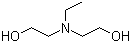 |
| Molecular Formula | C6H15NO2 |
| Molecular Weight | 133.19 |
| Protein Sequence | G |
| CAS Registry Number | 139-87-7 |
| EC Number | 205-379-8 |
| SMILES | CCN(CCO)CCO |
| Density | 1.0±0.1 g/cm3 Calc.*, 1.014 g/mL (Expl.) |
|---|---|
| Melting point | -50 °C (Expl.) |
| Boiling point | 246.4±15.0 °C 760 mmHg (Calc.)*, 246 - 252 °C (Expl.) |
| Flash point | 123.9 °C (Calc.)*, 124 °C (Expl.) |
| Index of refraction | 1.476 (Calc.)*, 1.466 (Expl.) |
| * | Calculated using Advanced Chemistry Development (ACD/Labs) Software. |
| Hazard Symbols |   GHS05;GHS07 Danger Details GHS05;GHS07 Danger Details | ||||||||||||||||||||
|---|---|---|---|---|---|---|---|---|---|---|---|---|---|---|---|---|---|---|---|---|---|
| Risk Statements | H315-H318-H319-H335 Details | ||||||||||||||||||||
| Safety Statements | P261-P264-P264+P265-P271-P280-P302+P352-P304+P340-P305+P351+P338-P305+P354+P338-P317-P319-P321-P332+P317-P337+P317-P362+P364-P403+P233-P405-P501 Details | ||||||||||||||||||||
| Hazard Classification | |||||||||||||||||||||
| |||||||||||||||||||||
| SDS | Available | ||||||||||||||||||||
 chemBlink Chemical Story
|
A good carbon-dioxide absorbent faces a paradox: it must react strongly enough to capture CO2, but not so strongly that releasing the gas consumes excessive energy. N-Ethyldiethanolamine, usually abbreviated EDEA, is a tertiary alkanolamine that illustrates this balance. Its nitrogen is basic, while two hydroxyethyl groups give the molecule high affinity for water and reduce volatility compared with simple trialkylamines. Primary and secondary alkanolamines such as monoethanolamine can react with CO2 to form carbamate species. Tertiary amines lack an N-H bond, so they cannot form the same stable carbamate directly. Instead, they act mainly as bases that facilitate conversion of dissolved CO2 into bicarbonate in water. This pathway can offer higher theoretical CO2 capacity per mole of amine and easier regeneration, although the uncatalyzed absorption rate is often slower. EDEA is interesting because its kinetics differ from those of better-known tertiary amines. Kanawade and Kenig measured the reaction of CO2 with aqueous EDEA and reported a second-order rate constant of about 19 M-1 s-1 at 303 K, faster under their conditions than MDEA, PDEA, and BDEA. They also showed that adding piperazine can strongly accelerate absorption. Such promoter chemistry is widely used in gas treating: one component contributes capacity and low regeneration energy, while another provides rapid reaction at the gas-liquid interface. A separate NMR study compared several tertiary alkanolamines and related their acid dissociation constants to absorption and regeneration behavior. EDEA showed a useful combination of moderate absorption and comparatively large CO2 release on regeneration. This illustrates why solvent design cannot be reduced to one number such as pKa. Absorption rate, equilibrium loading, heat of reaction, solvent volatility, corrosion, viscosity, and oxidative stability all influence the real energy cost of a capture process. Alkanolamine scrubbing has been used for decades to remove acid gases from natural gas and refinery streams, and it became central to discussions of post-combustion carbon capture. The chemistry is mature, but the engineering challenge remains enormous because regenerating thousands of tonnes of circulating solvent can require substantial steam. Molecular changes that slightly reduce heat demand or improve kinetics can therefore have large consequences at plant scale. N-Ethyldiethanolamine is memorable because it turns acid-base chemistry into an energy problem. The same basic nitrogen that helps trap CO2 must later let it go. Designing a better capture solvent is therefore not about maximizing binding; it is about balancing capture, release, speed, stability, and heat consumption across an entire cycle. References: 1. Yamada H. et al. 13C-NMR study of pKa effects on CO2 absorption and regeneration of aqueous tertiary alkanolamines. Energy Procedia. 2014, 63, 1876-1881. DOI: 10.1016/j.egypro.2014.11.196. 2. Kanawade R.B., Kenig E.Y. On the acceleration of CO2 reaction with N-ethyldiethanolamine. Industrial & Engineering Chemistry Research. 2016, 55, 38-44. DOI: 10.1021/acs.iecr.5b02496. 3. Rochelle G.T. Amine scrubbing for CO2 capture. Science. 2009. DOI: 10.1126/science.1176731. 4. General gas-treating literature on tertiary alkanolamine bicarbonate chemistry. |
| Market Analysis Reports |