
Online Database of Chemicals from Around the World
| Shanghai Weiyi Industry Limited | China | |||
|---|---|---|---|---|
 | www.shtio2.com | |||
 | +86 (21) 3252-5016 3252-5015 | |||
 | taibf@21cn.com | |||
| Chemical manufacturer | ||||
| chemBlink Standard supplier since 2011 | ||||
| Quagga Trading (Beijing) Co., Ltd. | China | |||
|---|---|---|---|---|
| www.quagga.com.cn | |||
| +86 (10) 5207-3961 | |||
| tracy.gong@quagga.com.cn | |||
| Chemical distributor | ||||
| chemBlink Standard supplier since 2012 | ||||
| Hubei Seven Eight Nine Chemical Co., Ltd. | China | |||
|---|---|---|---|---|
| www.hb789.cn | |||
| +86 (27) 8811-1833 +86 15802781837 | |||
| info@hb789.cn niuxiudan@163.com | |||
| Chemical manufacturer since 2012 | ||||
| chemBlink Standard supplier since 2013 | ||||
| Longwoods Chemical Company Limited | China | |||
|---|---|---|---|---|
| www.longwoods.cn | |||
| +86 (28) 6310-8508 | |||
| sale@longwoods.cn | |||
 | WhatsApp:+86 156 82536350 | |||
| Chemical distributor since 2022 | ||||
| chemBlink Standard supplier since 2026 | ||||
| Classification | API >> Diagnostic medication >> Image inspection medication |
|---|---|
| Name | Barium sulphate |
| Synonyms | Barite |
| Molecular Structure | 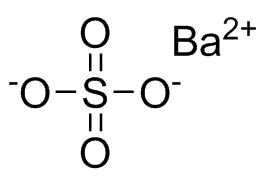 |
| Molecular Formula | Ba(SO4) |
| Molecular Weight | 233.39 |
| CAS Registry Number | 13462-86-7 |
| EC Number | 236-664-5 |
| SMILES | [O-]S(=O)(=O)[O-].[Ba+2] |
| Hazard Classification | |||||||||||||
|---|---|---|---|---|---|---|---|---|---|---|---|---|---|
| |||||||||||||
 chemBlink Chemical Story
|
A mineral can be unusually heavy without looking metallic. Barite, the mineral form of barium sulfate, takes its name from a Greek word meaning heavy. Its conspicuous density comes from a crystal built from barium ions and sulfate groups, rather than from a framework of a light metal such as aluminum. The registry number in this entry, 13462-86-7, is associated with barite. Barium sulfate is also widely indexed under 7727-43-7; keeping the supplied number preserves the mineral entry rather than silently exchanging identifiers. Barite's practical importance begins with something a balance can detect. The US Geological Survey describes its preparation for use as a weighting material in petroleum drilling mud. Dense particles allow a drilling fluid to carry more mass per unit volume. The resulting hydrostatic pressure is part of how the fluid counters pressure from the formations encountered by a well. The density of a solid and the performance of the circulating fluid are not the same measurement: particle size, mineral quality and the rest of the formulation also matter. A sample of ore is not automatically a finished drilling ingredient. The processing history reinforces that distinction. Crude barite can require upgrading to meet purity or density requirements, followed by grinding to an appropriate particle size. The USGS also describes barite as a filler or extender and as an aggregate in heavy cement. These uses emphasize different features of the material. A ground filler needs a suitable distribution of particle sizes, whereas a dense aggregate contributes to the bulk properties of a larger composite. The same mineral identity does not assign every grade the same performance. A very different use of barium sulfate depends on interaction with X-rays. Barium has a high atomic number, and formulated barium sulfate suspensions can provide positive contrast in radiographic examinations of the gastrointestinal tract. The E-Z-PAQUE prescribing information explains the radiopacity and the role of the poorly absorbed sulfate material. This is evidence for a specified pharmaceutical preparation, not permission to treat mined barite or an industrial powder as a medical ingredient. Purity, particle preparation, formulation and route of administration distinguish the clinical product from a mineral specimen. Low solubility connects these otherwise distant applications. A solid that remains as particles can serve as a weighting material rather than simply becoming dissolved ions. In contrast imaging, the material's behavior as a suspension is likewise important. Yet low solubility does not mean the absence of all risk: the pharmaceutical label addresses complications such as aspiration and gastrointestinal problems. The medical behavior cannot be inferred from the elemental name barium alone, and soluble barium salts should not be assumed to have the same behavior as barium sulfate. The two measurements are worth distinguishing even at the atomic level. Density concerns mass within a volume of the solid, while X-ray attenuation concerns how radiation interacts with the material along its path. A dense mineral and a radiopaque suspension can be useful for related compositional reasons without the terms dense and radiopaque meaning the same thing. One describes packing and mass; the other describes an interaction measured with radiation. The chemistry is therefore unusually instructive at several scales. The identity begins with a sulfate lattice. Mineral processing creates a particle population suited to an industrial task. Pharmaceutical manufacturing creates a different, tightly specified preparation for imaging. Barite links underground pressure control to radiographic visibility through density and composition, while showing why the transition from a mineral name to a usable material always requires more information than a formula. References: 1. ECHA. Barite (Ba(SO4)), CAS 13462-86-7, substance identity. https://echa.europa.eu/ro/substance-information/-/substanceinfo/100.033.317 2. US Geological Survey. Barite statistics and information. https://www.usgs.gov/centers/national-minerals-information-center/barite-statistics-and-information 3. DailyMed. E-Z-PAQUE barium sulfate powder for suspension, prescribing information. https://dailymed.nlm.nih.gov/dailymed/drugInfo.cfm?setid=7225868a-4037-c96a-44e3-3326d36cbedc |
| Market Analysis Reports |