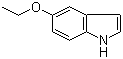
5-Ethoxyindole is a substituted indole derivative in which an ethoxy group is attached to the 5-position of the indole ring system. Indole itself is a bicyclic heteroaromatic compound consisting of a benzene ring fused to a five-membered nitrogen-containing pyrrole ring. This scaffold is one of the most important structural motifs in organic chemistry, appearing widely in natural products, pharmaceuticals, and biologically active molecules.
The chemistry of indole derivatives has been extensively studied since the late nineteenth century, when indole was first isolated from coal tar and later identified as a core structure in numerous natural compounds. The indole nucleus is notable for its electron-rich aromatic system and its ability to undergo electrophilic substitution preferentially at the 3-position, though substitution at other positions, such as the 5-position, can be achieved through directed synthetic strategies.
5-Ethoxyindole belongs to the class of 5-substituted indoles, which are typically synthesized through either direct functionalization of pre-formed indole or through construction of the indole ring from appropriately substituted precursors. Introduction of an ethoxy group at the 5-position is generally achieved via electrophilic aromatic substitution followed by O-alkylation strategies, or through functional group interconversion of a 5-hydroxyindole intermediate.
The ethoxy substituent influences both the electronic and steric properties of the indole ring. As an electron-donating group through resonance and inductive effects, the ethoxy substituent increases electron density on the aromatic system, which can enhance reactivity toward electrophiles. At the same time, the oxygen atom introduces a polar site capable of acting as a hydrogen bond acceptor, while the ethyl portion contributes mild hydrophobic character.
Indole derivatives are of major importance in medicinal chemistry due to their presence in biologically active compounds such as tryptophan, serotonin, melatonin, and numerous alkaloid natural products. Although 5-ethoxyindole itself is primarily a synthetic intermediate rather than a known endogenous metabolite, its structural framework is closely related to many bioactive indole systems. Substituents on the indole ring are often used to tune pharmacological properties such as receptor binding affinity, metabolic stability, and lipophilicity.
The 5-position of indole is a common site of substitution in drug design because modifications at this position can significantly alter molecular recognition while preserving the core indole hydrogen bonding characteristics. Ethoxy substitution is one of many possible modifications used to adjust electronic distribution and steric profile in indole-based compounds.
From a physicochemical perspective, 5-ethoxyindole is expected to be a moderately polar aromatic compound with limited water solubility and good solubility in organic solvents. The indole nitrogen can participate in hydrogen bonding as a donor, while the ethoxy oxygen can act as a hydrogen bond acceptor, contributing to intermolecular interactions. The compound is likely to exhibit aromatic stability with characteristic UV absorption due to the conjugated indole system.
In synthetic chemistry, 5-ethoxyindole can serve as an intermediate for further functionalization at various positions on the indole ring. Indoles are highly versatile scaffolds that undergo a wide range of transformations, including halogenation, acylation, alkylation, and metal-catalyzed coupling reactions. Such reactivity makes substituted indoles valuable building blocks in the synthesis of more complex heterocyclic compounds.
Overall, 5-ethoxyindole is a substituted indole derivative that combines the fundamental structural features of the indole nucleus with an electron-donating ethoxy group at the 5-position. Its significance lies in its role as a functionalized heteroaromatic building block used in organic synthesis and in the broader context of indole chemistry, which is central to natural products and pharmaceutical development.
|






 GHS07 Warning Details
 chemBlink Chemical Story