
Online Database of Chemicals from Around the World
| wuhan chemi Pharmacy Chemical Technology Co., Ltd. | China | |||
|---|---|---|---|---|
 | www.chemipharm.com.cn | |||
 | +86 13971619949 | |||
 | gmn424@chemipharm.com.cn | |||
 | QQ Chat | |||
 | WeChat: 13971619949 | |||
| Chemical manufacturer since 2014 | ||||
| chemBlink Standard supplier since 2026 | ||||
| Classification | Organic raw materials >> Alcohols, phenols, phenolic compounds and derivatives |
|---|---|
| Name | 3,3-Diethoxy-1,2-propanediol |
| Synonyms | DL-Glyceraldehyde diethyl acetal |
| Molecular Structure | 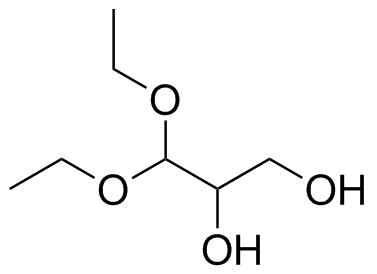 |
| Molecular Formula | C7H16O4 |
| Molecular Weight | 164.20 |
| CAS Registry Number | 10487-05-5 |
| SMILES | CCOC(C(CO)O)OCC |
| Density | 1.1±0.1 g/cm3 Calc.* |
|---|---|
| Boiling point | 278.8±35.0 °C 760 mmHg (Calc.)* |
| Flash point | 122.4±25.9 °C (Calc.)* |
| Index of refraction | 1.449 (Calc.)* |
| * | Calculated using Advanced Chemistry Development (ACD/Labs) Software. |
| Hazard Symbols |  GHS07 Warning Details GHS07 Warning Details |
|---|---|
| Risk Statements | H302-H315-H319-H335 Details |
| Safety Statements | P261-P280-P301+P312-P302+P352-P305+P351+P338 Details |
| SDS | Available |
 chemBlink Chemical Story
|
3,3-Diethoxy-1,2-propanediol is an acetal-containing polyol that has been described in the chemical literature as a synthetic intermediate and specialty organic compound. The molecule contains two hydroxyl groups together with a diethyl acetal functionality, combining the reactivity of a vicinal diol with the stability typically associated with acetal-protected carbonyl derivatives. Compounds of this type have been of interest in organic synthesis because acetals can serve as protected forms of aldehydes, allowing selective transformations to be carried out on other parts of a molecule before regeneration of the corresponding carbonyl group. The development and use of 3,3-diethoxy-1,2-propanediol are closely related to the broader evolution of protecting-group chemistry. During the twentieth century, organic chemists increasingly employed acetals as temporary protecting groups for aldehydes and ketones. These methods made it possible to conduct multistep syntheses with improved selectivity and control. Acetal-containing diols such as 3,3-diethoxy-1,2-propanediol became useful intermediates because they incorporated both protected and reactive functionalities within a single molecule. The compound has been reported as an intermediate in synthetic organic chemistry. Its two hydroxyl groups can participate in reactions such as esterification, etherification, and other transformations commonly applied to alcohols. At the same time, the acetal functionality remains stable under many neutral and basic reaction conditions. This combination enables chemists to modify the alcohol groups while preserving the protected aldehyde equivalent for later use. One documented area of application is the preparation of more complex oxygenated organic molecules. Polyfunctional intermediates are widely employed in the synthesis of pharmaceuticals, agrochemicals, and fine chemicals because they allow stepwise introduction of structural features. The presence of both hydroxyl and acetal groups in 3,3-diethoxy-1,2-propanediol provides synthetic flexibility and has led to its use as a building block in multistep reaction sequences described in the chemical literature and patent publications. The compound has also been utilized in research involving protected glyceraldehyde derivatives. Acetals derived from aldehydes are commonly used to control reactivity during synthesis, and 3,3-diethoxy-1,2-propanediol can be viewed as belonging to this general category of protected aldehyde intermediates. Such materials have been employed in studies directed toward the preparation of carbohydrates, polyols, and other oxygen-rich molecules where selective functional-group manipulation is required. Another application of the compound is as a precursor for the generation of aldehyde-containing products. Under acidic conditions, acetal groups can be hydrolyzed to regenerate the corresponding aldehyde. This property has made acetal derivatives valuable in synthetic planning because a reactive carbonyl function can be introduced at a later stage of a synthesis. Literature describing synthetic routes to aldehydes and aldehyde-derived products frequently relies on acetal intermediates for this purpose. In addition to its use in laboratory synthesis, 3,3-diethoxy-1,2-propanediol has appeared in patent literature describing processes for the preparation of specialty chemicals. In such applications, the compound functions primarily as an intermediate rather than as a final commercial product. The value of the material lies in the combination of its functional groups and the opportunities they provide for subsequent chemical transformation. The significance of 3,3-diethoxy-1,2-propanediol therefore derives from its role in synthetic chemistry. The compound exemplifies the utility of acetal protection strategies that have become standard tools in organic synthesis. By providing a stable protected carbonyl equivalent together with two reactive hydroxyl groups, it serves as a versatile intermediate for the preparation of more complex molecules. Its documented applications in synthetic methodologies, fine chemical preparation, and protected aldehyde chemistry have established it as a useful reagent within the broader field of organic synthesis. References 2015. Synthesis of Dendrimer-Like Polymers. Anionic Polymerization. DOI: 10.1007/978-4-431-54186-8_15 2007. Bouquet-type Dendrimerlike Poly(ethylene Oxide)s with a Focal Aldehyde and Peripheral Hydroxyls. Biomacromolecules. DOI: 10.1021/bm070146r 1983. Note on the esterification of someZ-amino acids with glyceraldehyde-diethylacetal. Monatshefte für Chemie / Chemical Monthly. DOI: 10.1007/bf00798619 |
| Market Analysis Reports |