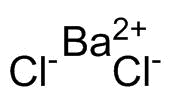
Barium chloride, CAS 10361-37-2, is the anhydrous form of the inorganic salt BaCl2, with a molecular weight of 208.23. It is a source of Ba2+ ions and is closely related to barium chloride dihydrate, BaCl2·2H2O. The distinction may appear minor: the two compounds differ only by two molecules of water per formula unit. In practical chemistry, however, whether those water molecules are present can matter greatly.
When barium chloride crystallizes from aqueous solution under ordinary conditions, the familiar product is commonly the dihydrate. The water in such a crystalline hydrate is not simply liquid trapped between particles. Water molecules occupy defined positions in the crystal structure and are part of the composition of the solid. This is why the dihydrate has its own formula and molecular weight and why a weighed quantity of BaCl2·2H2O contains less actual BaCl2 than the same mass of anhydrous barium chloride.
Heating the hydrated salt drives off its water of crystallization and produces anhydrous BaCl2. The transformation provides a simple example of an important principle in inorganic chemistry: a crystalline material can change composition without changing the identity of its principal ions. Before and after dehydration, the salt still contains Ba2+ and Cl−; what changes is the amount of water incorporated into the solid structure.
The difference becomes immediately important when preparing solutions quantitatively. One mole of anhydrous BaCl2 weighs about 208.23 g, whereas one mole of BaCl2·2H2O weighs about 244.26 g. A chemist preparing a solution from a specified mass must therefore know which form is being weighed. Treating the dihydrate as though it were anhydrous material would introduce a substantial concentration error even though both bottles are labeled "barium chloride" in ordinary conversation.
Once either form is dissolved in sufficient water, this distinction largely disappears from the solution chemistry. Both provide hydrated barium and chloride ions. Barium ions react readily with sulfate to form extremely insoluble barium sulfate:
Ba2+ + SO42− → BaSO4↓
This familiar reaction is used in sulfate analysis and in processes where soluble sulfate must be removed. The fact that anhydrous and hydrated barium chloride converge on essentially the same aqueous chemistry illustrates an interesting contrast: solid-state composition may be crucial before dissolution but become much less important after the crystal lattice has been destroyed by water.
Anhydrous salts become especially interesting when water is deliberately excluded. Many chemical reactions that are impossible, inefficient, or altered in aqueous solution are performed in dry solvents or at high temperatures. In these situations, introducing a hydrated salt also introduces water, sometimes in a surprisingly large amount. Two moles of water accompany every mole of barium chloride dihydrate, so the anhydrous form can be preferable when water would interfere with the intended process.
Barium chloride also belongs to a broad family of inorganic chlorides that can form molten ionic mixtures. When salts are heated above their melting temperatures, the orderly crystal lattice breaks down while the ions remain charged and mobile. The resulting molten salt behaves as an ionic liquid without requiring water or another molecular solvent.
Pure barium chloride has a high melting point, but mixtures of inorganic chlorides can melt at substantially lower temperatures than some of their individual components. BaCl2 has therefore been studied as a component of multicomponent chloride melts and eutectic systems. Such molten salts are of interest in high-temperature electrochemistry, metallurgy, heat-transfer research, and other processes where an electrically conducting ionic medium must operate at temperatures far above those tolerated by ordinary aqueous solutions.
This high-temperature behavior reveals another side of a compound commonly encountered as a simple laboratory salt. At room temperature, BaCl2 is a crystalline ionic solid. Add water and the lattice separates into solvated ions. Instead, add enough heat and the lattice can melt directly, producing mobile ions without any water at all. The same Ba2+ and Cl− ions can therefore exist in very different chemical environments depending on whether the surrounding medium is a crystal, an aqueous solution, or a molten salt.
The anhydrous form also demonstrates why chemical names and CAS numbers need to distinguish hydrates carefully. "Barium chloride" may be used informally for either anhydrous material or commercial hydrated material, but CAS 10361-37-2 specifically identifies anhydrous BaCl2, while CAS 10326-27-9 identifies the dihydrate. They are closely related substances, but they are not interchangeable when molecular weight, composition, water content, or high-temperature behavior matters.
This distinction is common throughout inorganic chemistry. Copper sulfate, calcium chloride, magnesium chloride, sodium carbonate, and many other salts can occur in anhydrous and hydrated forms. Water of crystallization is therefore not merely an inconvenient detail printed after a chemical formula. It affects formula weight, crystal structure, thermal behavior, storage, handling, and sometimes which chemical processes a material can enter.
Barium chloride provides a particularly straightforward example. Put the anhydrous and hydrated forms into water, and they eventually give essentially the same dissolved ions. Examine them before dissolution, weigh them for quantitative work, heat them, or use them where water is undesirable, and those two molecules of crystallization water suddenly matter.
Sometimes the difference between two chemical products is not a different element, ion, or functional group. It is simply water—but water in exactly the wrong place can change an experiment.
References
1. PubChem. Barium chloride, CAS 10361-37-2. Molecular formula BaCl2; molecular weight 208.23.
2. NIST Chemistry WebBook. Barium chloride. Thermochemical and phase-change data for BaCl2.
3. Published phase-equilibrium and thermodynamic studies of BaCl2-containing binary and multicomponent molten chloride systems.
4. Standard analytical chemistry literature describing barium chloride precipitation of sulfate as BaSO4.
|







 GHS06 Danger Details
 chemBlink Chemical Story