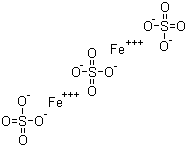
Ferric sulfate, Fe2(SO4)3, is an iron(III) salt whose importance lies less in the compound itself than in what happens when it is added to water. For more than a century, iron salts have been central to water purification, wastewater treatment, industrial processing, and environmental engineering. Ferric sulfate is a particularly useful example of how relatively simple inorganic chemistry can solve one of civilization's most persistent problems: separating extremely small contaminants from enormous volumes of water.
The challenge in water treatment is that many impurities do not behave like ordinary sediment. Clay particles, microorganisms, natural organic matter, and other finely divided materials can remain suspended for long periods because of their extremely small size and surface electrical charges. Simply allowing such water to stand may therefore accomplish surprisingly little. Effective purification requires chemistry capable of changing the behavior of these particles.
Ferric sulfate provides that chemistry through coagulation. When dissolved in water, it releases Fe3+ ions, which undergo extensive hydrolysis. Depending on pH and other water conditions, a variety of hydrolyzed iron species are produced, ultimately leading to the formation of poorly soluble ferric hydroxide, Fe(OH)3. These species can neutralize the surface charges that keep colloidal particles apart, while the growing hydroxide precipitate can adsorb and physically capture suspended material.
The result is one of the most visually striking processes in water treatment. Particles that were individually too small to see begin to associate into larger aggregates known as flocs. Through controlled mixing, these flocs grow until they become sufficiently large and dense to settle or to be removed by filtration. This process, combining coagulation and flocculation, remains a fundamental operation in conventional drinking-water treatment.
Ferric sulfate offers several practical advantages as a coagulant. Iron(III)-based systems can operate effectively across a relatively broad pH range and can remove not only turbidity but also natural organic matter and color. Removing natural organic matter before disinfection is particularly valuable because some of this material can react with disinfectants to form unwanted disinfection by-products. Thus, coagulation does more than make water appear clear; it can influence the chemical quality of the finished drinking water.
The same iron chemistry is important in wastewater treatment. Phosphate is an essential nutrient, but excessive phosphorus discharged into lakes and rivers can promote eutrophication and harmful algal growth. Ferric salts can react with phosphate and facilitate its transfer from the dissolved phase into solids that can subsequently be separated with wastewater sludge. Chemical phosphorus removal has therefore become another major environmental application of iron-based treatment chemicals.
Ferric sulfate has also found uses outside municipal water treatment. Iron salts have long been employed as mordants in dyeing, in metal treatment, and in various industrial processes. Nevertheless, water treatment remains one of the clearest demonstrations of their broader technological importance. Modern treatment plants may process millions of liters of water each day, yet much of the purification ultimately depends on molecular-scale interactions among ions, particle surfaces, and freshly formed metal hydroxides.
Like other treatment chemicals, ferric sulfate must be carefully controlled. The optimum dose depends on raw-water turbidity, natural organic matter, alkalinity, temperature, and pH. Insufficient coagulant may leave particles dispersed, whereas inappropriate dosing or pH control can reduce treatment efficiency and increase residual iron. For this reason, coagulation is not simply a matter of adding an iron salt; it is a carefully optimized chemical process.
Ferric sulfate illustrates an important principle of environmental chemistry: removing contamination does not always require destroying contaminants molecule by molecule. Sometimes the more efficient strategy is to change their physical and chemical behavior until they can be separated. By turning invisible colloidal particles into removable flocs and helping transfer dissolved pollutants into solids, ferric sulfate has become one of the quiet chemical tools behind modern water infrastructure.
References
1. National Research Council (1982). Water Chemicals Codex. National Academies Press. Ferric Sulfate. https://www.ncbi.nlm.nih.gov/books/NBK216463/
2. National Health and Medical Research Council. Australian Drinking Water Guidelines: Ferric sulfate. https://guidelines.nhmrc.gov.au/australian-drinking-water-guidelines/part-5/treatment-chemicals/ferric-sulfate
|





 GHS05;GHS07 Danger Details
 chemBlink Chemical Story